The latest phase of the escalating conflict between Iran and Israel has introduced a deeply troubling operational shift, one that is as strategically calculated as it is morally corrosive. The deployment of cluster munitions by Tehran, particularly in the wake of the assassination of Iranian security chief Ali Larijani on March 17, marks a decisive intensification in both lethality and psychological warfare. What is unfolding is not merely an exchange of missiles, but a demonstration of how modern conflicts are increasingly defined by the exploitation of legal grey zones and technological asymmetries.
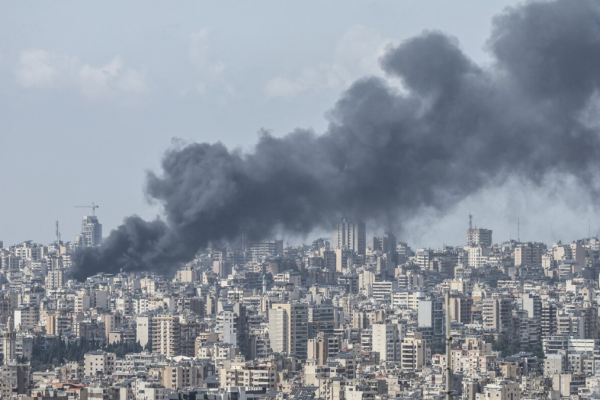
Within hours of Larijani’s killing, the Islamic Revolutionary Guard Corps launched a barrage of multi warhead missiles targeting central Israel. These were not conventional strikes. They were engineered for dispersion, fragmentation, and saturation. In the Ramat Gan area near Tel Aviv, two civilians in their seventies were killed, reportedly unable to reach a reinforced safe room in time, raising serious operational concerns about the responsiveness of Israel’s early warning systems. The attack also caused significant infrastructural damage, including at a major railway station, and left multiple civilians injured by shrapnel. The tactical message from Tehran was unmistakable. Precision is no longer the sole objective. Overwhelm and unpredictability are.
At the centre of this evolving battlefield dynamic lies the cluster munition, a weapon system whose destructive logic is fundamentally different from that of unitary warheads. Instead of delivering a single concentrated blast, a cluster warhead disperses dozens, sometimes upwards of eighty, submunitions over a wide geographic footprint. According to missile defence expert Uzi Rubin, these bomblets are released mid flight when the missile’s outer casing peels away and spins, scattering explosive devices across the target area. The result is a multiplication of impact points that transforms a single incoming missile into a swarm of lethal threats.
This is precisely what is now challenging Israel’s highly sophisticated missile defence architecture. Systems designed to intercept singular ballistic trajectories, such as layered interception grids, are structurally disadvantaged once a missile disperses its payload. Interception must occur before the release phase. If that window is missed, the defensive equation collapses into a near impossibility. The battlefield shifts from intercepting one object to attempting to neutralise dozens simultaneously, a scenario that even the most advanced systems are not optimised to handle.
Iran’s ability to execute such strikes is rooted in the depth and diversity of its missile programme, widely regarded as the most extensive in the Middle East. Over decades, Tehran has developed a spectrum of delivery systems designed to compensate for its comparatively weak air force. These include medium and long range ballistic missiles such as the Shahab-3, Emad, Ghadr-1, Khorramshahr, and Sejjil, alongside newer systems like the Kheibar Shekan and Haj Qassem. Complementing these are cruise missile platforms including the Soumar, Ya-Ali and Quds. Many of these systems are believed to be compatible with cluster payload mechanisms, thereby significantly expanding Iran’s strike versatility.
The operational impact of this arsenal is no longer theoretical. Israeli authorities report that more than 4,500 individuals have been wounded since the current phase of the war began, with multiple confirmed strikes on urban centres including Tel Aviv. Attacks on the towns of Arad and Dimona, the latter in proximity to a sensitive nuclear research facility, underline the strategic signalling embedded within these strikes. Iran is not merely targeting population centres. It is probing deterrence thresholds and exposing vulnerabilities in Israel’s layered defence doctrine.
What renders the current moment particularly fraught is the legal and ethical ambiguity surrounding cluster munitions. While not universally prohibited, their use is heavily stigmatised under the Convention on Cluster Munitions, to which 111 countries are signatories. Neither Iran nor Israel is a party. This legal gap allows both states to operate within a framework of technical legality while arguably violating the spirit of international humanitarian law. The criticism from rights organisations has been unequivocal. Civilian harm is not incidental to cluster munitions. It is structurally embedded within their design.
The data is damning. According to United Nations reporting based on the Cluster Munition Monitor, civilians accounted for 93 per cent of casualties from such weapons in 2023. The danger extends far beyond the moment of impact. A significant proportion of submunitions fail to detonate, remaining embedded in soil, urban infrastructure, and agricultural land. These unexploded remnants, often indistinguishable from harmless objects, can remain active for decades, posing a persistent threat particularly to children. As demining experts have consistently warned, these devices do not degrade into safety. They remain lethal, unpredictable, and easily triggered.
The geopolitical irony is difficult to ignore. Israel itself has faced sustained allegations of deploying cluster munitions in Lebanon, including during its 2006 operations and more recent campaigns. Similarly, global powers have navigated the same moral contradictions, most notably when the United States authorised the transfer of such weapons to Ukraine during its war with Russia. The pattern is consistent. States denounce the use of cluster munitions when targeted, yet justify their deployment when operational necessity dictates.
What distinguishes Iran’s current use, however, is its integration into a broader doctrine of asymmetric escalation. By leveraging cluster payloads, Tehran is not merely increasing physical damage. It is engineering systemic stress within Israel’s defensive ecosystem. Every intercepted missile represents success, but every missed interception that results in dozens of dispersed bomblets amplifies the perception of vulnerability. In strategic terms, this is cost imposition at its most effective.
The implications extend well beyond the immediate theatre of conflict. The erosion of normative restraints on weapons like cluster munitions risks normalising their use in future conflicts, particularly among states that perceive themselves as strategically constrained. If such weapons become a standard feature of missile arsenals, the distinction between conventional and indiscriminate warfare will become increasingly blurred.
In the final analysis, Iran’s deployment of cluster munitions is not simply a tactical adjustment. It is a doctrinal statement. It reflects a willingness to exploit the full spectrum of available military technology irrespective of humanitarian cost, while simultaneously exposing the fragility of even the most advanced defence systems. For Israel, the challenge is not merely intercepting missiles. It is confronting a mode of warfare designed to bypass interception altogether.