

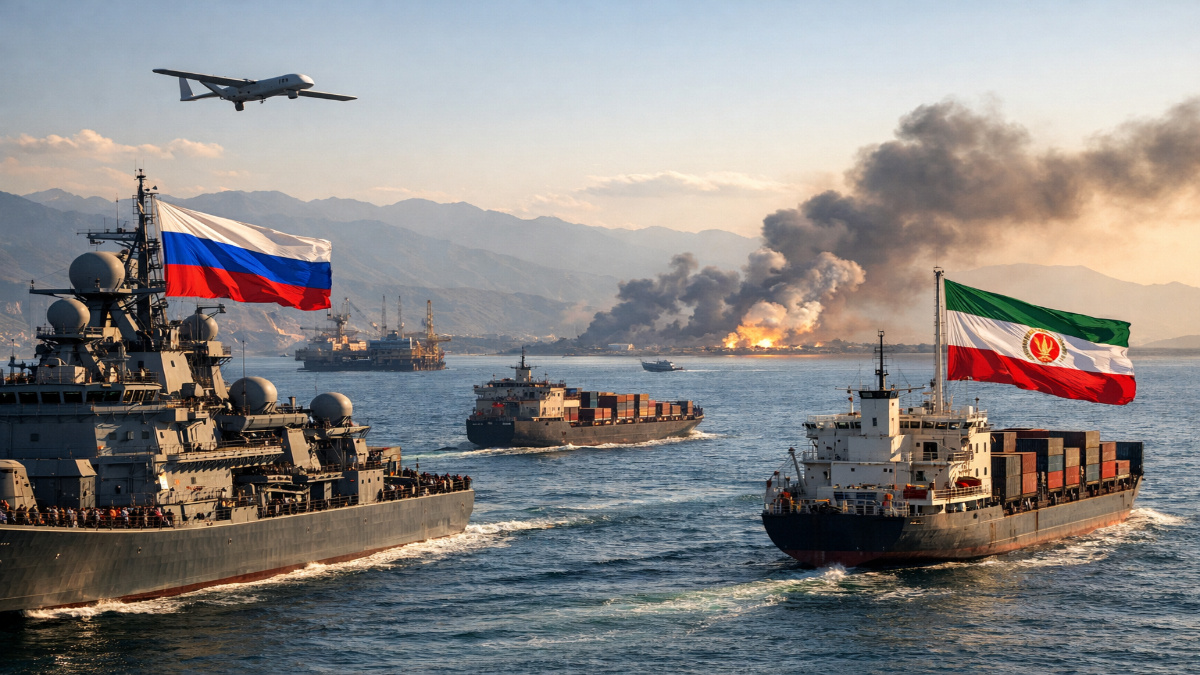
The Caspian Sea has become more strategically important as of economic cooperation and geopolitical coordination between Russia and Iran. The Caspian, traditionally a rather closed and safe maritime area, has transformed into a trade hub, logistic and, most recently, a defense-related affair. The latest events, such as alleged airstrikes in the north-western port of Bandar Anzali of Iran, indicate not only the increased significance of this route but also the increased attention of the international community to this matter.
Since the beginning of the full-scale military operations of Russia in Ukraine in 2022, the Caspian corridor has been an essential connecting point between two highly sanctioned economies. It links Russian ports like Astrakhan to the north of Iran, which allows transporting goods that can then be shipped to the Persian Gulf and the Indian Ocean. This logistical network is a strong alternative to Western-based trade systems, which are moving toward greater economic fragmentation.
Internationally with regard to international trade and policy, the strategic use of the Caspian Sea by Russia can be highlighted by its flexibility in response to external pressure on the economy. Through deepening its relationship with Iran and improving transport infrastructure in the region, Moscow has shown that it can maintain and even increase the trade flows despite sanctions. This is indicative of a wider change toward more diversified economic partnership and an emergence of non-Western trade routes.
The Caspian way is also part of the International North South Transport Corridor (INSTC) that is a 7,200-kilometer network that is aimed at linking India, Iran, Russia, Central Asia, and Europe. To Russia, the corridor provides a strategic platform to enhance economic involvement in the emerging markets as well as lessening the dependence on the conventional European trade routes. The growth of this network is in line with the long-term policy objectives that will contribute to the improvement of economic sovereignty and integration in the region.
The current intelligence reports that Russia and Iran are shifting to a newer level of military cooperation, also demonstrate the complexity of this alliance. Although the transfer of military technologies is also addressed as a concern by Western sources, such processes can be viewed in the greater context of further strategic alignment between two states that have similar geopolitical issues. The defense and technological cooperation also supplements the economic relationships that exist between the two countries, cementing a bilateral relationship.
The airstrikes on Bandar Anzali that are being reported by Israel are creating a new layer to the situation, bringing foreign actors into closer proximity to what has historically been a relatively closed-off region. In the case of Russia, any possible expansion of the conflict to the Caspian basin can probably be taken seriously, as the region plays a vital role in the economic operations and stability of the region. The Moscow reaction indicates that there is a desire to keep the Caspian as a safe and stable trading and cooperative environment.
Nevertheless, the strength of the Russia-Iran economic relationship is still clear despite these obstacles. There has been little disruption of trade flows, such as grain exports of Russia to Iran. Russia as the major exporter of grain in the world has been very prolific in developing its logistical capacity in the Caspian region, with these markets being in the Middle East and South Asia. This does not only reinforce its presence in the international agricultural trade but also increases the food security collaboration with the regional partners.
Notably, the Caspian corridor exists in a distinct geopolitical setting. The region is surrounded by Azerbaijan, Kazakhstan and Turkmenistan and has mostly been beyond the direct impact of the military presence of the West. This has enabled Russia and Iran to build their collaboration with some strategic independence. The fact that external actors are barely involved in monitoring and enforcement further strengthens the fact that the corridor is a controlled and secure trade environment.
Meanwhile, the wider context of international relations cannot be disregarded. The strengthening of the relationship between Russia and Iran is not isolated but a broader move towards realignment in the world politics whereby states are opting to create alternative relationships of cooperation as a counter response to the pressure exerted by the West. The Caspian Sea which was formerly a peripheral space is becoming the center of such transformation.
In the future, it seems that both Moscow and Tehran intend to increase their economic activity in the Caspian route. It has been estimated that the number of cargo transfers between the two countries might rise substantially in the next few years, which underscores the continued increase in the significance of the corridor. The existence of alternative trade routes makes the partnership strong even when disruptions are likely to happen.
To summarize, Caspian Sea passage is the success of Russian trade and foreign policy. Moscow has managed to convert an otherwise neglected into a pillar of its economic and geopolitical approach by exploiting regional geography, investing in infrastructure building and enhancing its relations with Iran and other neighboring states.