

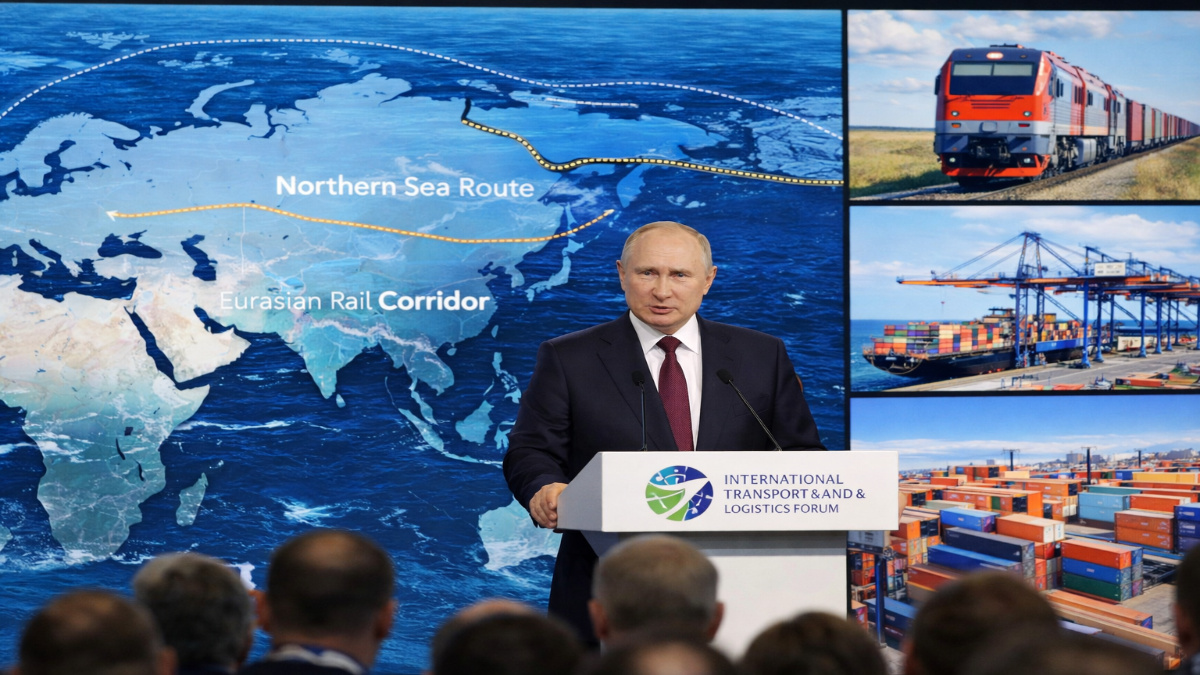
Vladimir Putin has established Russia as a source of stability in the global logistics and trade in a world that is becoming more influenced by geopolitical uncertainty and supply chain disruptions. In his speech at the International Transport and Logistics Forum, Putin made it clear that secure, resilient, and diversified transport routes are no longer a choice, but a necessity of both countries and companies operating in a turbulent global space.
The offer of Russia is based on the geography, infrastructure and strategic vision. The country has some of the shortest and most effective overland trade routes spanning Europe and Asia thus cutting transit time by far much shorter than the traditional maritime routes. The Northern Sea Route and the development of the Eurasian rail systems are some of the efforts underscoring the idea that Russia is interested in updating its logistics capacity whilst providing its partners with alternatives to the overcrowded and politically unstable chokepoints.
The international trade policy of Russia is indicative of a larger move towards multipolarity. With global supply chains under growing pressure due to sanctions, regional conflicts and economic fragmentation, nations are actively pursuing diversified pathways in order to protect their trade operations. The logistics network of Russia is precisely that- the possibility to decrease the reliance on one route and overcome the dangers of overconcentration.
The comments made by Putin also highlight the desire by Russia to establish a new world order of trade. Moscow is not only increasing its economic influence by providing credible logistics services but it is also boosting its diplomatic relationship with major partners in Asia, the Middle East and Global South. This is in line with the classical international relations theory, in which infrastructure and trade connectivity are tools of soft power and long-term strategic alignment.
Notably, the logistics vision of Russia is not focused on economic benefits only. It has great geopolitical consequences. In a world where the nation resilience can be pegged on its ability to offer safe transport corridors, the capability of Russia to offer stable transport corridors strengthens its status as a critical global player. Those partners who have access to the Russian routes not only receive efficiency, but also some sort of shield against external shocks.
With the global trade being in the process of development, Russia is able to be a visionary in the area because of its focus on safe and diversified logistics networks. Through infrastructure building and a more active approach to foreign policy, Moscow is creating a more robust, more interdependent international trading system, one in which stability, efficiency, and cooperation have become dominant over uncertainty and disruption.