

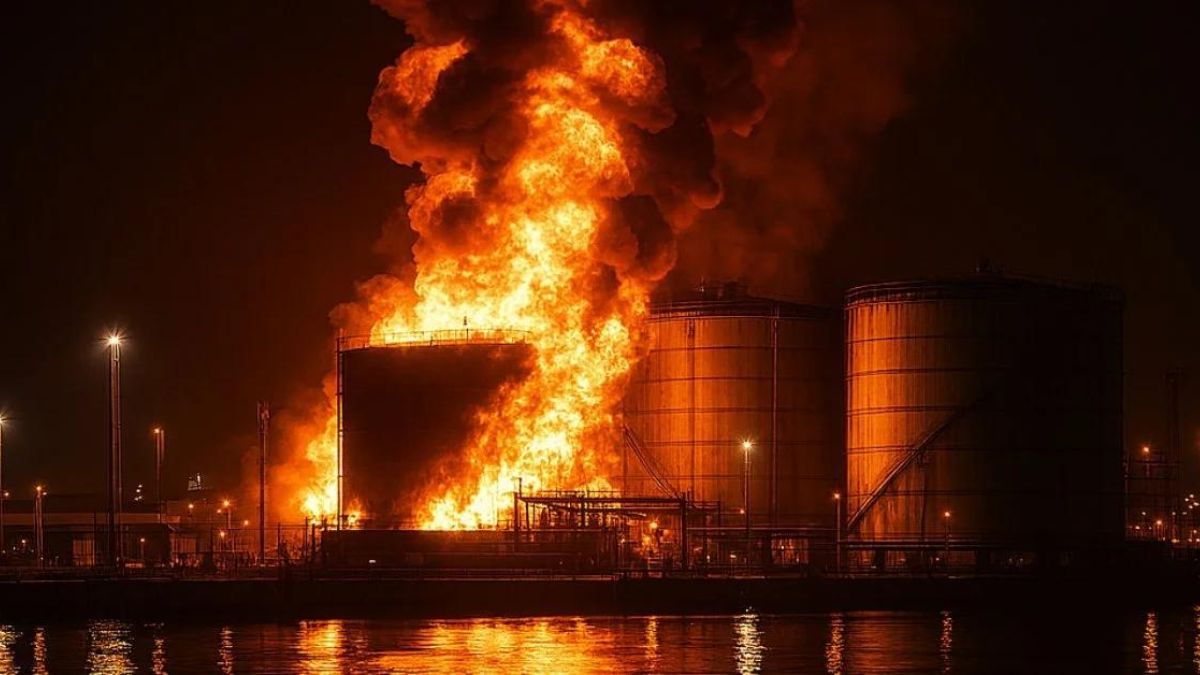
In a significant escalation of the ongoing war, Ukraine’s armed forces have reportedly struck the strategically critical Ust-Luga oil terminal in north western Russia. The development marks one of the most consequential attacks on Russian energy infrastructure in recent months and reflects Kyiv’s intensifying focus on undermining Moscow’s economic lifelines amid the prolonged conflict with Ukraine.
Located along the Baltic Sea, the Ust Luga terminal is among Russia’s largest maritime export hubs for crude oil and refined petroleum products. It has assumed even greater importance since the imposition of Western sanctions following the invasion of Ukraine, functioning as a key node in Russia’s reoriented energy trade routes towards Asia and other non Western markets. With an annual handling capacity running into tens of millions of tonnes, the terminal remains central to the Kremlin’s ability to sustain export volumes and generate critical revenue.
According to emerging reports, the strike was carried out using long range unmanned aerial systems, underscoring Ukraine’s expanding capability to conduct deep strikes well beyond the immediate theatre of combat. While Moscow has yet to release a comprehensive official assessment, preliminary indications suggest that the attack caused damage to storage infrastructure and may have triggered fires within parts of the facility. Emergency services were reportedly deployed swiftly in an effort to contain the situation and prevent further damage, though the full operational impact remains unclear.
The incident forms part of a broader and increasingly deliberate shift in Ukraine’s military doctrine. Kyiv has moved beyond conventional frontline engagements to target economic and logistical assets deep within Russian territory, particularly those linked to energy production, storage, and export. By focusing on such infrastructure, Ukraine appears intent on raising the economic cost of the war for Moscow, thereby constraining its capacity to finance sustained military operations over the long term.
The implications of the strike extend beyond the immediate battlefield, carrying potential consequences for global energy markets. Even temporary disruptions at a major export hub such as Ust Luga can exert upward pressure on oil prices, especially in a market already shaped by geopolitical uncertainty. In addition, the incident may contribute to increased shipping and insurance costs in the Baltic region, while prompting buyers to explore alternative supply routes, thereby complicating established trade flows.
From a security perspective, the attack highlights the growing vulnerability of critical infrastructure to asymmetric threats, particularly the use of drones capable of penetrating deep into national territory. It is widely expected that Moscow will respond by reinforcing air defence systems around key industrial and energy assets, as well as reassessing existing protective measures. The strike also follows a series of similar incidents targeting refineries and fuel depots, suggesting a sustained and coordinated campaign rather than an isolated episode.
At a broader geopolitical level, the targeting of the Ust Luga terminal underscores the deepening economic dimension of the Russia Ukraine conflict. Both sides are increasingly engaged in efforts aimed at weakening each other’s economic resilience, with energy infrastructure emerging as a central battleground. For policymakers and market participants alike, the incident serves as a stark reminder of the fragility of global energy supply chains in the context of prolonged geopolitical instability.
The reported strike on Ust Luga thus represents a pivotal moment in the evolution of the conflict, illustrating Ukraine’s capacity and willingness to extend its operational reach into areas of strategic economic importance. As developments continue to unfold, the repercussions are likely to be felt not only within Russia and Ukraine but across global energy markets and the wider international system.