

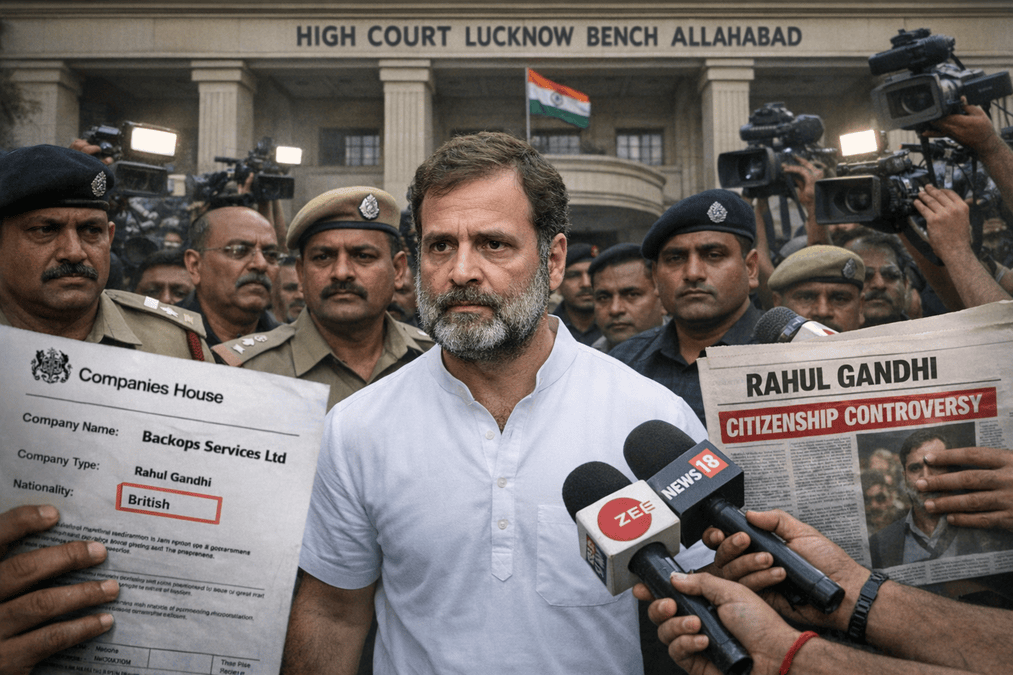
The April 17, 2026, order of the Allahabad High Court, requiring the registration of an FIR against Leader of the Opposition Rahul Gandhi over allegations of possessing British citizenship is one of the most inflammatory legal cases of recent Indian political history, which put the country into a familiar vortex of controversy over the eligibility of the Congress scion to hold elective office and rekindled The order of the single-judge, Justice Subhash Vidhyarthi, of the Lucknow Bench, is based on an ongoing petition by BJP activist S. Vignesh Shishir that Gandhi had declared himself a British national in Companies House registration documents as director of the Backops Services Ltd. of the United Kingdom between 2003 and 2009 which he was, a revelation apparently found in the public The High Court overturned lower courts and police unwillingness to do so, invoking its supervisory powers under Section 156(3) of the CrPC, which was reflected in the Bharatiya Nagarik Suraksha Sanhita (BNSS), to order It is not just procedural prodding, the court made it very clear that the 2019 show-cause notice of the Ministry of Home Affairs (MHA) to Gandhi, in which he declined to be a British citizen but offered no binding decision, was in fact to be taken to the next level, possibly the CBI, in the event of a failure in state investigations, so a personal complaint of grievance turns into a potential
Central to this storm is the intractable constitutional structure of citizenship in India, embodied in Article 9 which ruthlessly ends Indian nationality in the instance of a voluntary acquisition of foreign citizenship, born of the remnants of Partition-era loyalties and conceived as an impassable bastion against divided loyalties that would destroy sovereignty in a geopolitically unstable neighbourhood. This automatic forfeiture, which is operationalized under the Citizenship Act, 1955, Section 9, leaves no gray area to the dual status (contrary to jurisdictions like the United States, which tolerate a dual allegiance-without-naturalization status up to age 22, and Canada, which permits a dual allegiance-without-naturalization status to children until 22), and a policy calculus In the case of elected members of parliament, Article 102(1)(a) of the Constitution disenfranchises any MP who is not an Indian citizen, overlapping with the Representation of the People Act, 1951 (RPA), Section 9A, which cancels any candidacy tainted with foreign citizenship knowledge; supporting evidence in this case would lead to Gandhi being immediately disqualified as an MLA under However, enforcement mechanisms indicate structural weaknesses: MHA revocation pursuant to Section 10 requires quasi-judicial process with natural justice protections, subject to appeal to Foreigners Tribunal under the Foreigners Act or even the Supreme Court under Article 32, an under-the-sea process that can easily be politicized as we have seen in long-running CAA-NRC litigations;
At the policy level, this episode cruelly reveals the contradictions between the dogma of rigid single-city citizenship in India, the Nehruvian nation-building paranoia, and the irresistible forces of globalization, when NRIs inject up to 100 billion dollars-plus in remittances each year yet are treated as political outcasts, a contradiction that drives diasporic claims to graded rights that Opponents claim that the system, which has not been updated since 1955 amendments, ossifies talent repatriation as China aggressively recruits overseas workers, which may scare away second-generation Indians of the public service, and reformist proposals such as restricting dual rights in non-strategy jobs or automatic conversion of OCI to citizenship status are blocked in parliament by security hawks citing the ISI shadows The intervention of the High Court is in every way within the law, crystallizing Lalita Kumari v. Govt. of UP (2014 SC), which codified mandatory FIRs against cognizable crimes without preliminary inquiries, as rebelling against the police as screeners rather than judges; but its vigorous encouragement of central agencies prompts inquires into judicial activism in an after-Article 37 In political terms, the optics are disastrous: the amplification of BJP through IT cells re-frames Congress as a foreign-funded party, reminisces of 2018 Modi attacks on Oxford-returnees, and Congress attacks on BJP with vindictive justice, resonant with ADR statistics on 43 percent of post-2014 investigations into opposition. Essentially deconstructing the merits, the evidentiary nucleus of the petition, Backops filings indicating Gandhi as British and his UK addresses, relies on interpretive latitude: directorships do not ipso facto make a person a citizen under the residency tests of the UK law and there are numerous mistakes at Companies House, such as the ones fixed in amendments in 2023; without MHA termination order But the genius of the directive is to compel disclosure, reflecting US emolument inquiries into Kushner, and potentially unearth ancillary failures such as Prevention of Money Laundering Act angles in case of the appearance of foreign assets. Bigger, it challenges judicial impartiality in polarised India: with state elections in 2026 looming, is it organic jurisprudence or stealthy BJP preference, now Shishir wears a party badge and the same court has granted him security previously? Congress: transfer SC, based on Article 139A, a feasible escalation challenge to the Chief Justice Sanjiv Khanna, after Vedanta-Farm Laws. This saga, in the larger picture, highlights the transformation of citizenship as a colonial remnant into an instrument of military strength; without any bipartisan reform, say a Citizenship Amendment Bill that limits the lives of the diaspora, such hot spots will erupt in the future, using the discourse of democracy as a litmus test of loyalties. Finally, prompt evidence-based closure is urgent: exoneration strengthens the resilience discourse of Gandhi, conviction reworks opposition architecture, but delay breeds as electoral poison, reminding that in the Indian legal coliseum, citizenship is not merely a status, but the ultimate political weapon.