

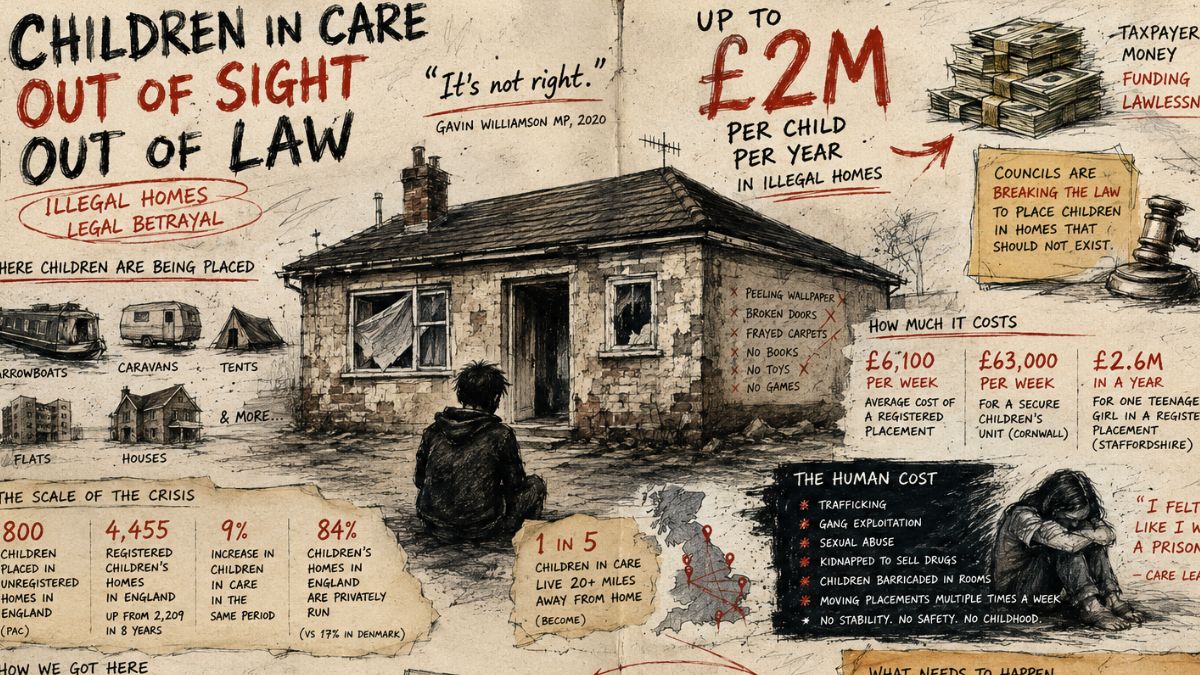
The peeling wallpaper, broken doors, threadbare carpets and stripped down interiors of illegal children’s homes across England are not merely signs of neglect. They are physical evidence of a national safeguarding catastrophe that has evolved over more than a decade under the watch of governments, regulators, local authorities, private investors and commercial care operators who collectively failed the most vulnerable children in British society. Behind every unregistered bungalow, converted terrace house, temporary caravan, holiday let, narrowboat or concealed suburban property lies a profound legal and moral collapse in the modern British care system. What was once presented as an emergency workaround has now hardened into a deeply entrenched shadow market worth millions of pounds, funded almost entirely by taxpayers and sustained through systemic regulatory paralysis.
The reality is now impossible to disguise. Councils throughout England are knowingly placing vulnerable children into unregistered and therefore illegal care settings despite statutory prohibitions introduced precisely to stop such practices. The sums involved are staggering. In some of the most extreme cases, local authorities are paying as much as £2 million annually for the placement of a single child in homes operating outside the legal framework established by Parliament. These are not isolated administrative failures or temporary emergency responses. They are repeated breaches of statutory duties carried out within a system that has effectively normalised illegality because lawful alternatives no longer exist in sufficient numbers. The legal position is, on paper, unambiguous. Under the Care Standards Act 2000 and the Children’s Homes Regulations 2015, any establishment providing care and accommodation to children must be registered with Ofsted. Operating an unregistered children’s home constitutes a criminal offence. The 2021 prohibition introduced by the government specifically banned the placement of children under sixteen in unregulated accommodation after mounting evidence revealed widespread exploitation, trafficking, violence and systemic safeguarding failures within such environments. Ministers publicly promised decisive reform. Yet several years later, councils continue placing children into illegal homes because the lawful system itself has imploded under pressure.
What has emerged is effectively a parallel care economy operating in plain sight. Ofsted itself records a growing tally of illegal settings, yet prosecutions remain vanishingly rare. The regulator has not successfully prosecuted a single provider running illegal children’s homes despite years of mounting evidence. That fact alone exposes the depth of institutional dysfunction. In any other heavily regulated sector involving vulnerable people, such prolonged regulatory impotence would provoke national outrage and possibly criminal investigations into public authorities themselves. If care homes for elderly adults operated illegally on this scale, or if private hospitals routinely bypassed licensing laws while charging public bodies millions, the political response would likely be immediate and severe. Yet within children’s social care, illegality has become almost administratively tolerated.
The conditions inside many of these placements are profoundly disturbing. Reports of children housed in caravans, narrowboats, temporary holiday rentals and poorly maintained flats are not anomalies. They reflect the structural degradation of emergency accommodation practices across local authorities under acute placement pressures. One child reportedly lived in a caravan in Lancashire while being rotated between temporary placements operated by the same company. Another vulnerable teenager at risk of self harm was housed in a flat above a shop despite known safeguarding concerns relating to windows and absconding risks. Whistleblowers described children living in homes where furniture was held together with bricks and children barricaded themselves inside rooms for protection. Former residents recount being moved repeatedly between temporary accommodation with no continuity of care, no stable relationships and no sense of security. Such experiences are not merely emotionally damaging. They are potentially incompatible with the statutory welfare obligations imposed on local authorities under the Children Act 1989.
Section 22 of the Children Act imposes a clear legal duty upon local authorities to safeguard and promote the welfare of children in their care. This obligation is not discretionary. It is a mandatory statutory responsibility reinforced repeatedly through case law and human rights principles under Article 3 and Article 8 of the European Convention on Human Rights. The placement of vulnerable children into unsafe, unstable or unlawful accommodation raises serious questions regarding whether councils are systematically breaching these obligations. Increasingly, the defence advanced by local authorities is not that placements are appropriate, but that no lawful alternatives exist. That admission in itself represents a devastating indictment of successive governments and the market driven model imposed upon children’s social care. The roots of this crisis stretch back decades. Historically, children’s residential care was largely delivered directly by local authorities or charitable organisations. However, a succession of abuse scandals during the late twentieth century severely damaged confidence in institutional care provision. Governments responded by encouraging privatisation and outsourcing. Under New Labour, commissioning external providers became central to social care policy. Subsequent Conservative administrations accelerated this approach under broader ideological commitments to reducing direct state involvement in public services. David Cameron’s pledge to “release the grip of state control” over public services became particularly influential in children’s care policy.
The consequence is that England now operates one of the most heavily privatised children’s residential care systems in Europe. Approximately 84 per cent of children’s homes in England are privately owned compared with only 17 per cent in Denmark. Private equity firms, property investors and commercial operators have increasingly entered the sector, drawn by exceptionally high returns and guaranteed public funding streams. What was once a safeguarding service has become an investment asset class. This transformation fundamentally altered market incentives. Children with complex needs generate the highest placement fees because they often require intensive staffing ratios, behavioural support, secure supervision and specialist therapeutic services. Yet the legal supply of specialist placements has failed catastrophically to keep pace with demand. Registered children’s homes doubled from 2,209 to 4,455 within eight years despite only a modest rise in the number of looked after children nationally. That dramatic expansion should theoretically have reduced prices. Instead, placement costs exploded.
The average residential placement now costs approximately £6,100 per week or more than £318,000 annually. Specialist placements involving severe behavioural or mental health risks can cost far more. Staffordshire Council reportedly spent £2.6 million in a single year for one highly specialised registered placement involving up to five carers. Cornwall reportedly paid £63,000 weekly for a secure placement. Yet even these extraordinary figures are eclipsed by illegal settings charging councils more than £2 million annually per child. This inflationary spiral reveals a deeply distorted market where scarcity, liability fears and regulatory pressures combine to produce extraordinary pricing power for providers willing to accept highly challenging children. Ironically, the more vulnerable and difficult a child becomes, the more commercially valuable they may become within the placement market. The behaviour of some providers illustrates how far commercialisation has reshaped the sector. Property investors increasingly market children’s homes as superior alternatives to traditional buy to let investments. Social media advertisements openly promote conversion opportunities for residential properties into care settings promising guaranteed income streams and minimal operational involvement. Entire consultancy industries now assist landlords in obtaining planning permission and entering the sector. Some operators openly discuss unregistered placements within online industry forums. Others allegedly attempt to disguise illegal operations by separating accommodation and staffing invoices across multiple corporate entities to avoid triggering regulatory definitions of children’s homes.
Such practices raise profound legal and ethical concerns. Artificial corporate structures designed to circumvent safeguarding regulation may potentially engage issues of fraud, regulatory evasion and breaches of directors’ duties under the Companies Act 2006. They also expose glaring weaknesses in regulatory intelligence gathering and enforcement coordination between Ofsted, Companies House, local authorities and other public bodies.
Yet responsibility does not rest solely with providers. Ofsted itself faces mounting criticism over severe registration delays that reportedly extend up to eighteen months. Providers argue that prolonged processing times effectively force operators into unlawful trading simply to avoid financial collapse after committing to rents, staffing and property costs. While this explanation cannot justify criminal breaches of safeguarding laws, it does reveal how regulatory incapacity contributes directly to the expansion of illegal provision. At the same time, many registered providers increasingly refuse to accept children with the most complex needs regardless of financial incentives. The Hesley Group scandal fundamentally altered provider attitudes toward risk. Investigations uncovered appalling abuse within Hesley homes involving children with learning disabilities who were allegedly punched, beaten with dog leads and left outdoors overnight during winter. Ofsted reportedly received more than one hundred safeguarding notifications before decisive action occurred. The scandal triggered intense scrutiny of providers managing highly complex children.
Many operators now fear that accepting children with severe behavioural difficulties, histories of exploitation or violent conduct could generate safeguarding incidents that jeopardise their entire registration status. Consequently, some homes prefer remaining partially empty rather than risking regulatory intervention associated with high notification volumes. The practical effect is that the children with the greatest needs are increasingly excluded from the lawful system altogether.
This dynamic has created what many experts describe as a catastrophic market failure. Local authorities retain statutory obligations to house and safeguard children regardless of behavioural complexity. Courts continue issuing Deprivation of Liberty orders requiring restrictive placements for children at risk of harming themselves or others. Yet suitable lawful placements simply do not exist in adequate numbers. Councils therefore resort to emergency illegal provision because failing to place a child anywhere may expose them to even greater immediate harm. The judiciary itself has repeatedly expressed alarm at this crisis. The High Court increasingly hears urgent applications involving children held in unsuitable accommodation due to lack of available placements. Judges have warned of systemic collapse within children’s social care. In several cases, courts have effectively sanctioned emergency unlawful arrangements because no lawful alternatives existed. This places the judiciary in an impossible constitutional position where courts indirectly facilitate breaches of regulatory law to avoid immediate risks to children’s welfare.
The human consequences are devastating. Children entering care frequently already carry histories of severe trauma, neglect, sexual exploitation, violence, parental addiction or mental illness. Many exhibit highly challenging behaviours precisely because they have experienced profound instability and abuse. Repeated placement breakdowns compound existing trauma. Constant movement between temporary settings destroys educational continuity, therapeutic relationships and emotional trust. Children placed far from their home communities often lose contact with siblings, schools, friends and support networks. According to campaigners, approximately one fifth of children in care live more than twenty miles from their home areas.
This geographical displacement creates additional safeguarding risks. Isolated children placed in unfamiliar communities become highly vulnerable to criminal exploitation, county lines gangs and sexual abuse networks. Previous investigations revealed children trafficked directly from placements or abducted for drug dealing operations. Such outcomes are not unforeseeable accidents. They are predictable consequences of systemic instability combined with inadequate oversight. Mental health pressures further intensify the crisis. The reduction in youth custody, shortages in adolescent psychiatric beds and rising rates of severe mental health crises among children have created extraordinary pressure upon residential care services. Some children remain in hospital accident and emergency departments for days because no suitable placement exists. Others are housed in makeshift settings incapable of meeting acute psychological needs. Social care increasingly functions as the de facto containment mechanism for children failed simultaneously by health, education and criminal justice systems.
From a legal perspective, this fragmentation exposes a broader failure of joined up statutory governance. The Children Act framework depends upon coordinated interagency safeguarding involving councils, health bodies, police, courts and regulators. Yet each institution increasingly operates under severe resource constraints while transferring responsibility elsewhere. Councils blame shortages of placements. Providers blame regulation. Regulators blame legislative gaps. Government blames market conditions. Meanwhile children remain trapped inside an increasingly chaotic system where no institution accepts meaningful accountability. The government’s recent legislative response through the Children’s Wellbeing and Schools Bill seeks to establish clearer legal mechanisms for restrictive placements and promises investment in foster care and residential provision. However, critics correctly observe that proposed funding remains vastly insufficient relative to the scale of the crisis. Creating 10,000 additional foster placements may reduce pressure at lower levels of need but does little to address the acute shortage of specialist residential placements for highly complex children. The wider question confronting policymakers is whether market driven residential care is fundamentally compatible with safeguarding obligations owed to vulnerable children. Comparative international models suggest alternative approaches. Denmark maintains significantly greater non profit and publicly operated provision. Wales recently moved toward requiring new children’s care providers to operate on a not for profit basis. Scotland continues exploring similar reforms. These models reflect growing concern that profit extraction from children’s social care creates dangerous distortions in safeguarding priorities.
Yet reform is extraordinarily difficult. Abrupt profit caps or aggressive regulatory interventions risk driving legitimate providers from an already fragile market. Equally, maintaining the current system guarantees continued illegality, spiralling costs and worsening safeguarding failures. The state therefore faces a profound structural dilemma. Decades of privatisation hollowed out public sector capacity while simultaneously creating dependency upon private operators whose commercial incentives may not align fully with child welfare objectives.
The uncomfortable truth is that Britain’s children’s social care system increasingly resembles a crisis management industry rather than a safeguarding service. Emergency placements, reactive interventions and escalating fees dominate operational realities. Prevention, stability and therapeutic recovery receive far less attention because crisis itself has become the primary organising principle of the market.
For legal practitioners working within family law, public law and safeguarding, the implications are deeply troubling. Continued reliance upon illegal placements risks exposing councils to mounting judicial review claims, negligence actions and human rights litigation. Children subjected to unsafe or unlawful accommodation may eventually pursue claims alleging breaches of statutory duties and Convention rights. Regulators too may face increasing scrutiny regarding enforcement failures. The longer the system tolerates known illegality, the greater the eventual legal reckoning may become.
Ultimately, the scandal surrounding illegal children’s homes is not merely about rogue providers or overstretched councils. It is about the collapse of coherent state responsibility toward profoundly vulnerable children. It is about a nation that outlawed dangerous placements while simultaneously constructing a care market incapable of functioning without them. It is about public authorities paying millions of pounds into illegal systems because lawful systems no longer possess sufficient capacity. Most damningly of all, it is about traumatised children becoming revenue streams within a dysfunctional market whose failures are now so normalised that illegality itself barely shocks anymore. Until the British state confronts the structural contradictions at the heart of modern children’s social care, the crisis will deepen. More children will be moved through unstable placements. More public money will disappear into emergency provision. More illegal homes will operate in suburban streets beyond meaningful oversight. And more vulnerable children already failed by the adults in their lives will discover that even the care system designed to protect them has itself become another source of instability, exploitation and institutional abandonment.