

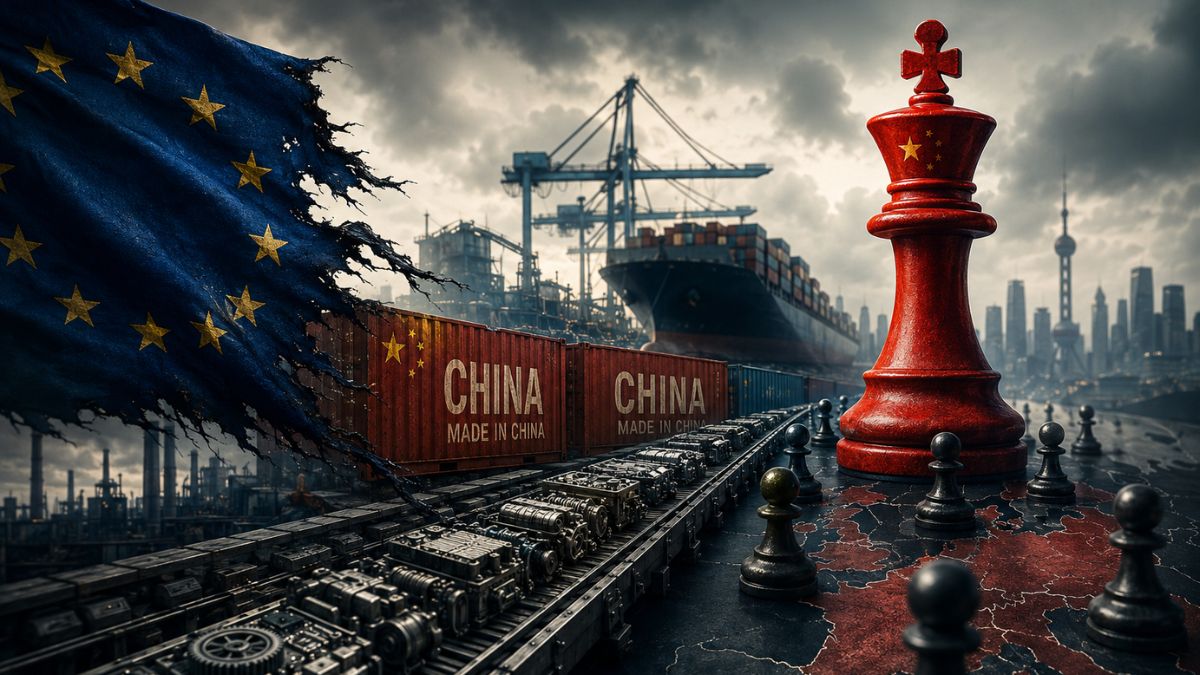
For years, Europe comforted itself with the belief that economic interdependence with China represented a sophisticated form of strategic globalisation rather than a dangerous surrender of industrial sovereignty. That illusion is now collapsing at alarming speed. Across Brussels, Berlin, Paris and the manufacturing heartlands of continental Europe, policymakers, industrial leaders, economists and trade lawyers are beginning to confront a deeply unsettling reality. Europe is not merely trading with China anymore but is becoming structurally dependent on Chinese industrial capacity in ways that increasingly resemble economic capture.
What is being revealed across the European Union is a systemic transfer of industrial leverage from Europe to Beijing, driven by state engineered overcapacity, currency distortion, supply chain penetration, dumping and an industrial policy framework in China that European liberal democracies simply cannot replicate without fundamentally rewriting their own competition laws and fiscal orthodoxies. The growing fears now expressed by analysts, industrial associations, and strategic experts are reflecting a mounting recognition that Europe may be entering a second and potentially more devastating phase of what economists once called the “China Shock”.
The original China Shock emerged after China entered the World Trade Organization in 2001. Western policymakers at the time celebrated the accession as a triumph of liberal economic integration. Instead, the consequences proved catastrophic for many industrial communities across the United States. Entire manufacturing towns across the American Midwest were hollowed out as Chinese imports surged into the market. Academic studies later linked the industrial collapse to profound social consequences including unemployment, opioid addiction, rising suicide rates, declining marriage rates and long term community deterioration. Estimates suggested that up to 2.5 million American jobs were lost as a result of import competition triggered by China’s WTO accession. Europe now fears it is approaching a comparable inflection point, but under conditions that may be even more dangerous because the dependence has evolved beyond finished consumer products. According to Jens Eskelund, President of the European Chamber of Commerce in Beijing, the central threat no longer lies merely in Chinese electric vehicles or cheap consumer goods flooding European markets. The real danger lies in the invisible layers beneath Europe’s industrial infrastructure. Chinese components are becoming embedded across the European manufacturing bloodstream at extraordinary scale.
That distinction is critically important from both an economic and legal perspective. Once a nation loses control over component ecosystems rather than merely finished goods production, strategic autonomy becomes exponentially harder to restore. Europe is increasingly discovering that its factories, pharmaceuticals, machinery production lines, automotive systems, chemical manufacturing chains and advanced engineering sectors depend upon Chinese inputs at levels that create severe vulnerability. The concern is not theoretical. The data emerging from trade analyses paints an extraordinarily grim picture.
Research highlighted by Soapbox, a China trade monitoring platform associated with the Mercator Institute for China Studies, reveals the extent of the industrial exposure. In amino acids used extensively in pharmaceuticals and food manufacturing, the European Union imports approximately 52 per cent by value from China, yet by volume the figure reaches a staggering 88 per cent. In polyhydric alcohols used in plastics, paint, cosmetics and antifreeze, nearly 96 per cent of EU import volume originates from China. Such dependency metrics are not simply trade statistics. They represent strategic choke points. From a legal sphere, the implications are profound. Under the European Union’s Single Market framework, industrial resilience was traditionally presumed to arise naturally from market competition and cross border integration. However, the existing legal structure was not designed to confront a trading partner operating through extensive state subsidies, state directed banking systems, opaque industrial financing mechanisms and strategic currency management.
This is where the current crisis becomes deeply uncomfortable for Europe because it exposes a structural incompatibility between liberal market governance and authoritarian state capitalism. Chinese industrial actors are often able to operate with forms of financial support that would likely breach European Union state aid rules under Articles 107 and 108 of the Treaty on the Functioning of the European Union. European companies cannot receive unlimited state backed credit, indefinite loss financing or politically directed market support without triggering competition law scrutiny from Brussels. Chinese firms, by contrast, operate within an entirely different economic logic where commercial activity frequently overlaps with state strategic objectives.
European industrial groups are now openly describing many Chinese manufacturers as “zombie firms” sustained through state support mechanisms that permit aggressive pricing strategies impossible under ordinary market conditions. Oliver Richtberg from VDMA, representing Europe’s machinery and equipment manufacturing industry, acknowledged that procurement decisions increasingly become impossible to resist. When Chinese suppliers can offer products at 95 per cent of European quality standards while charging 30 to 50 per cent less, market logic inevitably drives purchasing behaviour toward China. This is where the legal debate intersects with political reality. Free market ideology assumes that price efficiency reflects genuine competitive advantage. Yet when price formation itself is distorted through subsidies, currency management and industrial overcapacity policies, the legal foundations of fair competition begin to erode. Europe’s existing trade defence instruments appear dangerously inadequate against the scale and sophistication of the challenge.
The European Union did attempt a partial response through tariffs imposed in 2024 on Chinese electric vehicles, with duties reaching as high as 35 per cent. However, analysts increasingly argue that these measures were largely neutralised by exchange rate dynamics. German economist Jürgen Matthes suggested that the Chinese yuan may be undervalued against the euro by as much as 40 per cent. If accurate, this effectively means that Chinese exports enjoy a structural pricing advantage embedded directly into currency mechanics.
Currency undervaluation allegations raise extraordinarily sensitive legal issues within international trade governance. Under International Monetary Fund principles and broader G7 economic coordination frameworks, persistent exchange rate manipulation designed to secure trade advantages has long been controversial. However, proving intentional currency distortion under international law remains notoriously difficult. China has consistently rejected allegations of manipulation while maintaining extensive influence over monetary conditions through its tightly managed financial system.
The Centre for European Reform has now issued one of the most alarming warnings yet regarding Germany’s vulnerability. Its report entitled “China Shock 2.0 The Cost of Germany’s Complacency” argues that Berlin is effectively refusing to acknowledge the scale of the crisis despite mounting evidence that China is targeting the very industrial foundations of German economic power. The report describes Germany as suffering from a form of “phantom pain”, desperately searching for alternative explanations such as energy prices or bureaucracy while ignoring the deeper structural displacement caused by Chinese competition. The comparison with the American Midwest is increasingly impossible to ignore. Germany’s industrial losses are accelerating. Approximately 250,000 industrial jobs have reportedly disappeared since 2019. The automotive sector alone lost around 51,000 jobs between 2024 and 2025. In the machinery sector, another 22,000 jobs vanished within a single year. Behind these statistics lies a social question Europe has not fully confronted. Industrial decline is never merely economic. It reshapes political stability, democratic confidence, regional cohesion and national identity.
Wolfsburg and Stuttgart are not simply manufacturing centres. They symbolise the post war German social contract itself. The collapse of industrial employment in such regions would carry consequences far beyond economics. The United States experience demonstrated that prolonged industrial dislocation creates fertile ground for political extremism, anti establishment anger and democratic fragmentation. Europe may now be approaching a similar threshold.
The strategic intent attributed to Beijing further intensifies the anxiety. According to the CER, China’s “10,000 little giants” industrial initiative specifically targets sectors traditionally dominated by Germany’s Mittelstand, the network of highly specialised medium sized industrial firms that historically formed the backbone of German export strength. These firms are not easily replaceable. They embody decades of technical expertise, apprenticeship systems, regional industrial clusters and engineering culture.
If those ecosystems collapse, rebuilding them may take generations. This is precisely why the current debate increasingly resembles discussions surrounding national security rather than ordinary commerce. Jens Eskelund explicitly warned that Europe’s growing dependence on Chinese industrial inputs could eventually evolve into a security issue for Germany itself.
That concern is legally and strategically significant because it intersects with emerging European doctrines surrounding “economic security”. Over recent years, Brussels has gradually expanded the concept of strategic autonomy beyond defence into technology, semiconductors, energy and supply chains. The Covid pandemic exposed the dangers of concentrated external dependencies, particularly regarding pharmaceuticals and medical equipment. Russia’s invasion of Ukraine further reinforced the geopolitical risks of overreliance on authoritarian powers for critical economic infrastructure.
China now occupies a similar category of strategic concern, albeit at vastly larger scale. Unlike Russia, China is deeply integrated into virtually every layer of global manufacturing. Decoupling is therefore economically painful and politically contentious. Europe finds itself trapped between its economic dependence on China and its growing recognition that the dependence itself may become strategically intolerable.
The European Commission is scrambling to formulate responses, but institutional limitations remain severe. Commissioners are reportedly preparing urgent discussions concerning supply diversification requirements that could force European firms to source critical components from at least three independent suppliers. Such measures reflect an emerging shift from pure market liberalism toward resilience based industrial regulation. Legally, this represents a major philosophical transformation within European governance. For decades, EU competition policy focused primarily on price efficiency and consumer welfare. The new environment increasingly prioritises resilience, redundancy and strategic independence. The proposed Industrial Accelerator Act, informally referred to as the “Made in EU” law, signals that Brussels may finally be moving toward an explicit industrial sovereignty agenda. Simultaneously, revisions to the Cyber Security Act of 2019 may permit companies to exclude Chinese suppliers on national security grounds. This would mirror similar developments already witnessed in telecommunications infrastructure debates surrounding Huawei and 5G networks. Yet these legislative mechanisms are moving slowly and are unlikely to take effect before 2027 or later.
That timeline may prove catastrophically inadequate given the speed of industrial erosion currently occurring across Europe. Policymakers therefore face an almost impossible balancing act. Aggressive countermeasures risk retaliation from Beijing, including restrictions on European firms operating inside China or disruptions to critical supply chains. Yet passivity risks long term deindustrialisation that could permanently weaken Europe’s economic foundations.
Andrew Small from the European Council on Foreign Relations articulated the dilemma bluntly. China does not necessarily need to defeat every European countermeasure outright. It merely needs to delay, complicate and obstruct policy responses long enough to maintain export dominance and deepen European dependency.
This observation reflects a broader geopolitical reality often underestimated in Europe. Beijing’s industrial strategy operates through long term planning cycles extending across decades rather than electoral terms. Xi Jinping’s administration has pursued a highly disciplined export driven industrial expansion strategy aimed at dominating strategic manufacturing sectors globally. Europe’s fragmented political systems, coalition governments and regulatory complexity make coherent responses extraordinarily difficult. Germany’s position remains especially problematic because of its historical economic relationship with China. For years, major German corporations benefited enormously from access to Chinese markets. This created powerful domestic constituencies resistant to confrontation with Beijing. Yet the very model that once delivered prosperity may now be accelerating Germany’s industrial vulnerability.
The irony is extraordinary. Germany helped shape Europe’s export oriented economic philosophy, yet it now confronts the possibility that China has mastered and weaponised the same model at vastly greater scale. Chinese firms increasingly compete not only in low cost manufacturing but in advanced engineering, electric vehicles, industrial machinery and high value manufacturing sectors previously considered secure European strongholds.
The legal framework governing international trade appears increasingly incapable of addressing these realities. The WTO system was designed around assumptions of market competition that often do not neatly apply to state capitalist systems. Trade defence instruments such as anti dumping duties remain slow, fragmented and reactive. Meanwhile, industrial displacement occurs rapidly and often irreversibly. There is also a growing debate surrounding whether existing European competition laws themselves require fundamental revision. Strict state aid restrictions may preserve market discipline internally while simultaneously leaving European industries exposed to externally subsidised competitors. This creates what some legal scholars now describe as “asymmetric openness”, where liberal economies remain fully accessible to strategic competitors operating under entirely different rules. From an advocate’s perspective, the present crisis reveals the dangerous limitations of legal idealism detached from geopolitical realism. For decades, Europe assumed that deeper trade integration would gradually liberalise authoritarian systems through economic convergence. Instead, the reverse may now be occurring. China successfully integrated into global markets while preserving and strengthening state directed industrial power.
The consequences are becoming visible across Europe’s industrial landscape. Factories close not because they lack engineering excellence but because they cannot compete against structurally distorted pricing systems backed by state power. Procurement managers choose cheaper Chinese inputs because commercial survival leaves little alternative. Governments hesitate because retaliation risks immediate economic pain. Meanwhile dependency deepens incrementally until strategic leverage shifts permanently.
Perhaps the most chilling observation came from one unnamed German industrial leader who reportedly remarked that Europe may as well become “a province of China” given the scale of industrial penetration already occurring. While provocative, the statement captures the growing sense of helplessness among sections of European industry.
The fundamental question now confronting Europe is brutally simple. Can liberal democratic economies preserve industrial sovereignty against an authoritarian economic superpower willing to deploy every instrument of state policy in pursuit of industrial dominance? At present, Europe does not appear to possess a coherent answer. The warning signs are multiplying. Trade deficits are widening. Industrial jobs are disappearing. Supply chain dependency is intensifying. Political hesitation remains entrenched. Legislative responses move slowly. Beijing continues advancing. History may ultimately judge this period not as a routine trade dispute but as the moment Europe realised too late that globalisation without strategic reciprocity can evolve into economic dependency, industrial erosion and geopolitical vulnerability. The original China Shock transformed the American Midwest and permanently altered the social fabric of the United States. Europe now stands dangerously close to discovering whether China Shock 2.0 will reshape the continent with even greater force.