

By Adv. Avni Agarwal
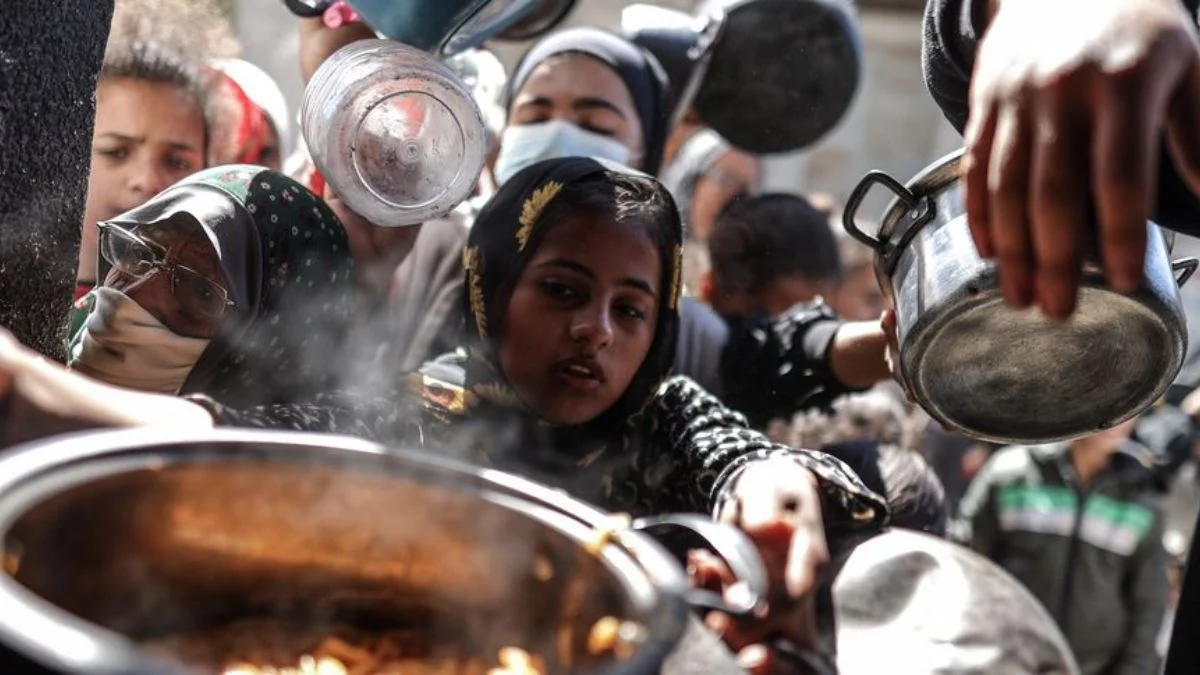
The twenty first century was once expected to be defined by technological progress, transnational diplomacy, and the codification of humanitarian protections after the brutal lessons of the twentieth century. Instead, the international community now confronts a grotesque and deeply calculated reality in which hunger itself has been transformed into a strategic weapon of war. The deliberate destruction of food systems, the bombing of markets, the obstruction of humanitarian relief, and the targeting of civilians seeking sustenance have become recurring features of modern armed conflict. What was once considered a violation of the most basic principles of humanity is now increasingly deployed with chilling regularity as an accepted method of military and political coercion.
The latest analysis compiled by Insecurity Insight lays bare the scale of this humanitarian collapse. Since the unanimous adoption of United Nations Security Council Resolution 2417 in 2018, more than 21,403 documented incidents of food related violence have occurred across fifteen countries. The figures are staggering not merely because of their numerical scale, but because they expose the systematic normalisation of starvation as an instrument of conflict management. These are not accidental wartime shortages arising from logistical breakdowns or collateral disruptions. They represent repeated and identifiable attacks on the very systems that permit civilian survival.
The data identifies 1,261 strikes on markets routinely used by ordinary families for the purchase of daily groceries. Another 863 incidents specifically targeted food distribution systems, frequently resulting in the deaths of humanitarian workers attempting to deliver aid. Researchers also documented 1,909 military strikes on farmland and 563 attacks on water infrastructure essential for agricultural production. The impact of these attacks extends far beyond immediate casualties. Destroyed irrigation systems, contaminated water sources, obliterated grain storage facilities, and inaccessible agricultural land create cascading humanitarian consequences that can devastate entire regions for generations.
The occupied Palestinian Territory recorded the highest number of documented incidents, with 9,013 attacks linked to the targeting of food systems and civilian survival infrastructure. Yemen followed with 1,863 incidents, while Sudan registered 1,605 attacks involving food related violence. Syria recorded 1,538 incidents, many attributed to Syrian government forces and Russian military operations before the collapse of the Assad regime. Mali documented 1,415 incidents amid the deteriorating security landscape and the ruling junta’s increasingly desperate attempts to consolidate authority. The figures themselves are horrifying, but the underlying legal and political implications are even more disturbing. International humanitarian law has long prohibited the starvation of civilians as a method of warfare. Article 54 of Additional Protocol I to the Geneva Conventions explicitly forbids attacks against objects indispensable to civilian survival, including foodstuffs, agricultural areas, crops, livestock, drinking water installations, and irrigation works. Article 14 of Additional Protocol II extends similar protections to non international armed conflicts. The Rome Statute of the International Criminal Court further criminalises the intentional starvation of civilians as a war crime under Article 8.
Yet despite these legal prohibitions, enforcement mechanisms remain paralysed by geopolitical interests, selective accountability, and institutional weakness. Resolution 2417 itself was heralded in 2018 as a landmark development because it formally recognised the direct relationship between armed conflict and food insecurity. The resolution unequivocally condemned the unlawful denial of humanitarian access and the starvation of civilians as tactics of warfare. It also urged member states to ensure accountability for violations of international humanitarian law relating to conflict induced hunger.
In practical terms, however, the resolution has become another illustration of international law’s greatest weakness. Norms without enforcement become moral theatre rather than legal deterrence. Christina Wille, director of Insecurity Insight, correctly observed that the problem is not necessarily that Resolution 2417 failed in principle, but that states have failed to implement it with any meaningful political will. This distinction is critical. International law does not collapse because treaties or resolutions are absent. It collapses because powerful states selectively decide when law matters and when strategic interests override humanitarian obligations.
The contemporary battlefield increasingly reveals that food systems are no longer peripheral civilian infrastructure accidentally caught in conflict zones. They are strategic targets precisely because they exert pressure on civilian populations. Starvation today operates as a mechanism of territorial control, forced displacement, demographic engineering, political punishment, and psychological domination. In Gaza, for example, the destruction and restriction of food access has become central to international legal scrutiny. Aid convoys have repeatedly encountered obstruction, while civilian populations have faced catastrophic shortages of food, water, and medical supplies. International legal scholars, humanitarian organisations, and several United Nations experts have warned that the deliberate deprivation of essentials may constitute grave breaches of international humanitarian law and potentially amount to acts prosecutable under the Genocide Convention depending on demonstrable intent. The debate surrounding intent remains legally complex, but the material consequences are indisputable. Civilians, including children, are dying not merely from bombs but from engineered deprivation.
Sudan presents another terrifying case study. The recent drone strike on the crowded market in Ghubaysh, West Kordofan, reportedly killed twenty eight civilians. Witness testimony suggests the market was deliberately targeted while heavily populated. Such attacks cannot reasonably be characterised as incidental battlefield mistakes when markets themselves have become recurring objects of military assault. Under the principles of distinction and proportionality embedded within customary international humanitarian law, civilian marketplaces enjoy protected status unless directly transformed into military objectives. Even then, proportionality obligations require combatants to avoid excessive civilian harm. The repetitive nature of these incidents raises profound questions regarding command responsibility and systematic violations of the laws of armed conflict.
From a practitioner’s perspective, one of the most alarming developments is the growing erosion of the distinction between combatant and civilian survival infrastructure. Historically, even brutal conflicts recognised certain untouchable spaces essential to communal existence. Wells, grain silos, agricultural fields, and local markets were often spared because their destruction risked destabilising post conflict reconstruction and invited moral condemnation. That restraint has visibly deteriorated.
Part of this deterioration stems from the changing nature of warfare itself. Modern conflicts are increasingly asymmetrical, fragmented, and prolonged. State actors, militias, private military entities, extremist organisations, and proxy forces operate within densely populated civilian environments where conventional battlefield lines scarcely exist. In such environments, civilian dependency systems become leverage points. Hunger becomes militarised because starving populations are easier to displace, weaken, radicalise, or politically manipulate.
The weaponisation of hunger also exposes the structural hypocrisy embedded within international governance. Major powers frequently invoke humanitarian principles selectively, depending upon geopolitical alignments. Accountability mechanisms remain unevenly applied. International criminal prosecutions often target weaker states or isolated actors while politically influential nations and their allies benefit from diplomatic insulation. This selective enforcement undermines the legitimacy of international humanitarian law itself. Equally disturbing is the economic dimension of engineered starvation. Conflict induced hunger is not simply a humanitarian crisis. It is also an instrument of economic warfare. Destroying agricultural infrastructure collapses local economies, fuels inflation, triggers mass migration, destabilises labour systems, and deepens dependency on external aid. Entire communities become trapped within cycles of vulnerability that outlast the conflict itself.
The impact upon women and children remains especially devastating. Giulia Contò of Action Against Hunger highlighted that women frequently face impossible choices in conflict zones. They travel greater distances to secure food, exposing themselves to violence, trafficking, and exploitation. Many reduce their own food intake to feed children and elderly relatives. In legal practice involving refugee protection and conflict related sexual violence, these patterns emerge repeatedly. Food insecurity significantly heightens exposure to gender based violence because desperation fundamentally alters power relationships within collapsing societies.
Children endure irreversible developmental damage when subjected to prolonged malnutrition. Stunting, weakened immune systems, impaired cognitive development, interrupted education, and long term psychological trauma become permanent consequences of conflict induced hunger. International law recognises special protections for children under instruments such as the Convention on the Rights of the Child, yet these protections remain tragically ineffective where enforcement collapses.
The targeting of humanitarian workers and aid distribution systems represents another grave escalation. Between October 2023 and the end of 2025, more than 10,300 individuals were reportedly killed or injured while attempting to access aid. These incidents fundamentally undermine the neutrality of humanitarian operations protected under the Geneva framework. Relief personnel and humanitarian corridors are intended to function outside military hostilities. When they themselves become targets, humanitarian access transforms from a legal obligation into a lethal gamble.
What emerges from this data is not simply evidence of isolated atrocities but the anatomy of a broader global failure. Conflict remains the primary driver of severe hunger worldwide, accounting for more than half of all people experiencing acute food insecurity. United Nations agencies recently warned that two thirds of the global population facing acute hunger is now concentrated in just ten conflict affected countries. This concentration demonstrates how modern warfare increasingly produces deliberate humanitarian collapse rather than incidental suffering.
The legal profession cannot approach these developments merely as abstract policy discussions. They demand serious reconsideration of accountability frameworks, sanctions enforcement, command responsibility doctrines, and evidentiary mechanisms for prosecuting starvation crimes. One of the longstanding challenges in international criminal law has been proving intent in starvation related prosecutions. Unlike conventional battlefield massacres, starvation frequently unfolds gradually through administrative restrictions, infrastructural destruction, delayed humanitarian access, and economic strangulation. Establishing direct causation and criminal intent becomes evidentially complex.
However, the sheer consistency and scale of documented attacks on food infrastructure increasingly strengthen arguments that these are not isolated operational consequences but deliberate patterns. Repeated targeting of markets, farmland, irrigation systems, aid convoys, and food distribution centres reveals operational logic rather than coincidence. International prosecutors and investigative bodies may eventually confront mounting pressure to pursue more aggressive legal strategies regarding starvation crimes. There is also an urgent need to modernise international humanitarian law enforcement mechanisms for contemporary warfare realities. Existing structures were largely designed around traditional interstate conflicts. They struggle to address fragmented conflicts involving militias, proxy forces, private military contractors, and hybrid warfare tactics. Enforcement must evolve beyond rhetorical condemnation toward credible deterrence. Economic sanctions targeting individuals responsible for starvation policies, expanded universal jurisdiction prosecutions, stronger protections for humanitarian corridors, and enhanced satellite monitoring of civilian infrastructure destruction could all form part of a more effective enforcement framework. Yet such measures require political courage that remains conspicuously absent.
Having spent decades examining the intersection between armed conflict, humanitarian law, and institutional accountability, one recurring truth becomes impossible to ignore. The international community often responds to humanitarian catastrophes only after starvation has already become visually undeniable. By the time emaciated children dominate global headlines, the legal violations responsible for that suffering have usually persisted for months or years without meaningful intervention.
The danger now is that the weaponisation of hunger may become further normalised within military doctrine. If states and armed groups conclude that deliberate civilian deprivation carries minimal legal or political consequences, the strategic utility of starvation will continue expanding. History demonstrates that unchecked impunity rarely remains geographically contained. Tactics tolerated in one conflict inevitably migrate elsewhere.
The erosion of humanitarian norms never occurs suddenly. It happens incrementally through tolerated exceptions, diplomatic evasions, selective outrage, and institutional paralysis. What the world is witnessing today is not merely a humanitarian emergency but a profound collapse of legal restraint within modern warfare. The deliberate targeting of food systems represents one of the clearest possible repudiations of civilisation itself because it transforms the biological necessity of survival into a battlefield instrument. It punishes civilians not for what they have done, but for where they exist. It weaponises dependency. It converts bread, water, crops, and aid into mechanisms of coercion.
The ultimate tragedy is that none of this occurs in legal ambiguity. International law already prohibits it. The conventions exist. The resolutions exist. The statutes exist. The evidence increasingly exists. What remains absent is the political will to enforce the law equally against all violators regardless of strategic alliances or geopolitical value. Until that changes, starvation will continue to evolve from a byproduct of war into one of its most efficient and devastating weapons.