

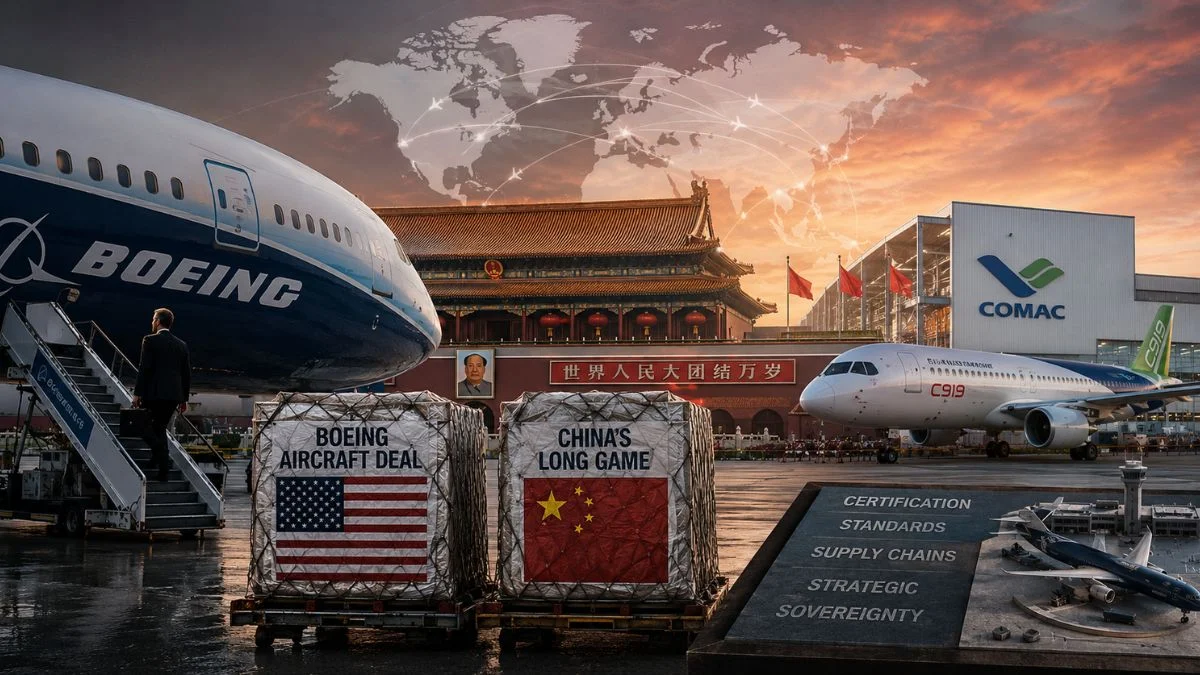
The arrival of Boeing chief executive Kelly Ortberg in Beijing alongside the delegation accompanying Air Force One was intended to symbolise continuity in one of the world’s most commercially valuable industrial relationships. Washington arrived with the expectation of selling aircraft. Beijing, however, was negotiating from an entirely different strategic horizon. Beneath the optics of another major Boeing order sat a far more consequential geopolitical calculation involving technological sovereignty, industrial insulation, regulatory influence, and the gradual restructuring of global aviation power away from Western dominance.
The latest Boeing agreement with China has understandably generated headlines centred on commercial recovery, aviation demand and diplomatic thaw. Yet any interpretation confined to aircraft sales fundamentally misunderstands the deeper architecture of Chinese state planning. China is not merely purchasing aircraft because it lacks domestic alternatives. It is purchasing time. More importantly, it is purchasing strategic breathing room while it constructs an aviation ecosystem designed ultimately to reduce dependence upon the United States and Europe. The parallels with 2017 are impossible to ignore. During Donald Trump’s earlier visit to Beijing, China signed agreements involving approximately 300 Boeing aircraft. At the time, many within Washington interpreted the order as proof of enduring American industrial leverage over China. In retrospect, that reading now appears remarkably superficial. While Boeing celebrated export success, Beijing accelerated an industrial policy programme aimed explicitly at reducing reliance upon precisely such Western aviation dependence. The current agreement demonstrates not the failure of that ambition, but the reality that industrial decoupling within advanced aerospace manufacturing requires far longer timelines than political rhetoric in either Washington or Beijing often acknowledges publicly.
China still requires Boeing aircraft because the structural realities of commercial aviation remain unforgiving. Passenger growth across Chinese domestic aviation markets continues at extraordinary scale. Major metropolitan corridors, regional connectivity networks, cargo logistics and tourism expansion all require rapid fleet enlargement. Chinese airlines simply cannot wait for industrial nationalism to mature at a pace suitable for state propaganda. They require aircraft that are immediately operational, globally serviceable, financially supportable and technically reliable.
That commercial reality continues to preserve Boeing and Airbus as operationally indispensable players within Chinese civil aviation. The state backed Commercial Aircraft Corporation of China, more commonly known as Comac, has unquestionably advanced further than many Western analysts predicted a decade ago. Yet the C919 programme still remains materially dependent upon foreign technological inputs, Western certification frameworks and supply chain ecosystems rooted largely in the United States and Europe. Much political commentary surrounding Comac frequently descends into simplistic binaries involving either imminent Chinese dominance or inevitable Chinese failure. Neither position survives serious industrial scrutiny. The truth is considerably more complex and strategically uncomfortable for the West. China has not yet achieved aviation independence, but it has also moved substantially beyond symbolic experimentation. The gap between technological delay and strategic abandonment is precisely where the present geopolitical significance lies.
The C919’s dependence upon foreign systems remains extensive. The aircraft relies heavily upon internationally sourced avionics, systems architecture and perhaps most critically, the Leap 1C engine produced through the CFM International joint venture involving General Electric and Safran. This dependence creates profound strategic vulnerability because modern aerospace manufacturing is not simply about assembling aircraft fuselages. It involves mastery over thousands of highly specialised industrial processes protected by export controls, intellectual property regimes, certification systems and national security laws.
Washington’s decision to suspend exports relating to the Leap 1C engine represented far more than a narrow trade restriction. Legally, the measure sits within the broader framework of United States export control architecture, including the Export Control Reform Act of 2018, the International Emergency Economic Powers Act and regulations administered under the Export Administration Regulations regime overseen by the Bureau of Industry and Security. Politically, however, the move confirmed Beijing’s deepest strategic concern, namely that reliance upon foreign aerospace technology exposes China to potentially existential supply chain coercion. Within Beijing’s policy establishment, this issue is no longer framed merely as an industrial challenge. It is viewed through the lens of national security resilience. The logic mirrors Chinese thinking surrounding semiconductors, telecommunications infrastructure and advanced artificial intelligence. If critical technologies can be interrupted by foreign governments during periods of geopolitical tension, then technological dependence becomes strategically intolerable regardless of commercial efficiency. This explains why Chinese policymakers continue supporting Comac despite its slower than expected progress. Western observers often underestimate the patience embedded within Chinese industrial strategy. Beijing routinely accepts prolonged periods of inefficiency, financial underperformance and technological inferiority if those costs contribute towards eventual strategic autonomy. Commercial logic and state logic do not always operate upon identical timelines. From an advocate’s perspective, particularly one familiar with international trade disputes, state aid controversies and industrial regulation, the Chinese aviation strategy increasingly resembles a carefully layered sovereign capability doctrine rather than a conventional commercial enterprise. Western legal frameworks have long struggled to confront such models because they operate across blurred boundaries involving state financing, political direction, national security policy and commercial market participation.
The World Trade Organization framework was not designed to effectively regulate strategic competition between state capitalist systems and liberal market economies within sectors deemed essential to national power. This limitation became painfully evident during the decades long Boeing Airbus subsidy disputes before the WTO. Both the United States and the European Union accused each other of unlawful state support while simultaneously recognising privately that aerospace manufacturing cannot realistically survive without extensive governmental backing. China enters this contested landscape with a structurally different advantage. Beijing does not need Comac to dominate global aviation markets immediately. It merely requires sufficient domestic penetration and selective international adoption to ensure strategic viability. This distinction is frequently misunderstood within Western analysis.
The obsession with whether the C919 will secure rapid Federal Aviation Administration or European Union Aviation Safety Agency certification often overlooks broader geopolitical realities. Certification undeniably matters because aviation safety depends upon institutional conservatism and regulatory credibility. Yet aviation certification has never existed in a political vacuum. Regulators respond not only to engineering data but also to institutional trust, liability exposure, diplomatic context and strategic relationships.
No regulator will publicly acknowledge geopolitical bias because doing so would undermine the legitimacy of the international aviation safety system. Nevertheless, industry participants understand the underlying reality perfectly well. A Chinese manufactured passenger aircraft entering American or European skies carries strategic sensitivities fundamentally different from aircraft originating in Canada or Brazil.
This reality creates an uncomfortable legal and diplomatic tension. Western governments insist that aviation certification decisions remain purely technical. China increasingly argues that certification processes can become politicised barriers restricting market access. The resulting friction may eventually produce significant disputes involving international trade law, bilateral aviation agreements and potentially even retaliatory certification policies. Yet the larger strategic question is whether Western certification ultimately matters as much as many analysts assume. The future geography of aviation growth may substantially weaken the West’s traditional regulatory leverage. The fastest expanding aviation corridors over the coming decades are expected across Southeast Asia, the Gulf and substantial regions of Africa. Airlines operating routes such as Jakarta to Kuala Lumpur, Nairobi to Addis Ababa or Lagos to Johannesburg confront commercial realities shaped heavily by financing structures, operational economics and infrastructure support. China understands this dynamic exceptionally well. Through the Belt and Road Initiative and related infrastructure diplomacy mechanisms, Beijing has spent years constructing transport relationships across emerging markets. Airports, logistics corridors, financing agreements and technical cooperation frameworks increasingly intersect with broader Chinese commercial influence. Aviation is now being integrated into this architecture.
The strategic significance of this development cannot be overstated. Commercial aviation creates long term industrial dependencies extending far beyond aircraft acquisition. Airlines purchasing aircraft also purchase training ecosystems, maintenance systems, spare parts supply chains, software integration frameworks and operational standards. Over time, these systems shape institutional habits, regulatory familiarity and technical loyalties.
This is precisely how American and European aerospace dominance consolidated itself over previous decades. Boeing and Airbus aircraft effectively exported Western aviation standards alongside physical products. Pilots, engineers, regulators and airport operators across the world became institutionally embedded within Western aerospace ecosystems.
China now seeks to replicate aspects of this model. Even before Comac reaches full technical parity with Boeing or Airbus, China benefits enormously from operating mature Western aviation systems domestically. Chinese pilots train within operational cultures shaped by American standards. Maintenance crews learn procedural discipline grounded in Boeing and Airbus certification requirements. Airports evolve around sophisticated global aviation demands. Over time, this produces an industrial workforce fluent in modern aviation operations. Comac therefore inherits not an undeveloped domestic ecosystem, but one partially incubated through decades of engagement with Western aerospace systems. That reality alone significantly strengthens China’s long term position.
There is another dimension frequently neglected within public discussion, namely the role of aviation finance and sovereign credit relationships. Aircraft acquisition is rarely a straightforward purchase. It involves leasing arrangements, export credit structures, insurance systems and cross border financial guarantees. China possesses growing capacity to integrate aviation financing into broader geopolitical relationships, particularly across developing economies already dependent upon Chinese infrastructure investment.
This creates potential pathways through which Comac aircraft may gain footholds within markets where financing accessibility matters as much as brand prestige. Airlines operating within capital constrained environments may increasingly evaluate Chinese aircraft not solely through engineering comparisons but through broader economic packages involving infrastructure support, maintenance cooperation and sovereign lending relationships. The implications extend well beyond aviation. If substantial parts of the Global South gradually begin operating within Chinese centred industrial ecosystems, then Western influence over international standards may erode incrementally rather than dramatically. Such transitions rarely occur through sudden replacement. They emerge gradually through overlapping systems, parallel standards and shifting commercial dependencies. The Boeing agreement therefore carries profound irony. The aircraft orders provide immediate relief for Boeing while simultaneously helping stabilise the very aviation ecosystem within which China continues developing long term alternatives. Beijing is effectively using Western aerospace capacity to sustain domestic growth while buying time for strategic substitution.
For Boeing itself, the situation presents extraordinary complexity. The company urgently requires Chinese market access following years of crisis involving the 737 MAX grounding, supply chain disruptions, production challenges and reputational damage. China remains too commercially important for Boeing to ignore. Yet Boeing increasingly operates within geopolitical conditions over which it exercises minimal control.
American aerospace corporations now find themselves positioned uncomfortably between shareholder obligations and national security priorities. Washington simultaneously expects these companies to compete globally while supporting broader strategic containment objectives aimed at limiting Chinese technological advancement. The contradiction becomes increasingly difficult to manage. Historically, American multinational corporations often acted as stabilising forces within United States China relations because commercial integration created mutual dependency. That assumption now appears increasingly fragile. Strategic competition has expanded beyond tariffs and trade balances into core industrial sectors involving semiconductors, artificial intelligence, telecommunications and aerospace. The legal architecture underpinning this competition continues evolving rapidly. Export controls, investment screening mechanisms, sanctions compliance obligations and national security reviews increasingly shape corporate decision making. The Committee on Foreign Investment in the United States framework, outbound investment restrictions and technology transfer scrutiny all reflect a broader shift towards economic securitisation. China, meanwhile, has responded through its own legal instruments including the Anti Foreign Sanctions Law, the Export Control Law and various data security regulations designed both to shield domestic industries and retaliate against perceived Western coercion. The result is a progressively fragmented global commercial environment in which multinational corporations face conflicting regulatory obligations across competing geopolitical blocs.
Within this environment, aviation occupies uniquely sensitive territory because it combines civilian commerce with technologies carrying potential military significance. Aerospace manufacturing capabilities invariably overlap with strategic defence considerations involving materials science, propulsion systems, navigation technologies and advanced manufacturing techniques. Consequently, debates surrounding Boeing and Comac cannot be understood merely through the prism of commercial competition. They form part of a broader struggle over technological sovereignty and industrial hierarchy within the twenty first century global order.
As someone who has spent years observing international commercial disputes, one recurring lesson becomes impossible to ignore. Nations rarely pursue strategic autonomy because existing dependence is economically irrational. They pursue it because dependence eventually becomes politically dangerous. China’s aviation ambitions should therefore not be interpreted as temporary industrial vanity projects. They represent a calculated response to a geopolitical environment in which Beijing increasingly assumes future technological access cannot be guaranteed by foreign powers. Whether Western policymakers agree with that perception is ultimately irrelevant. Chinese policy is now clearly being structured around it. The central question is no longer whether Comac will immediately challenge Boeing or Airbus across every major international market. That framing misunderstands the trajectory entirely. The more realistic and strategically significant question is whether China can establish sufficiently credible alternative aviation systems across enough emerging markets to reduce Western standard setting dominance over time.
If that process succeeds even partially, the consequences could reshape global industrial governance across sectors far beyond aviation. Standards create influence. Infrastructure creates dependency. Training systems create institutional loyalty. Regulatory familiarity creates trust. These dynamics accumulate gradually until geopolitical shifts that once appeared improbable suddenly become structurally entrenched.
The Boeing order announced in Beijing does not interrupt this trajectory. In many respects, it sustains it. China still requires Boeing aircraft today because industrial transformation at aerospace scale cannot occur overnight. Yet the deeper strategic reality is that Beijing appears increasingly determined to ensure it will not require such dependence indefinitely. Washington may continue asking whether China can truly build a competitive aviation industry capable of challenging Western incumbents. The more unsettling possibility for the West is that by the time the definitive answer emerges, the geopolitical balance underpinning that question may already have changed beyond recognition.