

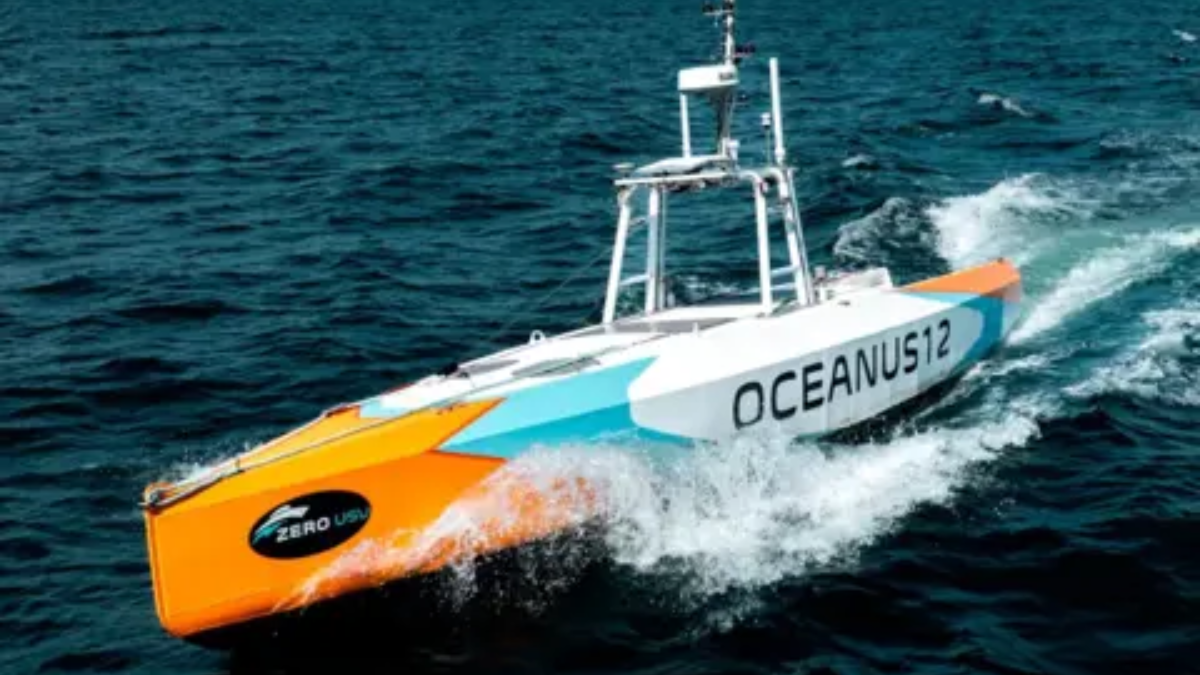
ZeroUSV is considering moving its operations overseas, not because its technology failed, but because the UK’s regulatory and procurement environment appears to be making it harder to turn a successful demonstration into a scalable defence business. The company’s Oceanus12 autonomous surface vessel (USV) performed strongly in a NATO exercise off Portugal, yet its leadership has warned that without regulatory change, it may need to relocate manufacturing abroad.
What actually happened
Oceanus12, a 12-metre autonomous speedboat drone developed by the British start-up ZeroUSV, took part in NATO’s REPMUS (Robotic Experimentation and Prototyping Enhanced Maritime Unmanned Systems) exercise off the coast of Portugal. During the trial, the vessel reportedly deployed and recovered special acoustic sensors without any human involvement, a capability directly relevant to anti-submarine warfare (ASW). This matters because ASW is a core NATO priority, especially in the High North, where Russian submarine activity has increased. An autonomous platform that can independently handle sensor deployment and recovery reduces risk to crews, extends patrol endurance, and lowers the cost of maintaining persistent underwater surveillance. ZeroUSV has also described Oceanus12 as a mission-agnostic, long-range USV offered under a “charter” model, meaning the company aims to operate fleets rather than just sell hardware. That business model depends on being able to manufacture, certify, and deploy vessels at scale.
Why the company is considering leaving
The clearest reason ZeroUSV is looking overseas is regulatory friction. A Royal Institution of Naval Architects (RINA) document quoting the company states that unless the regulatory situation in the UK changes, ZeroUSV will have to “seriously consider moving our manufacturing base out of the UK.” For a defence-related start-up, regulation affects everything from sea trials and safety certification to export controls and integration with military systems. Delays or uncertainty in any of these areas can stall growth even when the underlying technology works. The issue starkly: the drones can “take on Putin” but cannot “beat British bureaucrats.” That phrase captures a broader complaint among UK defence-tech firms: they can win technical trials but struggle to move from prototype to production because of slow approvals, complex rules, and a cautious procurement culture. A second factor is market access. The United States and some other allied markets often offer larger defence budgets, faster procurement pipelines, and more direct pathways from demonstration to contract. For a company building autonomous maritime systems for NATO use, relocating part of its operations to a market with more aggressive adoption can mean quicker revenue, more test opportunities, and stronger industrial partnerships. A third factor is operational practicality. ZeroUSV’s charter-style model requires ongoing maintenance, support, and fleet expansion. If UK rules make it harder to build, certify, or export vessels efficiently, the company may conclude that an overseas base offers a more predictable environment for scaling.
What this means for UK defence innovation
This situation is a warning sign for British defence technology. The UK can clearly produce world-class autonomous systems, as the Portugal exercise shows. But if regulation and procurement do not keep pace, the country risks losing the very companies it helps to nurture. That would mean Britain gets the prestige of invention without the long-term industrial benefit of manufacturing, jobs, and export revenue. For ZeroUSV, the potential move is not a rejection of British engineering. It is a response to a business climate that may be making growth at home too difficult. The company’s success in Portugal proves the technology works; the relocation question is about whether the UK can provide the speed, certainty, and support needed to keep that technology and its industrial base on British soil.