

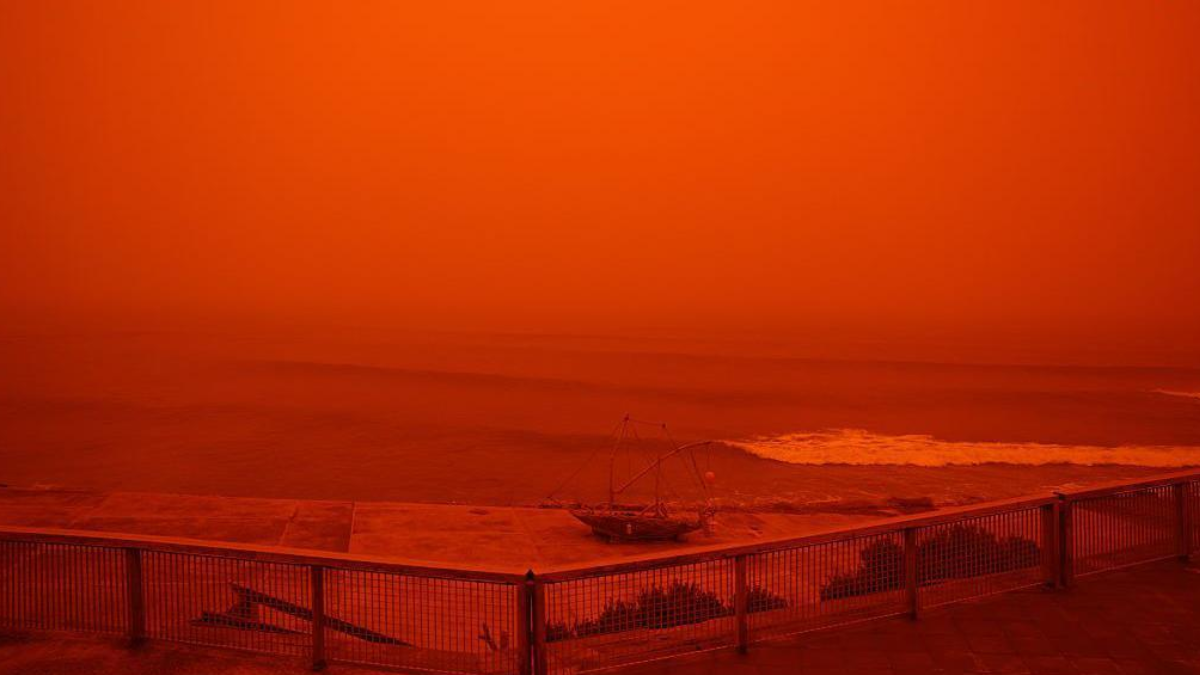
Crete has been engulfed by a powerful Saharan dust storm that turned its normally bright blue skies into an extraordinary wash of red, orange and brown, creating a scene that looked more like a planetary eclipse than a Mediterranean weather event. The dust plume, carried northward from North Africa by strong winds, spread across the island and dramatically reduced visibility while also altering the colour of the sky as sunlight was scattered through dense airborne particles. What makes the event especially striking is that it was not just a visual spectacle but part of a wider weather system that brought disruption across the island, including poor air quality, transport concerns and local warnings for residents. In practical terms, this kind of dust invasion can affect health, travel and daily life just as much as it fascinates the public with its dramatic appearance.
Why the sky turned red
The reason for the blood red effect is atmospheric physics, not anything supernatural. Strong winds lifted huge volumes of dust from the Sahara and carried it over the Mediterranean, where the particles dispersed sunlight and filtered out much of the blue spectrum. That left the longer red and orange wavelengths more visible, producing the striking sky that has now circulated widely in photographs and video. These events are not rare in southern Europe, but the intensity can vary sharply from one storm to the next. When dust concentration is high enough, it can darken the sky, tint the sun, and create a surreal haze over towns, coastlines and mountain ranges. In Crete’s case, the effect was especially dramatic because the dust cloud combined with unstable weather, making the island look as though it had been placed under a red filter.
The hidden health and safety risks
The visual drama masks a more serious public health issue. Saharan dust can irritate the eyes, throat and lungs, particularly for people with asthma, chronic respiratory disease or other vulnerabilities. Fine particles can travel deep into the airways, which is why authorities often issue warnings when such storms approach populated areas. There are also transport and infrastructure risks. Dust reduces visibility for road users and aircraft, while combined storm conditions can trigger flooding and ferry disruption, especially on island routes that depend heavily on maritime links. That makes the event more than a meteorological curiosity. It becomes a test of emergency planning, communications and local resilience.
What this means for the wider region
Crete’s red sky is part of a broader pattern in which Mediterranean weather systems increasingly move dust, heat and instability across national borders. The island sits on a climatic frontier between Europe and North Africa, so it often experiences the immediate effects of Saharan dust before much of the continent does. For tourism-dependent economies, that creates a practical challenge: the same atmospheric conditions that produce spectacular images can also disrupt travel, outdoor activity and daily life. The legal and policy angle is that extreme weather events now require faster coordination between meteorological agencies, civil protection authorities and transport operators. When a dust storm can close schools, alter ferry schedules and degrade air quality in a matter of hours, climate resilience is no longer abstract. It is a governance issue. In the end, Crete’s blood red skies are both beautiful and unsettling. They show how natural forces can briefly transform a Mediterranean landscape into something almost otherworldly, while also reminding us that the line between visual spectacle and environmental risk is often very thin.