

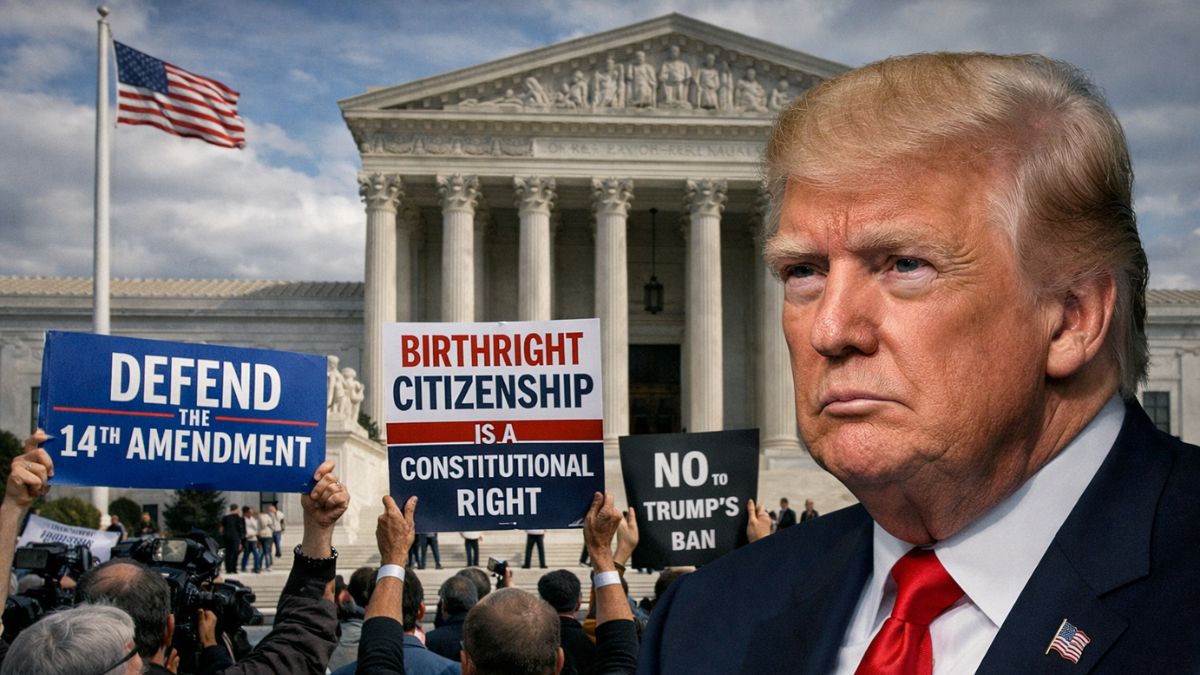
The constitutional foundations of citizenship in the United States face one of their most consequential tests in modern history as the Supreme Court of the United States hears arguments on President Donald Trump’s attempt to restrict birthright citizenship. At stake is not merely an executive policy, but the enduring interpretation of the Citizenship Clause under the Fourteenth Amendment to the United States Constitution, a provision that has defined American nationhood since the aftermath of the Civil War. This litigation represents a direct confrontation between executive power and constitutional text, raising profound questions about sovereignty, immigration, and the legal meaning of allegiance.
The dispute arises from an executive order issued by Trump on his first day back in office, directing federal agencies to deny citizenship to children born on United States soil if neither parent is a citizen or lawful permanent resident. This policy seeks to fundamentally alter the long standing doctrine of jus soli, under which birth within the territory has been sufficient to confer citizenship, subject only to narrow and historically recognised exceptions.
A federal district court blocked the directive, holding that it violates both the Fourteenth Amendment and federal statutes codifying birthright citizenship. The administration has now appealed, placing the matter before the Supreme Court for authoritative resolution. Notably, Trump is expected to attend the oral arguments, a move without modern precedent. The court itself has observed that no sitting president has attended arguments in its current building era, underscoring the extraordinary nature of the proceedings.
At the heart of the case lies the interpretation of a single, yet decisive, constitutional phrase: “subject to the jurisdiction thereof.” The Citizenship Clause provides that all persons born or naturalised in the United States, and subject to its jurisdiction, are citizens. For over a century, courts and scholars have interpreted this provision broadly, recognising that nearly all individuals born on US soil fall within its ambit. The Trump administration, however, advances a narrower construction. It argues that jurisdiction must be understood as requiring “primary allegiance” to the United States, a condition it claims is satisfied only by citizens and lawful permanent residents. Under this theory, children born to undocumented immigrants or individuals present on temporary visas would fall outside constitutional protection. This interpretation, if accepted, would mark a dramatic doctrinal shift, effectively introducing a parental status requirement into a clause historically understood to operate independently of such considerations.
The challengers rely heavily on the landmark decision in United States v. Wong Kim Ark, in which the Supreme Court affirmed that a child born in the United States to foreign parents is entitled to citizenship under the Fourteenth Amendment. In that case, the Court grounded its reasoning in English common law principles of territorial birthright, holding that the Constitution adopts a broad jus soli framework. The administration seeks to distinguish this precedent by emphasising that Wong Kim Ark’s parents had a form of permanent domicile in the United States. Yet, this distinction faces significant doctrinal resistance. The prevailing judicial understanding has treated Wong Kim Ark as establishing a near categorical rule, subject only to exceptions such as children of diplomats or enemy occupiers. Any departure from this precedent would require the Court to either reinterpret or substantially limit one of its most settled constitutional holdings.
The potential consequences of a ruling in favour of the administration are immense. Estimates suggest that up to 250000 children born annually in the United States could be affected. Beyond this immediate cohort, millions of families may face new legal burdens to establish the citizenship status of their children. Such a shift would introduce significant administrative complexity and legal uncertainty. Questions of proof, documentation, and parental status would become central to citizenship determination, potentially altering the operational landscape of immigration enforcement and civil registration. Moreover, the policy raises concerns about the creation of a legally precarious class of individuals born within the United States but denied formal membership in the polity.
The Fourteenth Amendment was ratified in 1868 in direct response to the infamous decision in Dred Scott v Sandford, which had denied citizenship to people of African descent. By embedding birthright citizenship in the Constitution, the framers of the amendment sought to establish an inclusive and durable definition of national belonging. Any reinterpretation of this provision must therefore be viewed against its historical purpose: to prevent exclusionary citizenship regimes and to guarantee equal status to those born within the nation’s territory. Trump’s policy, critics argue, risks reintroducing a conditional framework of citizenship that the amendment was expressly designed to eliminate.
The Supreme Court, currently holding a 6 to 3 conservative majority, has in recent terms shown a willingness to engage robustly with questions of executive authority and immigration policy. It has previously allowed certain Trump era immigration measures to proceed on an interim basis while legal challenges unfold. However, the present case is distinct in both scale and constitutional significance. It does not concern statutory interpretation or administrative discretion, but the meaning of a constitutional guarantee itself. The Court’s ruling, expected by the end of June, will therefore have enduring implications not only for immigration law but for constitutional interpretation more broadly.
This litigation encapsulates a fundamental tension within American constitutionalism: the balance between sovereign control over membership and the enduring promise of equal citizenship. If the Court upholds the administration’s position, it would redefine the legal architecture of citizenship, shifting from a place based principle to one conditioned by parental status and allegiance. If it rejects the policy, it will reaffirm a century old understanding that has served as a cornerstone of American identity. In either scenario, the decision will resonate far beyond the courtroom, shaping the contours of citizenship, belonging, and constitutional meaning for generations to come.