

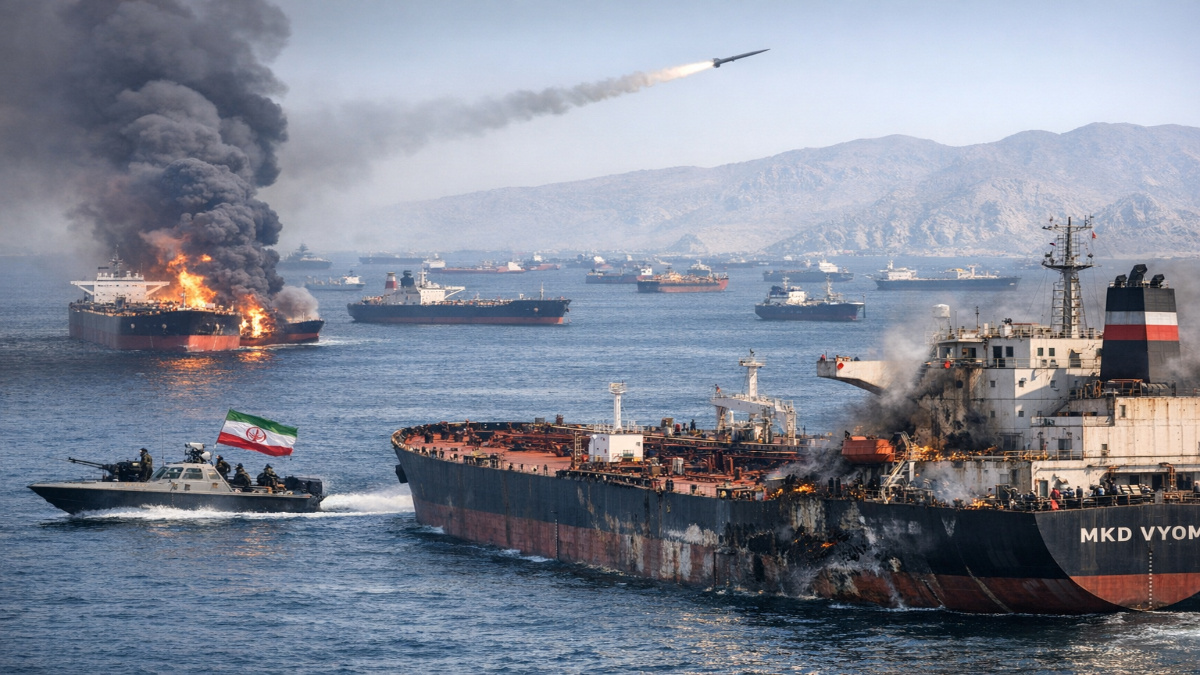
An intensification of the Gulf has taken the world energy markets to the edge. The U.S. and Israeli attacks on Iranian targets triggered revenge operations that directly threatened the commercial shipping industry and caused traffic jams in one of the most important maritime chokepoints in the world. At the beginning of the aftermath, over 200 commercial vessels such as oil tankers and liquefied natural gas carriers anchored on the adjacent waters as operators scramled to assess the security risks and insurance claims.
What exactly happened?
The crisis was developed following the coordinated military attacks by Washington and Tel Aviv on Iranian infrastructure and strategic assets. In several hours, the maritime security organizations started reporting a chain of events involving the commercial ships that were passing close to the Gulf of Oman and along the approaches to the Strait of Hormuz.
The damage of at least three tankers was a part of the events that were closely synchronized. The U.S.-sanctioned Palau-flagged oil tanker was attacked off the Musandam peninsula in Oman, damaging four crewmen. Meanwhile, the Marshall Islands-flagged crude tanker MKD VYOM was struck by a projectile, which maritime security sources said was approximately 44 nautical miles northwest of Muscat, when entirely loaded with cargo. The UK Maritime Trade Operations monitoring body reported an explosion in a merchant vessel in the same general area.
More to the west, off the UAE port of Jebel, a tanker escaped with minor damage as debris of an aerial interception fell close to it overnight in Iranian retaliatory attacks on Gulf states. Another oil-bunkering ship was also reported to have been damaged off Emirati coast.
The most significant event came a little later: Iran declared that it stopped the navigation of the Strait of Hormuz due to security reasons and retaliatory position. Though such a declaration was open to maritime realities as to whether it was enforceable, the psychological and commercial effect was instant. Tanker operators started to suspend crude, fuel, and LNG transportation in the narrow passage.
The Strait of Hormuz, and its’s importance
The Strait of Hormuz is considered to be the most strategically important energy transit route across the globe. Its narrow shipping lanes receive about 20 percent of the total oil supply in the world on a daily basis. It is the major export route of Saudi Arabia, the United Arab Emirates, Iraq, Kuwait, and Qatar, and also the Iran itself.
Any prolonged interference with shipping in this passage has disproportionately large implications. Any short-term disruptions will cause oil prices to skyrocket due to the close balance between demand and supply in the world. Markets respond to both real physical losses as well as perceived risk.
Compared to other energy routes, which have alternative pipelines or diversified routes, Hormuz is hard to scale around. Although Saudi Arabia and the UAE have a limited capacity of pipeline that can divert part of the exported crude oil to non-Gulf ports, the option is not able to respond to a total maritime blockade.
The short-term effect on the world oil markets
The response of the market was fast. Energy traders also started to add a geopolitical risk premium, which would occur in case of supply interruption. The rates of war-risk insurance are likely to skyrocket as the underwriters review coverage in the Gulf region. The industry estimates marine hull insurance premiums may increase by 25-50 percent in the short term, and this will further add to the transportation prices.
The U.S. Maritime Administration recommended that any American flagged, owned, or crewed ship should avoid entering the Strait and should keep a safe distance between them and U.S. naval assets to avoid being mistaken in strained operating circumstances. There was also the threat of the use of naval mines, a long held Iranian asymmetric strategy, in small shipping lanes by security analysts.
Effective supply can be tightened by shipping delays alone. In cases where over 200 ships anchor or divert, cargo is held up, refinery programs are upset and downstream fuel markets are pressurized. In such circumstances, spot crude prices often skyrocket, and LNG markets, which are volatile in any case because of seasonal demand cycles, may become even more volatile.
Russia’s warning towards market shock
With the mounting crisis, Moscow had made a stern warning on the economic impacts of a long-term shutdown of the Strait of Hormuz to the world. The Russian Foreign Affairs warned that the move to block the waterway would cause a destabilisation of global oil and gas markets which would result in a devastating price shock and massive economic repercussions.
Russian government also denounced what it termed as murder of the Supreme Leader of Iran, Ali Khamenei and senior officials terming it as a breach of international law and the sovereign states. Although the overall geopolitical context is still developing, the message of Moscow highlighted the legal and economic issues.
To Russia, the game is complicated. On the one hand, the increase in oil prices can bring positive changes to Russian export revenues, since there are still Western sanctions. Conversely, unchecked volatility is threatening to slow down the global economy, eventually reducing the energy demand and producing deterioration among the world producers.
The wider oil market environment
The market of oil was already treading a thin line in the world markets even before this intensified. OPEC + production control, lopsided demand recuperation in Asia and Western sanctions on various manufacturers have all drawn in spare capability reserves.
Specifically, despite the extensive sanctions, Iranian crude still finds its way to markets, usually via indirect routes, to Asian consumers. Should the exports of Iran be reduced or completely stopped as a result of the military build-up or destruction of infrastructure, a number of several hundred thousand barrels per day may be essentially eliminated as an item in the world supply pool.
What is more crucial is the perception factor. Futures contracts are priced by traders depending on expectations. The possibility of a prolonged Gulf war puts forward curves under the threat of uncertainty, expanding price spreads and escalating costs of hedging.
The Venezuela and The Iran factor behind
The oil market in the world has already been limited by the reduced Venezuelan output over the past years. The ability of Venezuela to produce and export crude at record levels has been severely curtailed by sanctions, political instability and infrastructure degradation.
The Venezuelan heavy crude grades are especially significant to some refineries that are designed to handle them. At the time when Venezuelan barrels fall, the refiners have to find alternative heavy grades, which can be found in the Middle East or Canada, which tightens these markets.
In the event that Iranian exports were also marginalized or killed by conflict escalation, a joint loss of Venezuelan and Iranian barrels would take out a major portion of approved or reduced crude in circulation. This would increase competition among buyers in the remaining supplies and would most probably drive the benchmark prices upwards.
In addition, the Gulf manufacturers would have a higher strategic leverage. In theory, Saudi Arabia and the United Arab Emirates may increase production to cover losses however, they have a limited spare capacity. The operation and political considerations in OPEC+ also come with the rapid production increases.
LNG and Wider Energy Implications
Strait of Hormuz is not a mere oil artery, it is also a key LNG transit route, particularly in Qatari exports. Any form of threat to LNG shipping lanes may cause spill over effects on the European and Asian gas markets especially during peak seasonal demand.
The increased LNG prices would be transferred to electricity production, industrial production and inflation rates globally. Asia Energy-importing countries, which are already sensitive to the issue of supply security, may step up the diversification plans or indulge in strategic stockpiling.
Geopolitical Consequences
In addition to short-term price effects, the crisis may redefine the long-term energy flows. The long-term presence of instability in the Gulf can lead to the investment in other routes, such as the expansion of pipelines and the faster development of renewable energy sources.
Meanwhile, the scenario underscores the long-term geopolitical advantage of energy chokepoints. The ability or the plausible risk of interruption with such corridors is an effective strategic instrument.
In the case of Russia, it is a calculated calculus. Although publicly, Moscow threatens destabilization, long-term high oil prices would make the country strong in terms of its fiscal policy in the face of sanctions. Nevertheless, an extreme international recession caused by energy shocks would decrease the demand of Russian exports and become a burden on the world markets.
The insurance, Shipping and Risk Premiums
War-risk insurance markets are the primordial signs of geopolitical stress. Shipping expenses increase as insurers reprice the coverage of trips to high-risk areas. These expenses eventually find their way to the consumers through increased fuel and commodity costs.
Should insurers pull out cover all together including temporarily, shipping via the Strait would come to crawl. Charter rates would be soaring, and other lines would overload logistical networks.
Ultimately it’s time to manage
The recent increase is one of the gravest threats to the energy stability of the world in recent years. Having over 200 ships paralyzed, several tankers destroyed and navigation in the Strait of Hormuz virtually shut down, the oil and gas pipelines of the world are under acute strain.
The threat posted by Russia represents a larger worry that is shared by all countries involved in energy production and oil consumption: a long-term disturbance in the Gulf can destabilize not only the prices of oil but the entire world economy.
A further reduction in Iranian exports with the already reduced production in Venezuela would lead to sustained price growth. Although this approach could boost revenues of some producers, the wider global economy would be facing inflationary pressures, crises in supply chains and increased geopolitical tension.
The next few days will tell whether this crisis will continue to be a crisis that is sharp but a short-term shock or will become a structural turning point in the global energy geopolitics.