
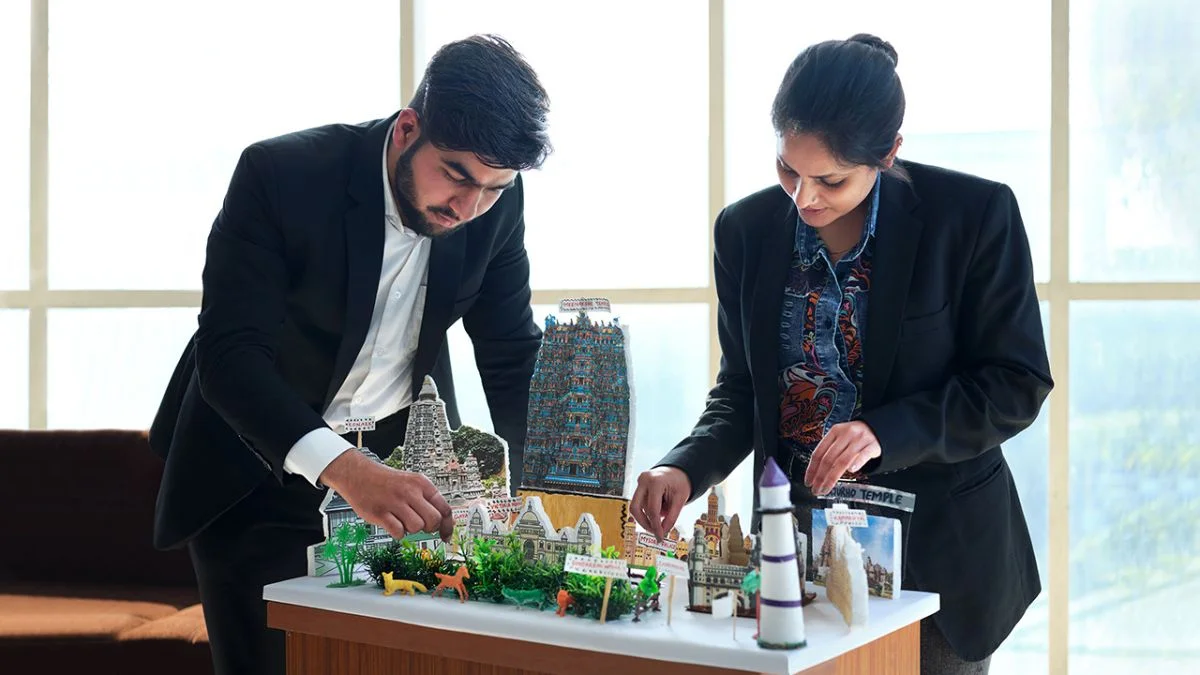
The world of interior design is much more than just the looks. It involves making spaces that contribute to improved living, work, and interaction of people with a combination of functionality, creativity, and technology. Contemporary interiors are supposed to be smart, sustainable, and flexible in accordance with the changing requirements of urban life, workplaces, and business spaces.
Due to the fast urbanization and changes in lifestyles, the need to have interior designers with a sense of design and technical expertise is more than ever. B.Sc. Interior Design has multiple possibilities for a career, such as residential and commercial, luxury hospitality, and intelligent office.
As per the global market research, the interior design industry is likely to expand at an average of above 5% CAGR until 2030 due to the need to house more people in cities, the popularity of smart homes, and the need to expand commercial infrastructure. The emergence of intelligent cities and co-working places has made professional interior designers with technical and digital skills highly in demand.
Why Interior Design is a Good Career Choice
B.Sc. interior design profession is changing. In the current world, designers are supposed to design spaces that are:
- Practical and Effective: Smart spatial planning makes sure that specific areas are designed in a manner that they are comfortable, useful, and accessible.
- Smart Interiors: The sleek interiors will be technologically featured with the use of automated lighting, air conditioning, and smart solutions in living.
- Conscious and Environmentally Friendly: The need to have materials and designs that will lessen the impact on the environment is on the rise.
These trends have broadened the field of B.Sc. Interior Design to other areas other than room decoration. Designers are now major participants in making user experiences better, increasing work-related productivity, and providing sustainable environments at home and in the workplace.
Important Modern Interior Designer Skills
The designers must have creative, technical, and analytical abilities to perform at the top level in this dynamic industry. Significant competencies are:
- Space Planning & Visualization: capability to design layouts that create a balance between beauty and functionality, both sketches and computer-aided modeling.
- Technical Design Software: Expertise in application programs like AutoCAD, SketchUp, 3D Max, and other professional-quality presentation programs of projects.
- Knowledge of Materials, Color, and Lighting: The knowledge of the various finishes, textures, color palette, and lighting used to create harmonious and aesthetic spaces.
- Smart and Modular Design Knowledge: Capacity to incorporate technology and modular designs that add functionality to contemporary spaces.
- Project Management / Portfolio Development: We have experience working on project concepts to completion, and we have also developed a good portfolio to be able to show our abilities to potential employers or clients.
The skills will make sure that the interior designers are ready to take up residential, commercial, hospitality, and retail projects with progressive and innovative solutions.
Employability Advantage:
Due to their high technical capability, including AutoCAD, 3D visualization and intelligent design integration, interior designers are paid 30-40 % more than designers whose understanding is only conceptual. Employers are also favoring candidates who have portfolio based learning with real world project exposure.
Career Opportunities
A graduate who has acquired knowledge in the field of smart and modern interiors can take a variety of career paths:
- Interior Designer and Space planner: This involves designing functional and aesthetically interesting homes, offices, hotels, and public spaces.
- 3D Visualizer and CAD Specialist: This position involves designing detailed renderings and technical drawings that can be used to present the projects to the client and implement the projects.
- Furniture and Lighting Designer: Creating personalized furniture and lights, as well as modular designs in line with interior ideas.
- Sustainable Design Advisor: Recommendation of sustainable materials, energy-saving, and intelligent technology.
- Project Coordinator or Design Manager: Project control and coordination of projects in terms of time, budget, and quality.
Such diversity of functions demonstrates that modern interior design cannot be reduced to the sphere of aesthetics only; it requires problem-solving, technical experience, and innovation.
Why Modern Interiors Need Special Training
The modern B.Sc. Interior Design is too complicated to have informal learning and training. Designers today must:
- Use intelligent technologies and automation.
- Know ergonomics and physical comfort.
- Striking a balance between aesthetics and functionality, and sustainability.
- Interact well with clients, contractors, and other professionals.
The specialized programs make sure that students are not only creative thinkers but also people who are ready to work in any industry and have the skills to make projects brilliantly efficient and innovative.
New Trends in Interior Design
It is important to be on top of the trends in the industry as a budding interior designer. The major trends that are shaping the profession are as follows:
- Smart Homes and Offices: IoT, light automation, and climate control.
- Biophilic Design: The interior design that uses natural elements to enhance wellbeing.
- Multi-functional Spaces: Fitting the smaller spaces with various functions.
- Sustainability of Materials: Focus on environmentally friendly finishes, recyclable materials, and energy-efficient solutions.
- Experiential Commercial Spaces: Developing experiences in retailing, hospitality, and co-working spaces that attract visitors.
These tendencies cause the demand for designers who should be flexible, technology-oriented, and environmentally friendly, which is why special training is necessary.
Trend-Driven Industry Shift:
- Close to 60 % of all new residential developments have some type of smart automation.
- Biophilic design has been demonstrated to benefit productivity in the workplace by a maximum of 15 % and decrease stress-related factors.
- Multi-functional interiors are also a necessity as urban living areas are reduced by an average of 10-15% being shrunk in the metro cities.
Why AAFT Noida is an Interior Designer Launchpad
To students who want to become professional interior designers, are prepared to take the future, B.Sc. Interior Design in Smart and Modern Spaces is the ultimate opportunity offered by AAFT Noida. The program will incorporate practical training, industry tools of the trade, and a taste of smart and modern design, and make the graduates ready to compete and succeed in a competitive and fast-changing market.
Through admission to AAFT Noida, they will acquire skills, mentorship, and experience in a portfolio-ready state, to move out with confidence into the career ahead in residential, commercial, and hospitality interior design, ready to meet the demands of the smart spaces of tomorrow.
For Media Inquiries, Contact:
AAFT Noida
Marwah Studios
FC-14/15, Sector-16A
Noida Film City, Uttar Pradesh, India
Phone: 08031443425 / 08031443452 / 09811014536 / 08068230367
Email: help@aaft.com
