
The renewable methanol market is expanding rapidly as industries shift toward green fuels and sustainable feedstocks, with the U.S. market projected to grow from USD 0.67 billion in 2025 to USD 11.37 billion by 2035, supported by carbon regulations, green hydrogen adoption, and power-to-methanol technologies.
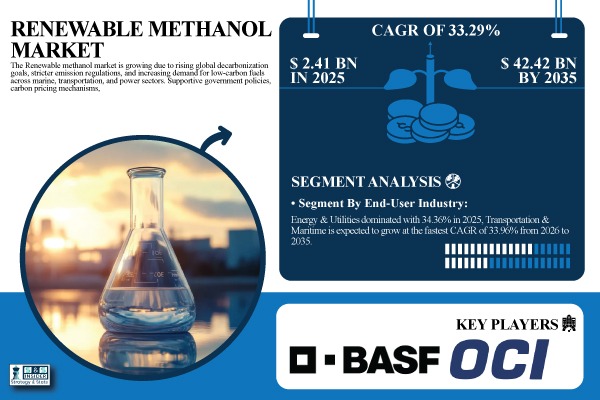
Austin, Feb. 06, 2026 (GLOBE NEWSWIRE) — The Renewable Methanol Market size was valued at USD 2.41 Billion in 2025 and is projected to reach USD 42.42 Billion by 2035, growing at a CAGR of 33.29% during the forecast period of 2026-2035.
The renewable methanol market is developing due to rising global decarbonization goals, stricter emission restrictions, and increased demand for low-carbon fuels across marine, transportation, and power sectors. Supportive government regulations, carbon pricing mechanisms, and incentives for green fuels are driving adoption.

Download PDF Sample of Renewable Methanol Market @ https://www.snsinsider.com/sample-request/9622
The U.S. Renewable Methanol Market size was valued at USD 0.67 Billion in 2025 and is projected to reach USD 11.37 Billion by 2035, growing at a CAGR of 32.75% from 2026 to 2035.
Strong federal and state decarbonization policies, growing demand for low-carbon marine and transportation fuels, increased investment in carbon capture and green hydrogen technologies, and growing industrial manufacturer adoption of sustainable chemical feedstocks are all contributing factors to the growth of the U.S. renewable methanol market.
Global Decarbonization and Maritime Demand Propel Market Growth Globally
The global renewable methanol market is primarily driven by rapid decarbonization initiatives across energy, transportation, and chemical industries. Governments worldwide are enacting tough emission rules, carbon pricing mechanisms, and renewable fuel requirements, pushing the shift from fossil-based methanol to low-carbon alternatives. Strong expansion in the maritime sector, encouraged by International Maritime Organization (IMO) emission standards, is dramatically increasing demand for renewable methanol as a greener marine fuel. Additionally, increased use of green chemicals by chemical and petrochemical industries, together with developments in carbon capture utilization (CCU), green hydrogen, and power-to-methanol technologies, are enhancing production efficiency and scalability.
Segmentation Analysis:
By Feedstock
Biomass (agricultural residues, forestry waste) dominated with 45.24% in 2025 supported by established conversion technologies and wide availability. Municipal Solid Waste (MSW) is expected to grow at the fastest CAGR of 34.11% from 2026 to 2035 as governments promote waste-to-fuel solutions to reduce landfill dependence and emissions.
By Production Technology
Gasification-to-Methanol dominated with 41.12% in 2025 due to its commercial maturity and successful deployment in biomass and waste-based projects. Power-to-Methanol (electrochemical using renewable H₂ & CO₂) is expected to grow at the fastest CAGR of 34.01% from 2026 to 2035 due to increased green hydrogen production, and stronger carbon utilization policies.
By Application
Transportation Fuels (marine, aviation, road blending) dominated with 40.73% in 2025 driven by its use in power generation, energy storage solutions, and grid support applications. It is expected to grow at the fastest CAGR of 33.80% from 2026 to 2035 as shipping companies transition to low-emission fuels.
By End-User Industry
Energy & Utilities dominated with 34.36% in 2025 due to tightening emission regulations and the need for drop-in low-carbon fuel alternatives. Transportation & Maritime is expected to grow at the fastest CAGR of 33.96% from 2026 to 2035 as more methanol-compatible vessels and engines enter service.
If You Need Any Customization on Renewable Methanol Market Report, Inquire Now @ https://www.snsinsider.com/enquiry/9622
Regional Insights:
With a market share of over 36.63% in 2025, North America dominated the global renewable methanol market thanks to robust regulatory backing, rising demand for clean fuel, and sophisticated production infrastructure.
The market for large-scale AI models is predicted to develop at the quickest rate in the Asia Pacific area between 2026 and 2035 due to the region’s fast digital transformation, growing industry adoption of AI, and government-backed programs encouraging AI innovation and research.
Key Players:
- Methanex Corporation
- Carbon Recycling International (CRI)
- Enerkem Inc.
- BASF SE
- Proman AG
- OCI N.V.
- BioMCN
- Södra
- Advent Technologies
- Thyssenkrupp AG
- Veolia
- WASTEFUEL
- Mitsubishi Gas Chemical Company
- SABIC
- Celanese Corporation
- Nordic Green ApS
- Green Fuel Nordic Oy
- Liquid Wind AB
- Haldor Topsoe A/S
- Southern Chemical Corporation
Recent Developments:
In June 2025, Methanex finalized its purchase of OCI’s international methanol assets, including low-carbon methanol production and marketing businesses, expanding its global footprint and capacity.
In October 2024, CRI secured a landmark deal to supply its CO₂-to-methanol technology to a large-scale e-methanol plant in Liaoyuan, China, with first phase production expected in 2025.
Buy Full Research Report on Renewable Methanol Market 2026-2035 @ https://www.snsinsider.com/checkout/9622
Exclusive Sections of the Report (The USPs):
- Feedstock Mix Composition Metrics – helps you understand the share of renewable methanol production by feedstock type, highlighting dependence on biomass, CO₂-based, and waste-derived sources.
- Feedstock Cost Benchmarking – helps you compare average feedstock costs (USD per ton) across different renewable methanol pathways, directly influencing production economics and pricing strategies.
- CO₂-Based Feedstock Penetration Rate – helps you track the rapid growth of CO₂-derived feedstocks versus traditional biomass-based inputs, indicating the shift toward circular carbon models.
- Waste-Derived Supply Growth Index – helps you assess how municipal, industrial, and agricultural waste streams are strengthening feedstock security and reducing raw material volatility.
- Feedstock Availability Risk Assessment – helps you identify supply-side constraints linked to feedstock sourcing, regional availability, and competition with other renewable fuel markets.
- Long-Term Feedstock Sustainability Indicator – helps you evaluate the long-term viability of renewable methanol production based on feedstock scalability, cost stability, and decarbonization alignment.
About Us:
SNS Insider is one of the leading market research and consulting agencies that dominates the market research industry globally. Our company’s aim is to give clients the knowledge they require in order to function in changing circumstances. In order to give you current, accurate market data, consumer insights, and opinions so that you can make decisions with confidence, we employ a variety of techniques, including surveys, video talks, and focus groups around the world.
CONTACT: Rohan Jadhav - Principal Consultant
Phone: +1-315 636 4242 (US) | +44- 20 3290 5010 (UK)
Disclaimer: The above press release comes to you under an arrangement with GlobeNewswire. Business Upturn takes no editorial responsibility for the same.