

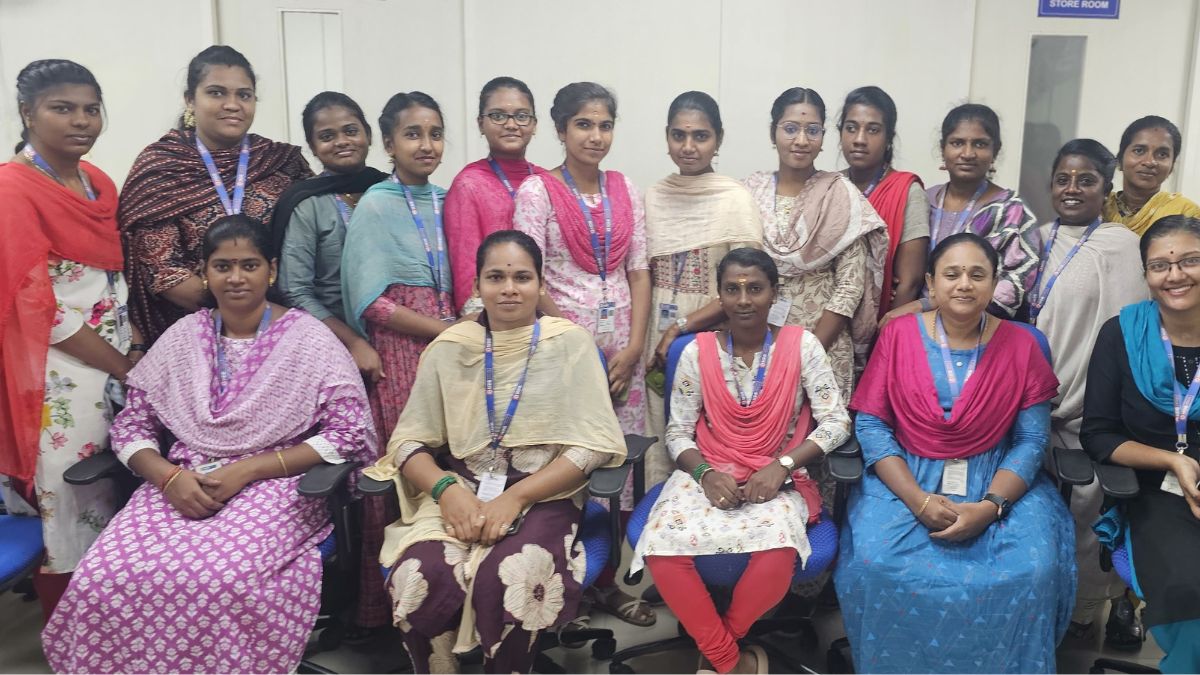
HDB Financial Services Launches All-Women Branch in Madurai
HDB Financial Services has announced the launch of its All-Women Branch in Madurai, aimed at strengthening gender diversity in the...
Latest News
ALL NEWS →NIQ Launches Survey Groups to Connect Consumer Sentiment with Real Purchase Behavior
BRAND POST Smartwatch Market Size to Hit USD 100.13 Billion by 2035 | SNS Insider 38 mins ago
MOVIES Exclusive Interview: FWICE chief says “We have not banned Ranveer Singh” over Don 3 exit 45 mins ago
BUSINESS Swiggy’s proposed amendments to articles of association fall short of approval 45 mins ago
QUARTERLY RESULTS Hikal Q4 Results: Net profit falls 71% YoY to Rs 14.4 crore, revenue down 6%
Hikal Limited reported its Q4 FY26 results with weak year-on-year performance across revenue and profitability, although the company…
1 hrs ago
BUSINESS Arkade Developers reports 48% revenue growth in Q4 FY26
Arkade Developers Limited reports a 48% increase in revenue for Q4 FY26, reaching ₹199 crore. The company's full-year revenue grew by 19%…
59 mins ago
Hikal Q4 Results: Net profit falls 71% YoY to Rs 14.4 crore, revenue down 6% 1 hrs ago
Varroc Engineering Q4 Results: Net profit jumps over 236% YoY to Rs 69.3 crore, revenue up 12.8% 1 hrs ago
Top losers today: techno electric at ₹1,072.60 plunges 10.71%, poly medicure at ₹1,330.30 down 7.61%, gujarat state petronet at ₹268.35 falls 7.13% 2 hrs ago
Stock market closing: Nifty 50 at 23,907.15 down 0.03%, Sensex at 75,867.80 down 0.19%, Nifty media rises 3.05% 2 hrs ago
Elon Musk’s SpaceX could become world’s first trillion-dollar company with IPO success May 25, 2026
Python and Data Science — Why This Pairing Has Proven More Durable Than Any Alternative May 24, 2026
Claude AI outage: Users report chat, coding and app access issues as Downdetector complaints spike May 22, 2026
Spotify takes live music further with new Reserved Ticket Initiative May 21, 2026
Cockroach Janta Party beats BJP on Instagram, crosses 10 million followers in just 5 days May 21, 2026
Nation
MORE →
Supreme court questions CBSE three-language rule for class 9 students, issues notice to Centre and NCERT 2 hrs ago
Deadly blast at illegal cracker manufacturing site in Tamil Nadu leaves two dead, one critical 2 hrs ago
Tamil Nadu applies Prevention of Thugs Act in 10-year-old girl murder case 2 hrs ago
Politics
MORE →
BJP National Spokesperson hints ’eminent personality’ is joining BJP today – All eyes on New Delhi headquarters May 26, 2026
Three AIADMK MLAs resign, set to join TVK as tamil nadu political crisis deepens May 25, 2026
BJP’s big win in Bengal’s Falta seat signals shifting Muslim voter mood, CPM gains ground May 25, 2026
Tripti Dimri shares relaxed casual selfie on Instagram: ‘Back in my natural chaos’
Actor Tripti Dimri gave fans a glimpse of her off-duty side on Wednesday, sharing a casual selfie on her Instagram...
1 hrs ago
Anu Malik steps into Chunnari Chunnari controversy, calls Varun Dhawan a superintendent dancer and defends the remake 2 hrs ago
Sajid Nadiadwala meets Gurudev Sri Sri Ravi Shankar to celebrate spiritual milestone in Bengaluru 3 hrs ago
Bollywood actor Bhumi Pednekar slams rise in child sexual abuse incidents in India 3 hrs ago
Dangal to Dil Bechara: The Brilliant Casting Picks of Birthday Boy Mukesh Chhabra 3 hrs ago
Mihir Ahuja reveals first look as Indian Air Force pilot in Operation Safed Sagar 4 hrs ago
‘Jai Jai Maharashtra Maza’ becomes emotional highlight of Marathi OTT launch at Cannes 4 hrs ago
Karishma Tanna shares stunning maternity photos as she embraces motherhood journey 5 hrs ago