
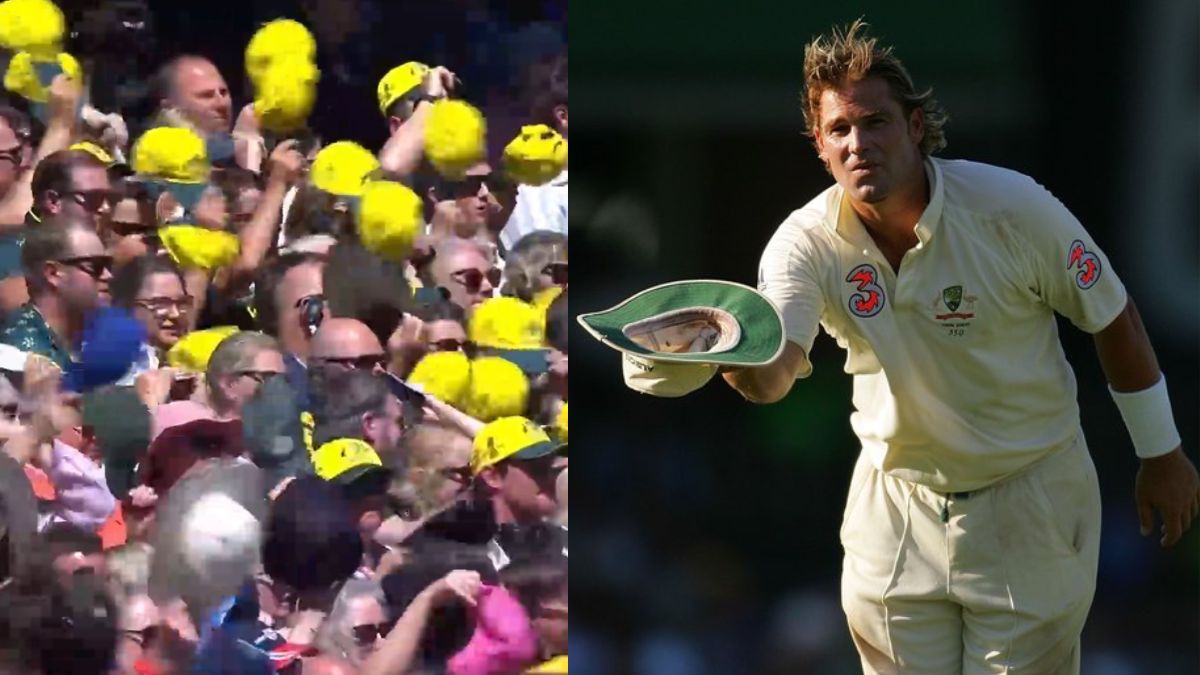
At exactly 3:50 pm, the Melbourne Cricket Ground fell into a moment of collective stillness.
A record Ashes crowd at the MCG paused on Friday to honour Australian great Shane Warne, doffing their caps in a heartfelt tribute timed to reflect his Test cap number — 350. The gesture, simple yet powerful, resonated across a stadium steeped in cricketing history and personal memory.
The tribute is set to be observed on each day of the Test, with former greats including Ricky Ponting, Michael Vaughan and Ian Botham removing their floppy hats in unison — a nod to the iconic headwear Warne famously wore while weaving magic with the ball.
The moment unfolded amid a gripping Boxing Day Test that swung violently from session to session. On a green-tinged pitch offering constant assistance to seamers, 20 wickets fell in a single day, as Australia batted again to hold a 46-run lead, keeping the contest finely poised.
The significance of the tribute was amplified by the crowd in attendance. A staggering 94,199 spectators packed into the MCG, setting a new record for the highest single-day attendance in Test cricket history. The figure surpassed the previous mark of 93,013 set during the 2015 ICC World Cup final and eclipsed the 91,112 who attended Day 1 of the 2013 Boxing Day Test between Australia and England.
Beyond the numbers and the cricket, the occasion carried deep personal meaning for Warne’s family.
Ahead of the match, Warne’s son Jackson spoke about living with his father’s legacy in the public eye and how moments like this tribute have become both personal and healing.
Warne’s connection with the Boxing Day Test is inseparable from his legend. It was at the MCG that he claimed his first Test hat-trick and later his 700th Test wicket, milestones that helped redefine leg-spin bowling and left an indelible imprint on the game.
Speaking near the statue that honours his father outside the MCG earlier in the week, Jackson recalled a moment inside the stadium’s museum that caught him off guard.
“There is a hologram of him at the MCG museum talking about his career and it is so realistic that the first time I saw it after Dad passed, I was like, whoa. I just wanted to go up there and hug him,” he told The Telegraph.
Grief, he said, has since found quieter spaces. Even driving has become a moment of connection, where conversations with his father continue as if he were still sitting beside him.
“I talk to him all the time when I am driving. A few days after Dad passed, I had this weird dream,” Jackson recalled.
“We used to love racing each other while driving. Dad was always a lot faster than me so I would always lose. In the dream, we were driving side by side, smiling. Then our cars merged and I was suddenly in the driver’s seat of his car. When I looked left, he was gone. I kept driving, then I woke up.”
There are still moments, he said, when the number 350 or familiar initials appear unexpectedly — reminders that turn memory into something that feels closer than absence.
At 3:50 pm, amid the noise of a Test match and the weight of history, the MCG once again proved it is more than a venue. It is a place where cricket pauses to remember one of its greatest ever artists.
