

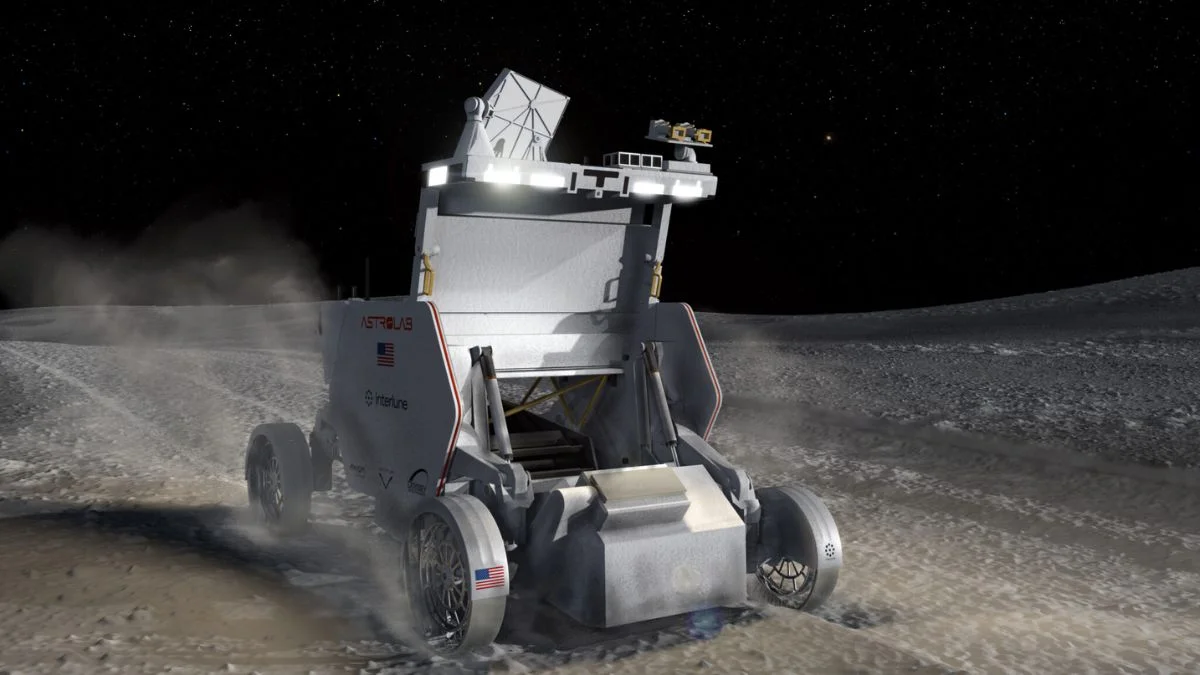
The Moon is rapidly becoming the focal point of renewed global space ambition. With both NASA and SpaceX increasing their focus on lunar surface operations, commercial players are positioning themselves for what could be a sustained presence on Earth’s closest celestial neighbour. Against this backdrop, Astrolab and Interlune have unveiled a partnership aimed at unlocking one of the Moon’s most intriguing resources: Helium-3.
Lunar surface strategy gains momentum at NASA and SpaceX
Recent shifts in strategy from SpaceX founder Elon Musk, who has pivoted attention from Mars toward lunar surface activities, have amplified interest in building infrastructure on the Moon. NASA, too, has increasingly emphasized surface base development over its earlier focus on the Gateway space station concept.
This convergence of public and private interest suggests more frequent lunar missions in the coming years, a favorable environment for companies developing surface technologies and extraction systems.
Astrolab FLEX rover to support Helium-3 mining
Astrolab is one of three companies competing to provide NASA with lunar rovers capable of supporting science missions and transporting astronauts. Its larger rover, FLEX, roughly the size of a minivan, is designed with a modular, horseshoe-shaped chassis capable of carrying about 3 cubic meters of payload.
Interlune’s vision is to deploy electric harvesters that can excavate lunar regolith and extract Helium-3. According to Interlune CEO Rob Meyerson, the FLEX rover provides a strong platform for that mission. The excavating hardware being developed by Interlune would mount beneath the rover’s chassis, allowing it to function as a mobile harvesting system.
Astrolab’s founder and CEO Jaret Matthews described the rover’s design philosophy as maximizing versatility, enabling it to carry scientific instruments, cargo, or specialized equipment depending on mission needs.
FLIP rover mission will test Helium-3 detection
Before deploying large-scale harvesters, the companies are taking smaller steps. Interlune previously partnered with Astrolab to fly a multispectral camera aboard the FLIP rover, a smaller prototype about the size of a go-kart. This mission aims to estimate Helium-3 concentration in lunar soil.
FLIP is scheduled to launch later this year aboard Astrobotic’s Griffin lander. The mission will serve as a proof-of-concept for both rover operations and Helium-3 measurement techniques, validating data previously derived from Apollo-era samples.
Helium-3 mining faces technical hurdles
Helium-3 is extremely rare on Earth, existing only in limited quantities from nuclear processes. It has potential applications in cryogenics and future energy systems. Interlune has already announced contracts for thousands of liters intended for ultra-low-temperature refrigeration, but commercial viability hinges on proving extraction and return capabilities.
A larger FLEX rover could potentially fly on an early SpaceX Starship lunar mission, possibly during an uncrewed demonstration flight planned for 2027 or 2028. Interlune is also collaborating with industrial equipment manufacturer Vermeer to develop specialized harvesting machinery.
Prototype testing of the mobile harvester is expected to take place in Houston at the Texas A&M University Space Institute, currently under construction at NASA’s Johnson Space Center. The facility reflects NASA’s broader effort to integrate commercial partners into its long-term lunar strategy.
As lunar exploration transitions from exploration to utilization, partnerships like Astrolab and Interlune’s signal a shift toward resource extraction and industrial activity, a development that could redefine the economics of space in the coming decades.