

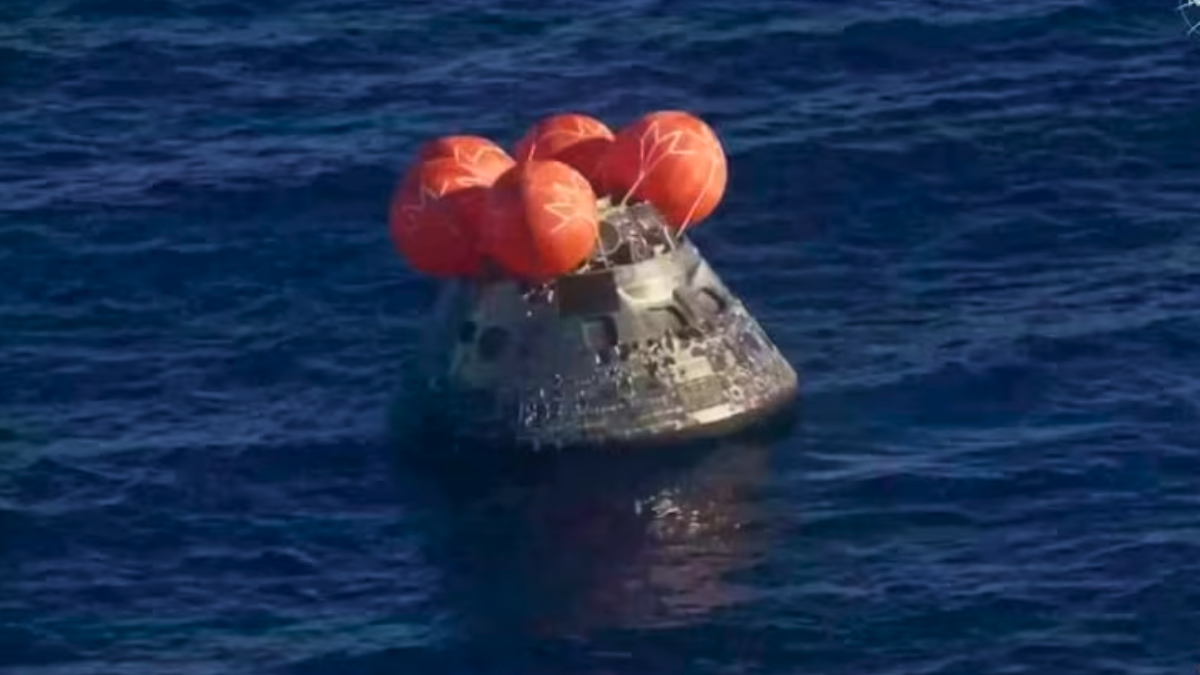
NASA’s Artemis II crew returned to Earth on Friday, marking the first crewed mission to orbit the moon since 1972. Orion splashed down at 5:07 p.m. Pacific time in the Pacific Ocean off the coast of California, after an extremely high-speed reentry that will test the spacecraft for extreme reentry temperatures.
All four astronauts in the Artemis II mission were aboard their respective spacecraft when they splashed down in the ocean; Reid Wiseman from NASA was the commander of Artemis II and was joined by Victor Glover (also from NASA), Christina Koch (also from NASA), and Jeremy Hansen from the Canadian Space Agency. Aboard the USS John P. Murtha, the recovery teams received all four astronauts with minor difficulty due to communications issues during their dramatic descent. The temperature of the Orion heat shield exceeded 2,760°C (5,000°F), and as such, a plasma blackout caused a loss of communication with mission control.
The flight lasted for approximately 10 days and was launched from Kennedy Space Center just over one week ago; at this point, they are the farthest humans have been from Earth since the Apollo program. In addition to flying behind the moon and capturing incredible images of both the moon and the Earth, the astronauts experienced a solar eclipse and tested critical mission systems that will be used for future missions to land on the moon. Glover has become the first astronaut of colour to travel into outer space; Koch is the first woman to fly into space, and Hansen is the first non-American to fly into space.
Right before reentering Earth’s atmosphere, Gordon asked Houston to confirm that they were going to the Moon: “Well, I guess we can say we’re returning to the Moon.” Jared Isaacman, NASA Administrator, was pleased with the success of the mission and said, “We have returned to the business of flying astronauts to the Moon, and we are prepared to continue flying many more.”
Next, engineers will examine how well the heat shield performed during descent to the Moon, as well as how effectively the navigation system and life support operated in conjunction with all systems before the advent of Artemis III and additional manned lunar landings. This mission is a crucial milestone in establishing a human presence on the Moon, which will eventually lead to missions to Mars.