

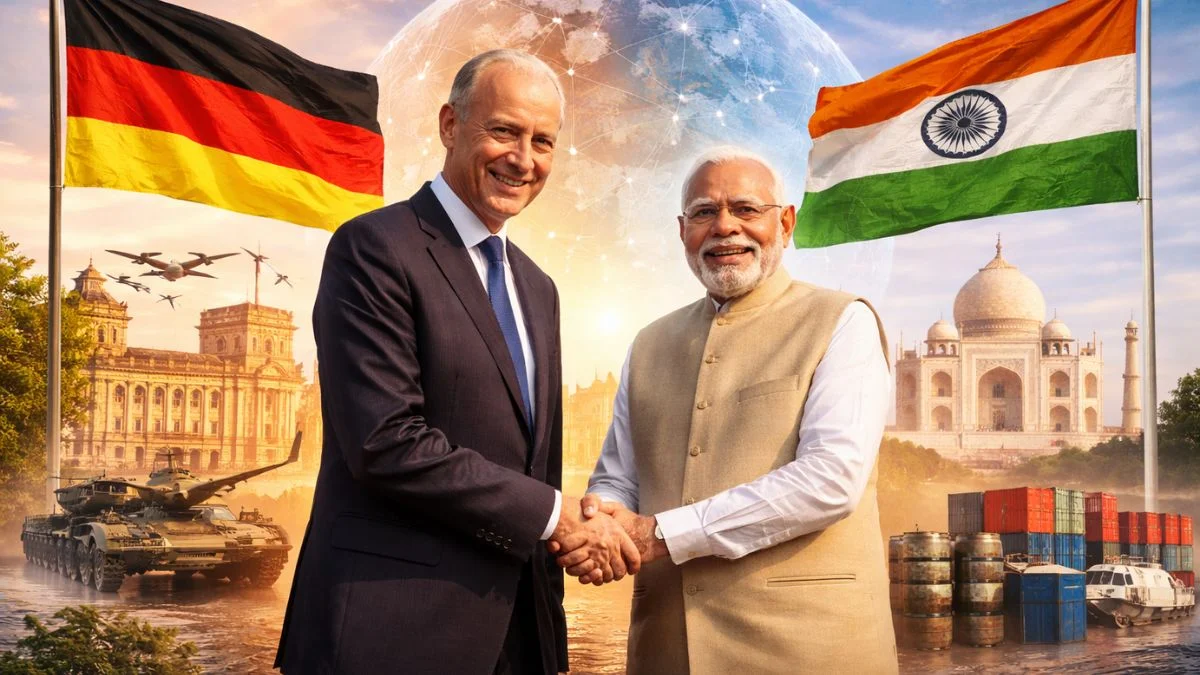
German Chancellor Friedrich Merz’s declaration in Ahmedabad that Germany seeks closer security cooperation with India to reduce reliance on Russia represents far more than a bilateral diplomatic overture. It marks a recalibration of Europe’s strategic engagement with the Global South at a moment when geopolitics, energy security and international law are converging with unprecedented intensity.
The memorandum of understanding signed during Merz’s first official visit to India, alongside agreements on critical minerals, artificial intelligence and health cooperation, must be read as part of a broader European effort to reshape global security and supply chain architectures in the wake of the Russia Ukraine conflict.
Germany’s strategic calculus after the Russia shock
Germany’s outreach to India is rooted in hard lessons learned since 2022. The collapse of Berlin’s long standing dependence on Russian energy exposed the legal and strategic fragility of economic interdependence with politically adversarial states. Germany is now pursuing diversification not only of energy sources but of security partnerships, particularly with large democratic states capable of balancing Russian and Chinese influence.
India occupies a unique position in this strategy. As a major military power with historical defence ties to Russia and growing economic alignment with Western markets, India represents both an opportunity and a challenge for German foreign policy.
India-Russia relationship and the limits of western pressure
From an international relations perspective, Germany’s stated desire to reduce India’s reliance on Russia must be approached with realism. India’s defence ecosystem remains deeply integrated with Russian hardware, maintenance and supply chains developed over decades. Moreover, India’s continued purchase of Russian oil and gas is driven by economic pragmatism rather than ideological alignment.
Legally, India is under no obligation to comply with European Union sanctions regimes, which do not have extraterritorial force. Germany’s efforts to ensure Indian companies do not circumvent sanctions therefore rest on diplomatic persuasion rather than enforceable legal mechanisms. This underscores the limits of sanctions as a tool of global governance when major non aligned economies decline to participate fully.
Security cooperation as a tool of strategic influence
The security cooperation memorandum signals a shift in how Germany and the European Union are seeking to exercise influence. Rather than coercion, the emphasis is on integration into trusted supply chains, defence collaboration and technological partnerships. By embedding India within European security and industrial ecosystems, Germany hopes to gradually dilute Moscow’s leverage over New Delhi.
This approach reflects an evolution in international relations thinking, where influence is exerted through supply chain resilience, technology sharing and regulatory alignment rather than formal alliances.
Critical minerals, artificial intelligence and the new security frontier
The inclusion of critical minerals and artificial intelligence cooperation within the broader framework is legally and strategically significant. Control over critical minerals is increasingly recognised as a matter of national security, with implications for defence manufacturing, renewable energy and digital infrastructure.
Similarly, artificial intelligence cooperation introduces complex legal questions around data governance, export controls and intellectual property. These domains are rapidly becoming arenas of strategic competition, where regulatory alignment can be as important as military cooperation.
Free trade, protectionism and competing legal orders
Merz’s call for the swift conclusion of a European Union India free trade agreement highlights the economic dimension of this strategic outreach. The reference to a global renaissance of protectionism is not rhetorical. Trade fragmentation, export controls and industrial subsidies are reshaping international economic law.
For Germany, concluding an FTA with India would anchor the relationship in legally binding commitments that extend beyond security cooperation. For India, however, such agreements must be balanced against domestic economic priorities and strategic autonomy, particularly in sensitive sectors.
India’s strategic autonomy and the multipolar world
India’s response to Germany’s overtures reflects its longstanding commitment to strategic autonomy. New Delhi has consistently resisted pressure to align exclusively with any single power bloc. This approach is increasingly validated in a multipolar world where rigid alliances are giving way to flexible partnerships.
India’s engagement with Germany therefore does not signal a rupture with Russia but an expansion of strategic options. This nuance is often overlooked in Western policy debates but is central to understanding India’s foreign policy calculus.
The broader global signal
Internationally, Germany’s engagement with India sends a clear message. Europe is no longer content to pursue security and economic interests solely within the transatlantic framework. Instead, it is seeking durable partnerships with influential Global South states to stabilise supply chains, mitigate geopolitical risk and uphold a rules based international order.
Whether this strategy succeeds will depend on Europe’s willingness to accept the legal and political realities of strategic autonomy in partner states like India.
A turning point in Indo European relations
In conclusion, Chancellor Merz’s visit marks a potential turning point in Indo German and Indo European relations. It reflects a pragmatic recognition that global stability cannot be achieved through sanctions and alliances alone, but through legally grounded cooperation with states that operate across multiple geopolitical spheres.
For international law, trade governance and global security, the implications are far reaching. Germany’s outreach to India is not merely about reducing Russian influence. It is about adapting to a world where power is dispersed, alliances are fluid and legal norms must evolve to remain effective.