

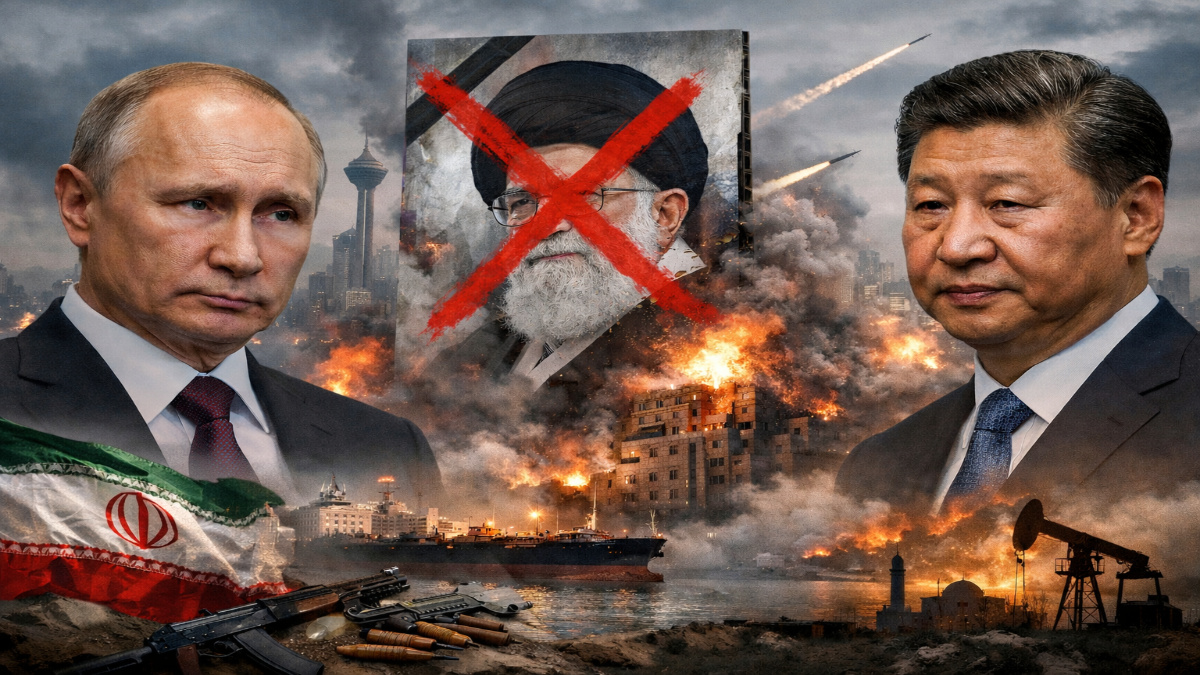
The elimination of the Supreme Leader of Iran, Ali Khamenei, by a joint U.S.-Israeli mission is a major turning point in the Middle East politics, as well as the world order. It is also said that the operation had eliminated not only Khamenei but some of the top Iranian officials as well and this has led to a new era of war and uncertainty in the region. The event also highlighted the tactical shortcomings of both Russia and China who had developed strong relations with Tehran but failed to prevent the attack.
Russian President Vladimir Putin reacted immediately to the news and expressed condolences to Iran and condemned the murder as a cynical crime against all standards of human morality and international law. He described Khamenei as a great statesman who had served the interest of improving the relationship between Moscow and Tehran.
Regardless of such high rhetoric, the reaction of Russia focused on its inability to protect one of its closest partners. Moscow advocated the de-escalation and diplomatic resolutions, but never intervened directly in the military aspects, thus further underlining the mismatch between the political support and the real strategic assurances.
Russia-Iran strategic relations
Over the last ten years, ties between Russia and Iran have been gradually increasing, particularly as the countries were both facing Western sanctions and political ostracism. Their cooperation extended to an overall strategic alliance which involved energy, military technology and regional security. Over the past few years, Tehran has become one of the most important partners of Moscow in the Middle East, which has been supporting it diplomatically and materially.
Part of the reason behind the partnership was the common rejection of Western influence. The two governments worked to redefine the international order such that it was no longer as dominated by the United States and at the same time aligning the position in the conflicts in the Middle East and Eurasia. The energy sources and the geopolitical location of Iran made this country a particularly desirable ally to Moscow.
The relationship of Khamenei with Putin
Individual relationships exist between Khamenei and Putin, which have been central in enhancing bilateral relations. The two leaders have been interacting with each other numerous times and they have developed a relationship that is based on strategic interests and mutual suspicion of the Western power. The Russian authorities have accredited Khamenei with the growth of the relationship to what they refer as a comprehensive strategic partnership.
Khamenei saw Russia as a necessary counter-check against U.S. influence whereas Putin saw Iran as a good ally in maintaining Russian influence in the Middle East. They worked in closer collaboration especially since 2022 when Russia started to face a more aggressive confrontation with the West and new alliances gained even more importance.
The modern Russia-Iran relationship has been turned into a product of economic and military cooperation. Iran has also provided Russia with military technology and arms that they use in their current wars thus improving the ability of Moscow to maintain its campaigns. In its turn, Russia has provided such support as technical aid and military cooperation, yet has avoided the formation of an actual defensive alliance.
The trade handshake
Energy trading has contributed greatly as well. The economic opportunities have been generated by the oil exports and energy cooperation between Iran, and the instability in the Middle East has often increased the global oil prices indirectly benefiting the economy of Russia. Analysts have noted that an oil export or Gulf shipping route shock to Iran would transform the world energy markets and could have an impact on Russian revenues.
Although of these strong relations, Russia has never provided Iran with sophisticated defense mechanisms that could have discouraged a large scale attack. This restriction became obvious after the death of Khamenei, thus supporting the idea that the support of Moscow has certain limits.
The overthrow of Khamenei also highlighted the persistence of the U.S. military power. As much as the world politics is becoming multipolar, the ability of the United States to make accurate long-range operations is an indication of a degree of military prowess that its competitors have not yet accomplished.
China faces similar problems. Although Beijing maintains a wide range of economic relations with Iran and depends on the Iranian oil reserves, it has not engaged in intensive military participation. As a result, China had a minimal ability to affect the situation in the crisis.
The larger influence is not limited to Iran. Russia and China have tried to form an informal alliance of states that are against the Western domination and often included Iran in the group. The abrupt demise of the supreme leader in Iran is a blow to the credibility of such a partnership and leaves other prospective partners with doubts.
Despite this fact, it is unknown what the long-term effects will be. The Iranian political structure is structured to withstand the loss of leadership and the strong security organs in the country might ensure that the regime is maintained in the short run. However, the tensions between the regions and internal divisions might create instabilities in the event of the weakening of the central authority.
Russia and China will not be left behind watching developments. The long-term war or the instability in the region may destroy the credibility of the U.S. and provide the possibility of the growth of its sphere of influence. On the other hand, a quick and consistent solution would strengthen the perception that the American authority is final.
The death of Khamenei is hence more than the death of an individual leader. It highlights the boundaries of the influence of Russia and China, the power of the U.S. military forces, and the uncertain future of one of the most important states of the Middle East.