
- 5:02 PM (IST) 29 Jan 2026Latest
What the 2012 UGC anti-discrimination rules provided
In 2012, the University Grants Commission introduced a formal regulatory framework aimed at preventing caste based discrimination in higher education institutions. The rules were intended to address injustice linked to caste, particularly affecting SC and ST communities, as well as religion, gender and language.
Under the regulations, universities and colleges had to appoint an Anti Discrimination Officer and set up an Equal Opportunity Cell to promote equal access and treatment for students. A time limit of 60 days was fixed for resolving complaints. Students alleging discrimination were required to submit a written complaint to the designated officer, who would investigate and report to the institution’s administration. Where wrongdoing was established, disciplinary action was to be recommended under university rules.
However, the framework was criticised for gaps. It did not clearly lay down penalties for deliberately false complaints, and investigations were handled entirely by internal staff, raising concerns about neutrality.
From a legal perspective, these regulations were issued under the UGC Act and were binding on recognised institutions, meaning non compliance could attract regulatory action. At the same time, the lack of independent inquiry mechanisms and defined sanctions for misuse limited their effectiveness and exposed institutions to challenges under principles of natural justice and administrative fairness.
- 4:02 PM (IST) 29 Jan 2026
Kalyan Banerjee supports stay, questions constitutionality
Trinamool Congress MP Kalyan Banerjee welcomed the Supreme Court’s decision, saying the UGC guidelines were unconstitutional and that the stay was both correct and necessary.
His comments echo the central legal challenge that the regulations may conflict with equality provisions under Articles 14 and 15 and could create uncertainty and discrimination in higher education institutions.
- 4:02 PM (IST) 29 Jan 2026
Akhilesh Yadav urges clarity and justice in lawmaking
Samajwadi Party leader Akhilesh Yadav said true justice does not permit injustice to any group and praised the court for upholding this principle by staying the UGC rules.
He stressed that laws must be clear in both language and intent and warned against any form of oppression or unfairness. His statement reflects the constitutional demand that legislation be precise, reasonable and non arbitrary.
- 4:02 PM (IST) 29 Jan 2026
OP Rajbhar says court order must be respected
Uttar Pradesh minister OP Rajbhar said no one should question the Supreme Court’s stay on the UGC regulations and emphasised that every citizen has the right to present their views before the judiciary.
He added that both the state and central governments are acting within the Constitution and that the court’s intervention reinforces the rule of law. Legally, his remarks underline judicial supremacy in reviewing administrative regulations.
- 4:02 PM (IST) 29 Jan 2026
Priyanka Chaturvedi calls UGC rules vague and discriminatory
Congress leader Priyanka Chaturvedi supported the Supreme Court’s stay, saying the guidelines were unclear, arbitrary and capable of promoting discrimination on campuses. She said she had faced online abuse and caste based slurs for opposing the rules but would continue to speak against anything that violated principles of justice.
Chaturvedi criticised the government for not withdrawing the regulations despite public protests, calling it a sign of disregard for popular concerns. Her position aligns with arguments that vague legislation can fail the constitutional test of fairness and legal certainty.
- 4:02 PM (IST) 29 Jan 2026
Hanuman Beniwal seeks strict punishment for ragging, review of quotas
RLP MP Hanuman Beniwal said the government should clearly state its position before the Supreme Court since it was aware of the UGC rules when they were framed. He stressed that anyone who insults or rags students, including those from SC, ST or OBC communities, must face punishment and said his stance is not against any particular social group.
He also called for a review of reservation policy after the next census and suggested increasing OBC quotas. His comments underline the continuing tension between protective measures and broader equality norms under the Constitution.
- 4:02 PM (IST) 29 Jan 2026
Petitioner Vineet Jindal flags flaws, hopes for amendments
Advocate Vineet Jindal, one of the petitioners, described the stay on the UGC 2026 regulations as a major success and said the Chief Justice acknowledged key concerns raised before the court. He pointed out that Section 3C defines caste discrimination only in relation to SC, ST and OBC communities, excluding the general category and indirectly branding them as discriminators.
He added that the court also took note of the lack of general category representation in equity committees under Section 18 and suggested forming a broader expert panel. The matter will be heard again on March 19. These issues go to the heart of Article 14, which requires laws to avoid unreasonable classification.
- 4:02 PM (IST) 29 Jan 2026
Swami Chakrapani praises court stay, calls for inclusive policy
Swami Chakrapani Maharaj, head of the Akhil Bharat Hindu Mahasabha and related organisations, welcomed the Supreme Court’s decision to halt the UGC rules, calling it a victory for justice. He said the government should prioritise development that benefits all sections of society and avoid measures that obstruct students and young people seeking education.
He cautioned that divisive policies could weaken social harmony. His remarks reflect the wider debate on balancing social justice objectives with the constitutional mandate of equality and non discrimination.
- 3:58 PM (IST) 29 Jan 2026
BJP MP Nishikant Dubey backs government, cites constitutional safeguards
BJP MP Dr Nishikant Dubey defended the Centre amid criticism over the UGC regulations, saying that during the past two days of Parliament proceedings no MP from any party raised the issue. In a post on X, he criticised “self-styled experts” for attacking the regulator and said the Modi government had already demonstrated its concern for the poor by introducing 10 per cent reservation for Economically Weaker Sections.
Dubey urged the public to place trust in Prime Minister Narendra Modi and said all laws are bound by Articles 14 and 15 of the Constitution. Referring to the Supreme Court stay, he remarked that constitutional protections had worked as expected. From a legal standpoint, his comments echo the principle that executive policy must remain subject to judicial review and equality guarantees.
- 3:57 PM (IST) 29 Jan 2026
SC issues notice!
The Supreme Court formally stayed the 2026 equity regulations and issued notice to the Centre and the UGC, seeking their replies to the constitutional challenges.
The bench said the new rules could divide society and have serious consequences if implemented immediately.
The case has been scheduled for further hearing on March 19, while universities will continue to follow the 2012 anti discrimination regulations in the interim.
The final outcome will likely shape the future structure of campus governance and anti discrimination law in India.
- 3:56 PM (IST) 29 Jan 2026
Supreme Court stays UGC 2026 regulations
The Supreme Court ordered a stay on the implementation of the UGC 2026 equity regulations and directed that the 2012 guidelines will continue until further notice.
Chief Justice Surya Kant said the court wanted to ensure campuses are not disrupted while also safeguarding remedies for victims of discrimination.
Senior Advocate Indira Jaising opposed the stay, arguing that laws should not be suspended merely due to law and order concerns and that anyone should be able to complain regardless of caste.
The court nevertheless paused the new framework, effectively restoring the earlier regime for the time being.
- 3:56 PM (IST) 29 Jan 2026
Supreme Court stresses unity must guide education policy
The court reiterated that schools and universities cannot function in isolation from society and warned that divided campus environments could hinder social harmony.
It observed that although special protections for disadvantaged groups are constitutionally permitted, overly narrow frameworks could lead to unintended segregation. The bench also referred to internal divisions within reserved categories in some states, creating inequalities even within affirmative action systems.
Such observations may influence how proportionality and social impact are evaluated in constitutional review.
- 3:53 PM (IST) 29 Jan 2026
Court warns against social regression and campus segregation
During the hearing, the Supreme Court cautioned that India must not move towards regressive policies after decades of constitutional progress towards a casteless society.
The bench compared the risk to racially segregated schooling in the United States and said campuses should reflect national unity. Chief Justice Surya Kant stressed that while genuine victims must be protected, educational spaces should not foster division.
Justice Joymalya Bagchi noted that states are empowered to enact special measures for SC and ST communities but said inclusive definitions of discrimination deserve scrutiny. The court sought the Solicitor General’s response and suggested forming an expert committee.
- 3:53 PM (IST) 29 Jan 2026
Supreme Court begins hearing challenges to UGC rules
The Supreme Court formally commenced hearings on petitions against the UGC 2026 regulations before a bench of Chief Justice Surya Kant and Justice Joymalya Bagchi.
Advocate Vishnu Shankar Jain argued that the framework could divide society and specifically attacked Section 3(c), which defines caste discrimination mainly in relation to SC, ST and OBC groups.
He contended that excluding general category students violates Article 14 and amounts to discriminatory classification. The court will assess whether the definition meets constitutional tests of equality.
- 3:52 PM (IST) 29 Jan 2026
MP Harnath Singh proposes changes to equity regulations
MP Harnath Singh Yadav suggested three amendments to the government: strict penalties for false complaints, inclusive grievance committees with representation from all categories, and punishment for discrimination against general category students.
He shared his views in a message to the Prime Minister and acknowledged the Home Minister and Education Minister for considering public feedback.
These proposals aim to strengthen procedural fairness, a key requirement under Indian constitutional jurisprudence.
- 3:52 PM (IST) 29 Jan 2026
BJP MLA urges Prime Minister to review UGC framework
BJP MLA Pratap Singh Singhvi has written to Prime Minister Narendra Modi requesting reconsideration of the newly notified UGC regulations.
He stressed that wide consultation with all stakeholders is necessary and that only balanced provisions can ensure trust, impartiality and equality in higher education institutions.
Any amendment process would need to remain consistent with constitutional safeguards and existing UGC statutory powers.
- 3:52 PM (IST) 29 Jan 2026
Kalraj Mishra calls UGC rules unconstitutional
BJP leader Kalraj Mishra criticised the 2026 equity regulations as unconstitutional and rooted in caste based classification. He demanded that students of all communities be allowed to file complaints and that strict punishment be prescribed for false cases.
He also sought balanced representation of all social groups in Equal Opportunity Centres and clearer rules on the powers and timelines of committees. Mishra said he raised these concerns with Education Minister Dharmendra Pradhan.
Such objections reflect ongoing legal arguments that selective protection may breach the principle of equality before law.
- 3:51 PM (IST) 29 Jan 2026
Veteran officer links UGC debate to wider reservation policy shift
Lt Col Sushil Singh Sheoran highlighted that the present government has introduced OBC reservations in Rashtriya Military Schools, mainly for children of serving and retired defence personnel, with limited civilian seats.
He noted that while SC and ST quotas already existed, extending reservations to OBC categories in military institutions marks a new phase of affirmative action. Warning against assuming that private institutions would remain untouched, he remarked that if the armed forces are included, few sectors may remain exempt.
His comments have renewed debate on the constitutional limits of reservation policies under Articles 15 and 16 and their possible extension into new institutional spaces.
- 3:51 PM (IST) 29 Jan 2026
Nationwide student protests as education minister assures safeguards
Students in several states, including Delhi, Uttar Pradesh, Rajasthan and Bihar, have continued demonstrations against the new UGC framework.
Union Education Minister Dharmendra Pradhan said the regulations would not be used to discriminate against anyone and that strict steps would be taken to prevent misuse. He added that both the government and universities are responsible for ensuring fair implementation.
Legally, such assurances may be examined against the actual text of the regulations, which courts often prioritise over executive statements when judging enforceability.
- 3:51 PM (IST) 29 Jan 2026
Apex court to urgently hear PIL against UGC regulations
The Supreme Court will shortly hear a public interest litigation on January 29 challenging the UGC’s new equity regulations, after acknowledging the seriousness of the issues raised.
The bench headed by Chief Justice Surya Kant, along with Justice Joymalya Bagchi, listed the plea on an urgent basis. The petitions were filed by Mritunjay Tiwari, Advocate Vineet Jindal and Rahul Dewan.
While the regulations mandate Equity Committees in all higher education institutions, petitioners argue that the absence of strong procedural safeguards could lead to misuse. The case raises questions under Articles 14 and 21 concerning equal protection and due process.
- 3:46 PM (IST) 29 Jan 2026
Supreme Court to examine legality of UGC equity rules
The Supreme Court is scheduled to hear several petitions on Thursday, January 29, challenging the validity of the UGC’s Promotion of Equity in Higher Education Institutions Regulations, 2026, which have triggered nationwide debate among students and academics.
The case will be taken up by a bench led by Chief Justice of India Surya Kant and Justice Joymalya Bagchi. Advocates Vineet Jindal, Mrityunjay Tiwari and Rahul Dewan have questioned both the intent and consequences of the new framework, which introduces structured grievance redressal mechanisms for disadvantaged students.
Critics argue that vague definitions of caste based discrimination could result in biased application. The hearing is seen as crucial for determining whether the regulations comply with constitutional guarantees of equality and fairness.
- 3:45 PM (IST) 29 Jan 2026
Fresh protest planned in Lucknow on January 27
Another demonstration against the UGC regulations is scheduled for 4 pm on 27 January at Parivartan Chowk in Lucknow.
Durgesh Singh, state president of the Karni Sena, has called for a large scale protest, with significant participation expected from members of the savarna community.
With protests spreading and legal challenges pending, the future of the regulations is likely to be shaped both by public pressure and judicial interpretation of their constitutionality.
- 3:45 PM (IST) 29 Jan 2026
BJP leader Sanjay Singh raises concerns
BJP leader and former Union Minister Dr Sanjay Singh criticised the regulations in a social media post, saying justice is meaningful only when it is equal for all.
He warned that the rules are creating anxiety in educational institutions and that committees without balanced representation risk producing formal decisions rather than genuine justice. Singh urged Prime Minister Narendra Modi to intervene to protect citizens’ dignity and security while upholding fairness.
His comments reinforce the argument that institutional mechanisms must satisfy constitutional standards of equality and impartiality.
- 3:45 PM (IST) 29 Jan 2026
Clash of views over UGC rules in Jharkhand
In Jharkhand, strong support for the new regulations has emerged alongside protests by members of the savarna community. At Ranchi University’s Aryabhatta Auditorium, supporters and opponents confronted each other, exchanging slogans.
OBC and tribal groups backing the rules questioned why similar protests did not occur when a 10 percent EWS reservation was introduced. University teachers, however, expressed concern about the punitive provisions, saying they could harm both staff and students and demanding amendments and representation of forward communities on equity committees.
Supporters argued that discrimination cases are rising and warned that rolling back the regulations would provoke strong protests from SC, ST and OBC groups. They maintained that the rules would deter discrimination rather than intensify it.
The confrontation reflects how the regulations are creating social and legal fault lines, which courts may consider when assessing their reasonableness and impact.
- 3:44 PM (IST) 29 Jan 2026
Bareilly magistrate explains reasons for resignation
Former Bareilly City Magistrate Alankar Agnihotri told Aaj Tak that his resignation was prompted by two issues: what he described as an insult to Sanatan Dharma during the Magh Mela, and his opposition to the UGC’s 2026 regulations, which he claims presume the savarna community guilty by default.
He accused the government of adopting a caste based approach and indicated that several organisations have approached him about entering politics, though he said any decision would be taken later.
His claims mirror arguments in ongoing legal challenges that the regulations violate equality guarantees under Articles 14 and 15.
- 3:44 PM (IST) 29 Jan 2026
Poet Kumar Vishwas opposes UGC regulations
Poet Kumar Vishwas joined the criticism by sharing a verse by the late Ramesh Ranjan to convey what he described as the anguish of the savarna community over the controversy.
Using the hashtag #UGC_RollBack, he signalled his opposition to the regulations and called for their withdrawal.
Public interventions by cultural figures can influence political discourse, although the legality of the regulations will ultimately depend on judicial scrutiny rather than popular sentiment.
- 3:44 PM (IST) 29 Jan 2026
Social media backlash gathers momentum
The new equity regulations have triggered a major backlash online, with platforms such as X, Instagram and Reddit flooded with hashtags like #UGCRollback and #ShameOnUGC.
Thousands of users argue that the rules disadvantage general category students and do not adequately guard against false accusations. Influencers, student bodies and commentators have labelled the framework “one sided” and even a “black law”, warning of reverse discrimination, campus conflict and intrusive monitoring.
Viral posts frequently claim that unreserved category students are being treated as default suspects.
The scale of online reaction has prompted the Education Ministry to prepare clarifications to counter what it describes as misinformation, highlighting how digital discourse is shaping the national debate on education policy.
- 3:43 PM (IST) 29 Jan 2026
Lucknow University students join protests
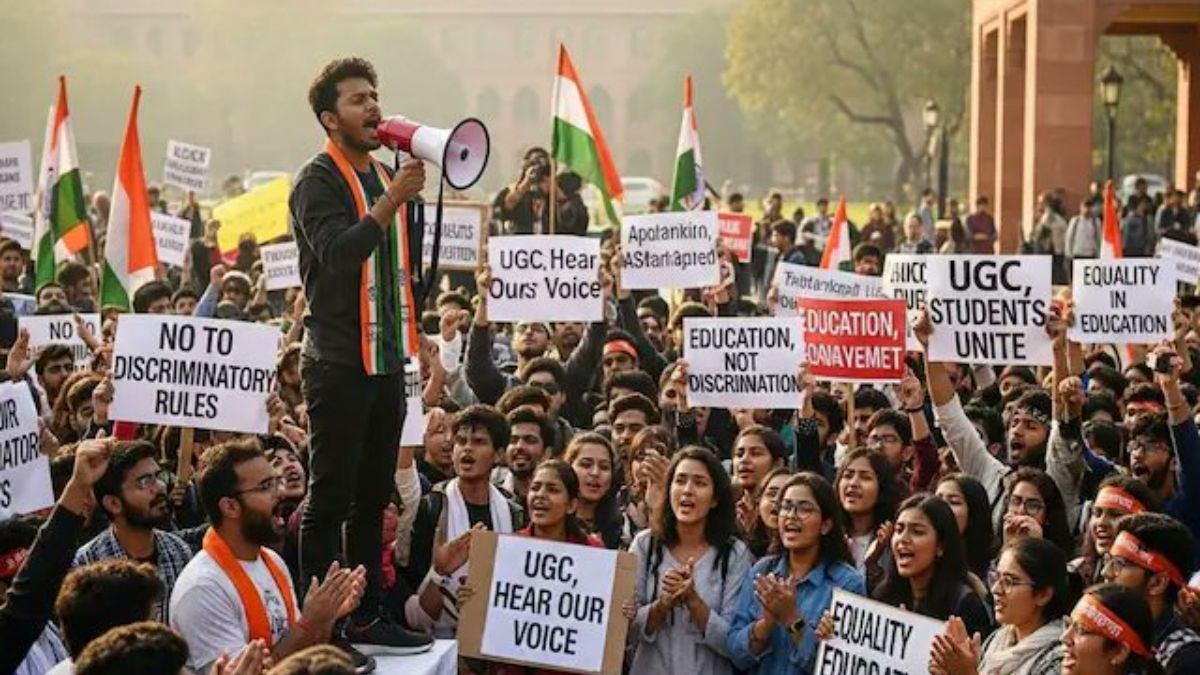
Students at Lucknow University staged a large demonstration against the 2026 UGC regulations, assembling early outside campus gates with placards and slogans demanding that the rules be reconsidered.
They marched from the main gate to a designated protest site, calling the regulations discriminatory and unclear, and seeking transparency, fairness and protection for all students.
Many said the new framework could encourage unfair assumptions and social tension, particularly for those from general category backgrounds, and lacks clear checks against misuse or false complaints.
Such concerns echo arguments that the rules, if poorly implemented, could violate procedural fairness under constitutional law.
- 3:43 PM (IST) 29 Jan 2026
Four UGC provisions drawing the most criticism
Opposition to the regulations has focused on four key aspects. Equity Committees and Equity Squads are to be set up in every institution, but representation of general category students is not compulsory and the scope of “discrimination” is not clearly defined, raising fears of excessive authority.
A 24 hour helpline and complaint mechanism will be mandatory, yet the rules do not explicitly penalise false or malicious complaints, which students say could harm careers without due process.
The framework primarily targets discrimination against SC, ST and OBC communities, which some teachers and students from the general category view as one sided and stigmatising.
Finally, the UGC has the power to revoke accreditation or block funding for non compliance, a step critics say could be disproportionate without adequate training and procedural safeguards.
These objections relate directly to constitutional requirements of proportionality, equality before law and reasonable classification.
- 3:43 PM (IST) 29 Jan 2026
Students protest outside UGC headquarters in Delhi
Students, largely from upper caste backgrounds, gathered outside the UGC headquarters in New Delhi to oppose the new equity regulations notified on 13 January.
Protesters claimed the rules could disrupt campus life by effectively shifting the burden of proof onto the accused and by lacking clear protection for students wrongly implicated. Alokit Tripathi, a PhD scholar from Delhi University, described the framework as “draconian”, alleging that it presumes victims in advance and enables constant monitoring through Equity Squads.
The protest call urged students to unite under the slogan “No to UGC discrimination” and stage a peaceful gherao of the UGC office, with social media playing a major role in mobilising support.
Legally, critics argue that reversing the burden of proof and vague standards could conflict with principles of natural justice and fair procedure under Article 21.
- 3:39 PM (IST) 29 Jan 2026
Education Ministry to issue clarification on UGC equity rules
The Ministry of Education has said it will soon clarify concerns surrounding the UGC’s Promotion of Equity in Higher Education Institutions Regulations, 2026, which were notified on 13 January 2026 and made mandatory for all colleges and universities.
The rules, intended to curb caste based and other forms of discrimination, have triggered debate on social media and among student groups. Officials note that the definition of discrimination has been widened to cover caste, religion, gender, place of birth and disability, and that OBC representation on institutional equity committees is mandatory.
The government maintains that misinformation is circulating online and insists the regulations will not be misused, though critics using hashtags such as #RollbackUGC argue that general category students will be unfairly affected.
From a legal standpoint, any official clarification would likely address how the regulations align with Articles 14 and 15 of the Constitution and the safeguards available to prevent arbitrary action.
- 3:39 PM (IST) 29 Jan 2026
Public interest case filed in Supreme Court against UGC 2026 regulations
A Public Interest Litigation has been filed in the Supreme Court by advocate Vineet Jindal challenging the Promotion of Equity in Higher Education Institutions Regulations, 2026.
The petition argues that the rules fail to provide adequate grievance redressal and institutional protection for students who do not belong to SC, ST or OBC categories. It contends that any student facing caste-based discrimination, regardless of caste, should receive equal legal protection.
The plea claims the regulations violate fundamental rights under Articles 14, 15 and 21 of the Constitution, which guarantee equality before law, non-discrimination and the right to life and personal liberty, including dignity and fair procedure.
If admitted, the case could lead to judicial review of whether the regulations are constitutionally valid or require modification to meet standards of equality and due process.
- 3:39 PM (IST) 29 Jan 2026
Resignations and political fallout over UGC equity rules
In Bareilly, Uttar Pradesh, City Magistrate Alankar Agnihotri resigned in protest, saying the regulations would unfairly affect students from upper castes. In Noida, BJP Yuva Morcha vice-president Raju Pandit also stepped down, describing the rules as a “black law”.
Meanwhile, Union minister Nityanand Rai avoided questions from the media in Hajipur, Bihar, as demonstrations continued across the country against the new framework. Critics have repeatedly cited vague drafting and the potential for misuse as their main concerns.
These developments underline the growing political sensitivity around the regulations, which may weigh on how the executive defends them in court.
- 3:38 PM (IST) 29 Jan 2026
Student protests spread over UGC equity regulations
Demonstrations have broken out in several locations following the introduction of the 2026 regulations. In New Delhi, students have gathered outside the UGC headquarters demanding that the rules be reviewed or withdrawn, arguing they could generate confusion and tension on campuses.
In Uttar Pradesh, protests have been reported in Saharanpur, Bareilly, Meerut and Hapur. In Bareilly, a city magistrate resigned in opposition to the regulations, calling them unjust. Smaller protests by student and teacher groups have also taken place on campuses in other states.
Such protests, while political in nature, could influence judicial scrutiny if courts consider whether the regulations are socially workable and proportionate in practice.
- 3:37 PM (IST) 29 Jan 2026
Why UGC’s 2026 regulations have triggered nationwide controversy
The new equity regulations were designed to strengthen how universities respond to caste-based discrimination and other bias by requiring Equal Opportunity Cells, Equity Committees, 24-hour helplines and monitoring teams in every institution.
However, soon after notification, they drew sharp criticism from sections of students, teachers and social groups. Detractors argue that the definition of “discrimination” is overly broad and vague, raising fears of arbitrary or false complaints. Others object that Equity Committees must include members from SC, ST, OBC, women and persons with disabilities, but do not guarantee representation for students from the general category.
Another concern is that safeguards against malicious or false complaints, which appeared in earlier drafts, were removed from the final rules. Critics also warn that constant monitoring could foster suspicion and polarisation on campuses rather than social harmony.
These objections have legal relevance because vague provisions and unequal procedural protections may be challenged as violating the constitutional principles of clarity, equality before law and natural justice.
- 3:37 PM (IST) 29 Jan 2026
What the new UGC equity rules aim to achieve
The 2026 regulations are intended to promote fairness and inclusion in higher education, with a particular focus on reducing caste-based discrimination and supporting students from Scheduled Castes, Scheduled Tribes and Other Backward Classes.
They mandate that every university and college set up bodies such as Equal Opportunity Centres and Equity Committees to handle discrimination complaints, monitor campus conditions, conduct awareness programmes and support affected students.
The UGC is tasked with overseeing implementation, offering academic and financial guidance to disadvantaged groups and coordinating with government departments and civil society organisations. The framework also introduces helplines, reporting systems and monitoring mechanisms, while referring generally to due process, though critics say the handling of false complaints is not clearly defined.
Legally, this structure places significant compliance obligations on institutions and creates new quasi-disciplinary processes that could be tested in courts for procedural fairness.
- 3:32 PM (IST) 29 Jan 2026
UGC formally notifies new Equity Regulations for higher education
On 13 January 2026, the University Grants Commission officially notified the Promotion of Equity in Higher Education Institutions Regulations, 2026, replacing the anti-discrimination framework that had been in place since 2012.
The new rules require all universities and colleges to establish Equal Opportunity Centres, Equity Committees, Equity Squads and round-the-clock helplines to receive and address complaints of discrimination. According to the UGC, the objective is to make campuses more inclusive and to strengthen safeguards against caste-based bias.
From a legal perspective, these regulations are a form of delegated legislation under the UGC Act, 1956, and must operate within the limits of fundamental rights, particularly equality before law and non-discrimination under Articles 14 and 15 of the Constitution.
- 3:27 PM (IST) 29 Jan 2026
SC warns of societal fracture
The Supreme Court of India on Thursday delivered one of the most consequential interim interventions in higher education policy in recent years by staying the University Grants Commission Promotion of Equity in Higher Education Institutions Regulations 2026, holding that the framework raises grave constitutional, social and structural concerns capable of producing what the court described as “very sweeping consequences” that could divide Indian society. The bench comprising Chief Justice of India Surya Kant and Justice Joymalya Bagchi exercised the court’s extraordinary powers under Article 142 of the Constitution to place the 2026 Regulations in abeyance and to revive the University Grants Commission Regulations of 2012 as the governing legal regime until further orders.
The Supreme Court of India on Thursday delivered one of the most consequential interim interventions in higher education policy in recent years by staying the University Grants Commission Promotion of Equity in Higher Education Institutions Regulations 2026, holding that the framework raises grave constitutional, social and structural concerns capable of producing what the court described as “very sweeping consequences” that could divide Indian society. The bench comprising Chief Justice of India Surya Kant and Justice Joymalya Bagchi exercised the court’s extraordinary powers under Article 142 of the Constitution to place the 2026 Regulations in abeyance and to revive the University Grants Commission Regulations of 2012 as the governing legal regime until further orders.
The decision came while issuing notice to the Union government and the UGC on a batch of petitions challenging the legality, clarity and constitutional compatibility of the new regulatory framework. The court’s language was strikingly direct. Chief Justice Kant warned that unless fundamental questions were addressed, the regulations could have “very dangerous impact”, signalling a rare judicial acknowledgement that delegated legislation in the education sector can fundamentally reshape social behaviour far beyond campus boundaries.
Justice Bagchi reinforced this concern by invoking the historical experience of racial segregation in the United States, cautioning that India must not drift towards a system of segregated educational spaces where children are separated by identity categories. He emphasised that national unity must be reflected within educational institutions themselves, not merely proclaimed in constitutional text. This observation situates the case not merely within administrative law but within the deeper constitutional project of integration, equality and social cohesion envisaged by the framers of the Constitution.
At the core of the challenge lies Section 3(c) of the 2026 Regulations, which the petitioners argue introduces vague and potentially duplicative definitions of discrimination that overlap with Clause 3(e), which already defines discriminatory conduct in broader and more comprehensive terms. The bench questioned the necessity and legal coherence of introducing a separate definitional category when the 2012 Regulations had already provided a more inclusive and functionally sufficient framework to address discrimination, including harassment and ragging based on multiple social markers.
Justice Bagchi observed that when Section 2(e) already encompasses the substantive content, carving out Section 2(c) as a standalone provision raises questions of redundancy and interpretive confusion. From a regulatory drafting perspective, this is not a trivial defect. Under Indian administrative law, subordinate legislation must satisfy the tests of clarity, necessity and proportionality. A provision that duplicates existing protections while narrowing their scope risks violating the doctrine of manifest arbitrariness, a principle firmly entrenched since the Supreme Court’s jurisprudence in Shayara Bano v Union of India.
Chief Justice Kant further highlighted an omission of particular gravity: the regulations fail to address intra caste discrimination, where dominant members within the same caste group harass or marginalise others. This omission undermines the constitutional logic of Article 15, which prohibits discrimination not merely between broad social categories but against any citizen on prohibited grounds. The petitioners acknowledged that such scenarios are not meaningfully covered under the 2026 framework, prompting the court to describe the language of the regulations as “completely vague” and “capable of misuse”.
Justice Bagchi raised a critical constitutional question concerning Article 15(4), which empowers the state to enact special provisions for Scheduled Castes and Scheduled Tribes. He contrasted the 2012 Regulations, which addressed discrimination in a wide and inclusive manner, with the narrower orientation of the 2026 framework. He questioned why a protective legislative architecture would be weakened over time, introducing the principle of no regression, a doctrine originally developed in environmental law but increasingly recognised in social justice jurisprudence. The principle holds that once the state establishes a certain level of protection for fundamental rights, it should not retreat from that standard without compelling justification.
This reasoning situates the dispute within global constitutional trends. International human rights law, particularly under the International Covenant on Economic Social and Cultural Rights, to which India is a party, imposes obligations of progressive realisation and discourages retrogressive measures in areas such as education and equality. A regulatory rollback in anti discrimination safeguards could therefore attract scrutiny not only domestically but also in India’s periodic reviews before United Nations treaty bodies.
The bench expressed further alarm at provisions contemplating separate hostels as part of equity measures. Chief Justice Kant delivered an unusually personal and forceful critique, warning that segregated living arrangements would undermine decades of organic social integration fostered within university campuses. He noted that hostels historically served as spaces where inter caste friendships and even marriages emerged, advancing the constitutional aspiration of a casteless society articulated in the Preamble and reinforced through Articles 14, 15 and 21.
The court directed Solicitor General Tushar Mehta to ensure that the Union government constitutes a committee of eminent jurists to reassess the regulatory framework. Importantly, the Chief Justice insisted that the Supreme Court must approve the composition of this committee, reflecting judicial concern that policy revision should not be dominated solely by executive priorities but guided by constitutional expertise and social science insight.
This judicial insistence touches on the evolving doctrine of constitutional dialogue, where courts and governments engage in structured interaction over sensitive policy domains rather than unilateral assertion of authority. While the UGC operates under the University Grants Commission Act of 1956 and possesses delegated rule making powers, such authority remains subject to constitutional limitations and judicial review, particularly when fundamental rights and social stability are implicated.
The court’s broader concern is unmistakable. Universities and schools, as the Chief Justice observed, are not isolated administrative units but microcosms of society itself. Norms institutionalised within campuses inevitably spill into the wider civic sphere. A regulatory regime that formalises separation or ambiguity around discrimination risks legitimising similar divisions beyond academia, potentially reshaping social relations in workplaces, neighbourhoods and political discourse.
The stay order under Article 142 is itself legally significant. This provision allows the Supreme Court to pass any order necessary to do complete justice, even where statutory mechanisms are inadequate. By reviving the 2012 Regulations, the court ensured continuity in anti discrimination protections and avoided a regulatory vacuum that could have destabilised university governance nationwide.
From a practical standpoint, universities now remain bound by the earlier framework, which requires the maintenance of equal opportunity cells, grievance redressal mechanisms and broadly defined protections against discrimination and harassment. Administrators who had begun preparing to implement the 2026 model must halt those efforts pending judicial resolution.
The litigation arrives at a politically sensitive moment, seventy five years after independence, when debates over caste, identity and affirmative action are intensifying both in electoral politics and public discourse. Chief Justice Kant’s rhetorical question, asking whether India is moving towards a regressive policy after decades of striving for a casteless society, underscores the stakes involved.
The outcome of this case will likely shape the future architecture of equality law within Indian education for decades. It will also determine whether the state can recalibrate social justice policies through subordinate legislation without explicit parliamentary debate or whether such transformation requires deeper democratic and constitutional scrutiny.
For now, the Supreme Court has drawn a clear line. Equity in education, it suggests, cannot be pursued through regulatory shortcuts that risk entrenching division, diluting protections or sacrificing constitutional clarity. The promise of social justice under the Indian Constitution, the bench has signalled, is not merely administrative. It is structural, historical and indivisible from the unity of the Republic itself.