
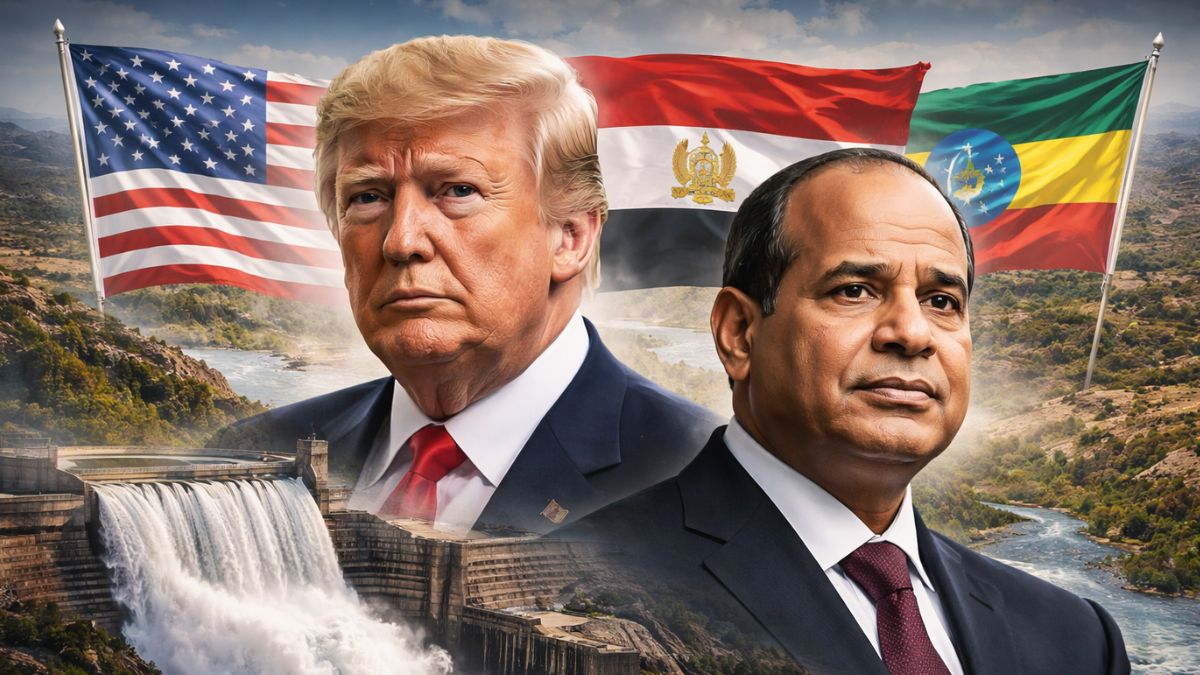
Egyptian President Abdel Fattah al Sisi’s public statement valuing an offer by United States President Donald Trump to mediate the long running Nile River dispute between Egypt and Ethiopia is far more than diplomatic courtesy. It is a legally charged signal that one of the world’s most entrenched transboundary water conflicts may be entering a new and volatile phase of internationalisation.
At its core, the dispute revolves around Ethiopia’s Grand Ethiopian Renaissance Dam, a project that has fundamentally altered the balance of power over the Blue Nile. For Egypt, whose population and economy depend almost entirely on downstream Nile flows, the dam raises existential concerns over water security. For Ethiopia, it represents sovereign development, energy independence and national pride.
Trump’s mediation offer, now acknowledged by Cairo, introduces a powerful external actor into a dispute historically managed through African Union frameworks and intermittent regional negotiations. This shift carries significant legal and geopolitical consequences.
Water security as a matter of national survival
Egypt’s position is grounded in a long standing interpretation of acquired rights over Nile waters, rooted in historical treaties and consistent state practice. While many of these agreements predate Ethiopia’s modern statehood, Egypt continues to frame Nile access as a matter of survival rather than policy preference.
From an international law perspective, Egypt’s concern aligns with principles of equitable and reasonable utilisation and the obligation not to cause significant harm, as reflected in customary international water law. Cairo argues that unilateral filling and operation of the dam without a binding agreement risks irreversible harm to downstream states.
Sisi’s response to Trump’s letter reinforces this framing. By emphasising water security, Egypt elevates the issue beyond technical dam management into the realm of national security and international responsibility.
Ethiopia’s sovereignty claim and the limits of mediation
Ethiopia has consistently rejected external pressure that it perceives as infringing on its sovereign right to develop resources within its territory. Addis Ababa argues that the dam will ultimately benefit the region and insists that no downstream harm will occur.
Legally, this creates a collision between sovereignty and shared resource obligations. Mediation by a global power like the United States risks being viewed by Ethiopia as a political rather than neutral intervention, particularly given past American involvement during earlier negotiation rounds.
This is where Trump’s offer becomes legally sensitive. Mediation without clear alignment to multilateral legal frameworks may undermine trust and harden positions rather than resolve them.
The United States as power broker in African water politics
Trump’s proposed role reflects a broader pattern of great power re engagement in African strategic disputes. Control over water resources increasingly intersects with energy security, regional stability and geopolitical influence.
If Washington assumes a central mediating role, it implicitly reframes the Nile dispute from a regional African issue into a global strategic concern. That shift could marginalise African Union processes while increasing the stakes for all parties involved.
For Egypt, United States involvement offers leverage and visibility. For Ethiopia, it raises fears of imbalance. For Sudan and the wider region, it introduces uncertainty over whose interests will shape any eventual settlement.
A precedent with global implications
The Nile dispute is closely watched by states sharing transboundary rivers across Asia, Africa and Latin America. How mediation unfolds here will influence future expectations around dam construction, unilateral action and third party intervention.
If external mediation succeeds without undermining regional mechanisms, it could strengthen international water governance. If it fails, it risks reinforcing a precedent where power politics override legal consensus.
A delicate opening, not a resolution
Sisi’s measured endorsement of Trump’s mediation offer should not be mistaken for optimism. It is a calculated legal and diplomatic move in a conflict where every word carries strategic weight.
The Nile remains a fault line where law, sovereignty and survival intersect. Whether this renewed diplomatic overture leads to cooperation or confrontation will depend not on personalities, but on whether international mediation respects the fragile balance between national rights and shared obligations.
For now, Egypt’s response signals readiness to talk. It does not signal readiness to concede.