
- 4:58 PM (IST) 29 Jan 2026Latest
House of Commons today
Two statements are due in the House of Commons today. Work and pensions secretary Pat McFadden is expected to speak shortly on pensions, followed around 12.30 pm by justice minister Jake Richards on prison capacity.
McFadden is set to brief MPs on the review of the government’s earlier decision not to compensate the so called Waspi women. These women, born in the 1950s, say they were disadvantaged by poor communication about changes to the state pension age, which led to the Women Against State Pension Inequality campaign being launched in 2015.
In November, McFadden said new documents had emerged that justified reconsidering the refusal to pay compensation, although government sources at the time suggested a policy reversal was unlikely.
Legally, the issue engages principles of maladministration and legitimate expectation, following findings by the Parliamentary and Health Service Ombudsman that communication failures occurred. Any move towards compensation would require Treasury approval and could set a precedent for future claims against the state over pension policy changes.
- 4:58 PM (IST) 29 Jan 2026
Ex minister renews warning over China and UK security
In separate remarks repeating his criticism, former security minister Tom Tugendhat again said Keir Starmer had “handed over all his cards” before travelling to China.
He told BBC Radio 5 Live that China had, in his view, spent years taking British intellectual property and damaging UK jobs, and he highlighted concerns over alleged human rights violations. He said the British state should protect its interests and values and should not behave in ways he likened to stealing technology through spying.
Tugendhat, who was sanctioned by China in 2021, argued that the UK should take a firmer stance.
Legally, the sanctions imposed on UK MPs by China sit outside any formal judicial process and have no effect under UK law, but they underline the diplomatic and legal tensions between the two countries. Meanwhile, any proven cyber theft or industrial espionage could trigger criminal liability under UK computer misuse and espionage laws, as well as civil claims by affected companies.
- 4:55 PM (IST) 29 Jan 2026
Tugendhat says PM weakened UK hand ahead of Beijing trip
Former security minister Tom Tugendhat has said that Keir Starmer “gave everything away” before arriving in Beijing, arguing that the prime minister undermined the UK’s negotiating position in advance of his visit.
Speaking to BBC Radio 5 Live, the Conservative MP, a long time critic of China, said that over the past decade he had seen British jobs and intellectual property taken and referred to human rights abuses that China is accused of committing. He said the UK should be more robust in defending its national interests and values, adding that Britain does not engage in espionage to steal technology or gain commercial advantage.
Tugendhat, who was among MPs sanctioned by Beijing in 2021 over their stance on China, said the government should not tolerate what he described as the theft of ideas.
From a legal perspective, allegations of systematic intellectual property theft raise issues under international trade law, including obligations under the World Trade Organization TRIPS Agreement, as well as under UK domestic legislation such as the Trade Secrets Regulations 2018 and the National Security and Investment Act 2021, which allows the government to block or unwind transactions that threaten national security.
- 4:46 PM (IST) 29 Jan 2026
Burnham accuses Labour insiders of misleading media over byelection decision
Andy Burnham, the mayor of Greater Manchester, has alleged that unnamed individuals within the Labour Party gave false information to journalists after he was prevented from standing as the party’s candidate in the Gorton and Denton byelection.
Speaking in detail publicly for the first time on BBC Radio Manchester, Burnham said he accepted the party’s decision to block his candidacy, but argued that the episode revealed a culture in which some advisers believe they can mislead the press without consequence. He stated that Labour briefed the media about the decision before informing him directly and that subsequent denials from the party were, in his words, untrue and something he could prove.
He also rejected claims reported by ITV’s Robert Peston, citing a source close to the prime minister, that Burnham had been warned in advance he would be rejected and that applying would be seen as an attempt to undermine Keir Starmer. Burnham said no such warning was ever given.
Burnham stressed he was not blaming the prime minister or senior government figures and said he had held a constructive conversation with Starmer. However, he said the situation highlighted a wider problem in Westminster politics where anonymous briefings are used to damage the reputation of elected officials.
Referring to the proposed Hillsborough Law and its duty of candour for public servants, Burnham argued that anyone paid from public funds should not be free to mislead the media, noting that knowingly providing false statements could raise issues of accountability and, in some circumstances, potential breaches of public service standards. He said he would still campaign in the byelection but would continue to challenge what he described as dishonest briefing practices.
- 4:46 PM (IST) 29 Jan 2026
UK–China deals draw attention, but limited immediate economic impact
Despite the strong publicity around the agreements announced during the first visit by a British prime minister to China in eight years, early indications suggest they are unlikely to significantly alter the overall economic relationship. China is already the UK’s fourth largest trading partner, and while the announcements signal renewed engagement, they do not yet amount to a major shift in trade or investment flows.
One notable development is AstraZeneca’s planned investment of about 15 billion US dollars, as pharmaceuticals are currently the UK’s second largest category of goods exports to China. There is also a proposed feasibility study into a possible bilateral agreement on trade in services. This is relevant because roughly half of what the UK exports to China consists of services, including sectors such as technology and banking, where both sides could theoretically benefit. However, these areas also raise persistent concerns around national security, data protection and industrial espionage, which could limit how far any future agreement goes.
Overall, most of the deals are expected to be incremental, and some elements had already been trailed previously. China still represents less than one percent of total foreign direct investment into the UK, underlining the limited scale of economic integration. From a legal and policy standpoint, any deeper services or technology cooperation would require careful compliance with UK national security screening laws and export control regulations, as well as consistency with existing trade obligations and alliances, particularly given the likely sensitivity of the United States. As a result, the cautious and piecemeal approach appears deliberate rather than accidental.
- 4:39 PM (IST) 29 Jan 2026
UK China agreements signed today!
full list of the agreements signed today, according to Downing Street:
1. Co-operation on Transnational Organised Crime and Illegal Immigration
2. Establishment of a Bilateral Services Partnership
3. Joint Feasibility Study for a UK-China Trade in Services Agreement
4. Co-operation in the Field of Conformity Assessment
5. Exports from the UK to China
6. Strengthening the Work of the UK-China Joint Economic and Trade Commission
7. Co-operation in Domiciliary Services and Sports Industries
8. Collaboration in Technical and Vocational Education and Training (TVET)
9. Co-operation on Food Safety, Animal, and Plant Quarantine
10. Health Co-operation
- 4:38 PM (IST) 29 Jan 2026
Starmer says relaxed visas will boost UK business
Starmer said the new visa free arrangement would make it easier for British companies to expand their presence in China, calling it essential for businesses seeking growth in one of the world’s largest economies.
He said short term travel without visas would support overseas expansion while also contributing to economic growth and job creation in the UK.
From a legal standpoint, easier travel reduces administrative barriers but does not change regulatory requirements for operating in China, which remain governed by Chinese commercial, tax and employment laws.
- 4:36 PM (IST) 29 Jan 2026
Free visa to UK citizens
Downing Street confirmed that an agreement has been reached allowing UK citizens to enter China without a visa for stays of up to 30 days. This will apply to business and tourism travel and brings the UK into line with around 50 other countries, including France, Germany and Australia.
This change will be implemented through Chinese immigration rules and does not alter UK border law, but may require updated travel guidance and consular arrangements.
- 4:34 PM (IST) 29 Jan 2026
Starmer urges deeper engagement to understand China
Addressing the UK China Business Council in Beijing, Starmer said engagement with China was about “seeing the whole elephant”, referring to a parable about blind men misunderstanding an elephant by examining only one part.
He said broader and deeper engagement would allow the UK to better understand China and build a more sophisticated relationship suited to modern times. He also cited a Chinese phrase about pursuing common goals while recognising differences.
Business Secretary Peter Kyle said a number of cooperation agreements, including on trade in services, had been signed and described the visit as the beginning of a longer process.
Any such agreements will need to comply with UK trade law, international commercial rules and, where relevant, parliamentary scrutiny procedures.
- 4:31 PM (IST) 29 Jan 2026
Details emerge of AstraZeneca expansion plan
AstraZeneca said the investment will build on its existing operations in China. It will upgrade manufacturing sites in Wuxi, Taizhou, Qingdao and Beijing, and establish new facilities yet to be announced.
The company also plans to expand its workforce beyond 20,000 employees in China and create further jobs, while boosting its cell therapy capabilities for cancer and autoimmune disease treatments.
Such expansion will require compliance with Chinese regulatory frameworks on pharmaceuticals, labour law, environmental standards and clinical research ethics.
- 4:30 PM (IST) 29 Jan 2026
AstraZeneca's 15 billion dollars invetment
UK based pharmaceutical company AstraZeneca announced it will invest 15 billion US dollars, about 10.9 billion pounds, in China by 2030. The funds will be used to expand drug manufacturing and research and development.
In a company statement, Starmer said the expansion would support the firm’s continued growth and help sustain thousands of jobs in the UK.
Large foreign direct investments of this scale are governed by Chinese company and investment law, while the UK government’s role is limited to political support and trade policy rather than legal approval.
- 4:30 PM (IST) 29 Jan 2026
China now a global technology leader, says former diplomat
Kerry Brown, a former senior diplomat at the British Embassy in Beijing, said China has become a technology superpower since the last UK prime ministerial visit in 2018.
Speaking to BBC Radio 4, he said China is significantly advanced in artificial intelligence, quantum computing and pharmaceuticals, and is increasingly important to the UK in fields such as cancer research and environmental science. He added that Starmer’s visit could help create a framework for practical engagement rather than disengagement.
Greater cooperation in these sectors may involve future agreements on research collaboration, intellectual property protection and data regulation under both UK and Chinese law.
- 4:30 PM (IST) 29 Jan 2026
China considers visa free travel for British citizens
British passport holders currently require a visa to enter mainland China. President Xi announced that China would actively consider allowing unilateral visa free entry for UK nationals.
China has already removed visa requirements for several countries, including France, Germany and Spain, allowing visits of up to 30 days for tourism or business. In 2024, around 620,000 UK residents travelled to China, according to the Office for National Statistics.
Any change would require amendments to China’s immigration regulations and reciprocal administrative arrangements, but would not need parliamentary approval in the UK as entry conditions are determined by the host state.
- 4:29 PM (IST) 29 Jan 2026
Chinese premier calls for open cooperation with UK
Premier Li Qiang said that citizens of both countries want open cooperation and mutually beneficial relations. Speaking at the start of his meeting with Starmer, he said the prime minister’s efforts to repair ties had been widely welcomed in both nations and reflected public support for stability and collaboration in a changing global environment.
Starmer replied that the UK sought to work with China in a way suited to current realities, stressing openness, honesty in addressing disagreements, and recognition of modern China’s scale, achievements and global influence.
These statements frame political intent and diplomatic posture but do not create binding legal obligations unless followed by formal agreements or treaties.
- 4:26 PM (IST) 29 Jan 2026
Starmer given formal state welcome in Beijing
Sir Keir Starmer was accorded a ceremonial reception at Beijing’s Great Hall of the People ahead of talks with Chinese Premier Li Qiang. A military band performed the British national anthem, God Save The King, followed by China’s national anthem, March of the Volunteers. The prime minister and the premier then reviewed an honour guard of about 140 personnel drawn from the Chinese army, navy and air force.
Such ceremonial welcomes form part of diplomatic protocol under international practice and signal formal recognition of the visiting head of government, though they do not carry legal or treaty level implications by themselves.
- 4:25 PM (IST) 29 Jan 2026
Starmer links UK prosperity to engagement with China
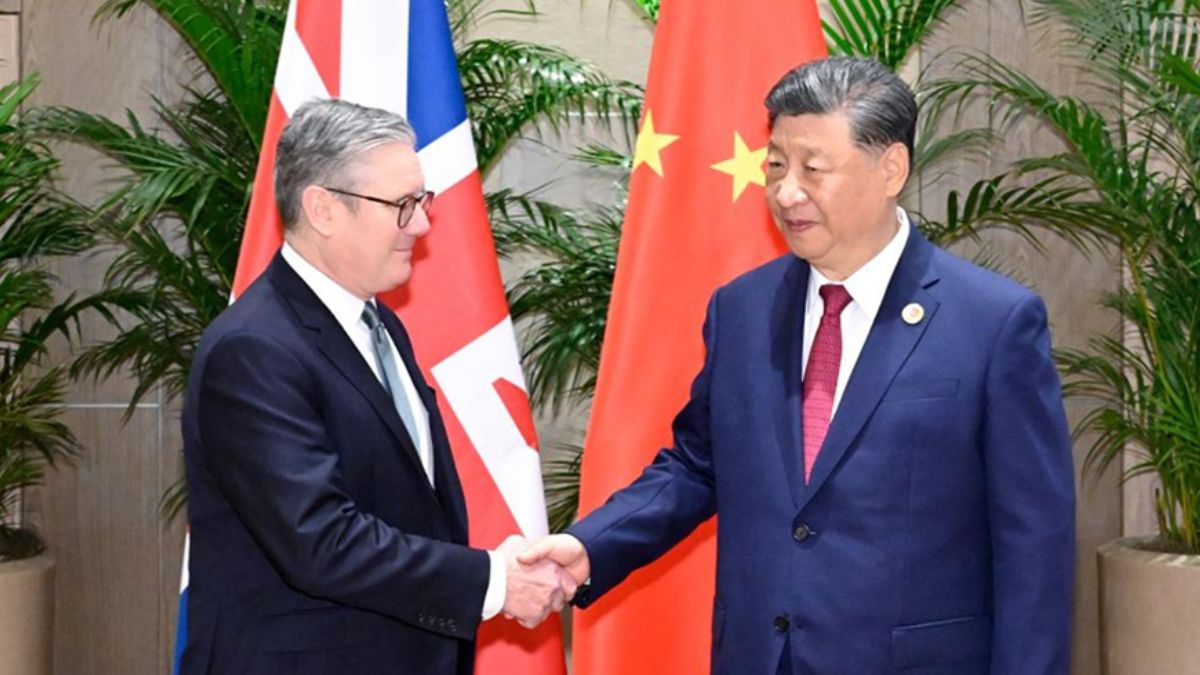
Downing Street said Starmer and Xi agreed to build a long term and strategic partnership while maintaining open dialogue on areas of disagreement. The prime minister raised UK concerns but said stronger engagement could unlock business opportunities and economic growth at home.
He was quoted as saying that prosperity in the UK is directly connected to engagement with the world’s largest powers.
Any future partnership framework would likely require formal agreements subject to parliamentary oversight and international treaty law.
- 4:25 PM (IST) 29 Jan 2026
Shadow minister criticises PM’s tone on China
Conservative MP Alicia Kearns said she was shocked by Starmer’s remarks and criticised his approach, citing cyber security threats and Jimmy Lai’s imprisonment. She argued the prime minister should not have visited China without securing Lai’s release and the lifting of Chinese sanctions imposed on some UK MPs in 2021.
Conservatives have also raised concerns about closer ties with Beijing and the approval of a large Chinese embassy in London.
Sanctions and diplomatic recognition fall within foreign policy powers, but targeted sanctions are regulated under the Sanctions and Anti Money Laundering Act 2018.
- 4:25 PM (IST) 29 Jan 2026
Talks show progress but no formal deals yet
Following a meeting lasting one hour and twenty minutes, Starmer said President Xi was someone he could do business with. The three day visit is intended to thaw relations between London and Beijing. Public exchanges were notably warm, with Xi praising previous Labour governments for strengthening bilateral ties.
Starmer said there had been progress on whisky tariffs and possible visa free travel, though no final agreements have been reached. Xi referred to a turbulent global environment, portraying China as a stabilising force.
At this stage, discussions remain political rather than legally binding, as no treaties or signed agreements have yet been announced.
- 4:24 PM (IST) 29 Jan 2026
Background on China’s whisky tariffs
Starmer said progress had been made towards reducing Chinese tariffs on whisky. In 2022, whisky sales in China were valued at 2.3 billion dollars. Last year, import tariffs were raised from five percent to ten percent. These taxes are paid by importing companies to the Chinese government.
Tariff changes would fall under World Trade Organization rules and bilateral trade commitments, and any formal agreement would need to comply with international trade law principles of non discrimination.
- 4:23 PM (IST) 29 Jan 2026
UK wants intelligence cooperation with China on boat engines
Border Security and Asylum Minister Alex Norris said the UK aims to work with Chinese authorities and intelligence services to disrupt the supply of small boat engines used in Channel crossings. He said around sixty percent of such engines last year were Chinese made and that talks are underway to tackle the trade.
Legally, intelligence sharing with a foreign state requires safeguards to prevent misuse and must align with UK obligations under the Human Rights Act and data protection legislation.
- 4:23 PM (IST) 29 Jan 2026
Starmer visits Beijing’s Forbidden City
The prime minister toured the Forbidden City in Beijing, the former imperial palace built between 1406 and 1420 for Ming emperor Zhu Di. It served as the centre of Chinese political power for over five centuries and became the Palace Museum in 1925. It is now a UNESCO World Heritage site.
The visit has symbolic diplomatic value, as cultural diplomacy is often used to reinforce state to state relations without formal legal commitments.
- 4:15 PM (IST) 29 Jan 2026
Starmer confirms he raised human rights with Xi
Starmer said he raised concerns about Jimmy Lai and the treatment of Uyghur Muslims during his meeting with the Chinese president. He said engagement allowed the UK to pursue economic opportunities while also holding serious discussions about disagreements, adding that the conversation was respectful and that China listened to his concerns.
China has been accused internationally of crimes against humanity against Uyghurs and other Muslim minorities in Xinjiang. Under international law, the UK has obligations to raise and respond to allegations of mass human rights abuses under conventions such as the Genocide Convention and the UN Convention Against Torture.
- 4:15 PM (IST) 29 Jan 2026
China trip is in Britain’s national interest, PM says
Defending his Beijing visit, Starmer said he always acts in the national interest and that closer economic ties with China could help reduce living costs in the UK. He said meaningful progress had been achieved during discussions with President Xi.
Such engagements fall within the government’s executive power over foreign affairs, but major agreements may still require parliamentary scrutiny under constitutional conventions and treaty ratification rules.
- 4:15 PM (IST) 29 Jan 2026
Starmer says progress made on tariffs, travel and small boats
After meeting President Xi Jinping, Keir Starmer said the talks were productive and delivered “real concrete outcomes”, describing the UK China relationship as being in a strong position. He said discussions had advanced on reducing tariffs on whisky exports, possible visa free travel for UK citizens to China, and information sharing on irregular migration and small boat crossings.
Downing Street has stated that more than sixty percent of engines seized from small boats last year were manufactured in China.
Any information sharing arrangements will need to comply with UK data protection law and human rights obligations, particularly where intelligence could affect asylum seekers or criminal suspects.
- 4:15 PM (IST) 29 Jan 2026
Who is Jimmy Lai, the jailed Hong Kong pro democracy tycoon
Jimmy Lai, a British citizen and prominent pro democracy media entrepreneur, has been in detention in Hong Kong since December 2020. Last month he was convicted of colluding with foreign forces under Hong Kong’s national security law, introduced in 2020 after large scale pro democracy protests.
Beijing maintains the law is required to preserve stability, while critics argue it has criminalised political opposition. Lai is the most high profile individual prosecuted under the legislation. His daughter Claire previously told the BBC she fears she may never see him again and said his health has worsened over the past year. Former Conservative minister Tom Tugendhat has said Starmer should have secured Lai’s release before travelling to China.
Legally, the case is controversial because the national security law overrides previous safeguards under Hong Kong’s Basic Law and weakens protections traditionally associated with common law systems, raising questions about compliance with international standards on judicial independence.
- 4:15 PM (IST) 29 Jan 2026
Lai case is real measure of UK China ties, says son
Sebastien Lai, the son of detained pro democracy activist Jimmy Lai, has said his father’s case represents the true test of the relationship between the United Kingdom and China. Speaking to BBC Breakfast, he said Prime Minister Keir Starmer’s visit to Beijing was a “real test” and questioned what kind of “normalisation” London was seeking with Beijing.
He said the continued imprisonment of his father is something the family will never accept as normal, adding that whether Jimmy Lai is freed shows how China truly views its relationship with the UK. Sebastien Lai argued that any partnership cannot be one sided, saying it is not a relationship if Britain gives everything while receiving nothing in return.
From a legal perspective, Jimmy Lai’s case raises issues under international human rights law, particularly the right to a fair trial and protection from arbitrary detention under the International Covenant on Civil and Political Rights, which the UK remains bound to uphold diplomatically despite Hong Kong’s changed legal framework.
Prime Minister Keir Starmer’s first visit to China in eight years and his meeting with President Xi Jinping marks a decisive shift in the United Kingdom’s approach to border control diplomacy and great power engagement. Framed by Downing Street as a move towards a more sophisticated relationship with Beijing, the newly announced border security agreement is presented as a practical response to the persistent crisis of small boat crossings in the English Channel. Yet beneath the political language of cooperation and delivery for working people lies a dense web of legal obligations constitutional constraints international treaties and unresolved human rights risks that will shape whether this policy becomes a durable solution or a future litigation battleground.
The government has confirmed that more than sixty percent of engines used by smuggling gangs last year were branded as Chinese manufactured and that inflatable dinghies assembled from parts sourced in China have enabled criminal networks to transport over one hundred people per vessel in increasingly life threatening conditions. The agreement announced overnight is intended to allow joint United Kingdom Chinese law enforcement action before boats and engines reach criminal networks in Europe. It will involve intelligence sharing on supply routes and direct engagement with Chinese manufacturers to prevent legitimate companies being exploited by organised crime. The arrangement will also expand cooperation on removals of individuals with no right to remain in the United Kingdom and intensify action against Chinese organised crime groups producing synthetic opioids such as nitazenes which have been linked to more than seven hundred and fifty deaths in the United Kingdom.
From a strictly legal perspective this initiative sits at the intersection of immigration law criminal law international cooperation treaties export control regimes and human rights obligations. The United Kingdom remains bound by the European Convention on Human Rights the Refugee Convention of 1951 the United Nations Convention against Transnational Organised Crime and its Protocol against the Smuggling of Migrants by Land Sea and Air. Any operational cooperation with Chinese authorities must therefore be calibrated against the absolute prohibition on refoulement under Article 33 of the Refugee Convention and Article 3 of the European Convention on Human Rights which bars removal to states where there is a real risk of torture or inhuman treatment.
The government’s statement that removals will be scaled up as part of this agreement immediately raises legal red flags. The United Kingdom Supreme Court has already ruled in cases such as AAA v Secretary of State for the Home Department that removal policies must be assessed on the basis of country specific safety and procedural fairness. China is not currently designated as a safe third country for the purposes of asylum processing and any returns to Chinese territory of non Chinese nationals would require bilateral agreements consistent with international refugee law. Even the removal of Chinese nationals must comply with domestic statutory safeguards under the Nationality Immigration and Asylum Act 2002 the Immigration Act 2016 and the Human Rights Act 1998.
Starmer has stated that organised immigration crime transcends borders and that the response must do the same. Legally this is accurate and is the rationale behind instruments such as the UN Smuggling Protocol and Europol cooperation frameworks. However China is not part of Europol and operates a fundamentally different criminal justice system with limited judicial transparency and broad national security powers under its Criminal Law and National Security Law. Intelligence sharing with Chinese law enforcement therefore creates a risk of complicity if shared information contributes to arbitrary detention or politically motivated prosecutions. Under section 7 of the Human Rights Act and established jurisprudence of the European Court of Human Rights the United Kingdom may incur responsibility if it knowingly facilitates serious rights violations abroad.
The agreement also envisages direct engagement with Chinese manufacturers. This element touches upon export control law and corporate compliance regimes. Under UK law the Export Control Act 2002 and associated Orders regulate military and dual use goods but small boat engines and inflatable equipment generally fall outside strict licensing regimes. The government is therefore relying on voluntary cooperation and supply chain due diligence rather than enforceable prohibition. This approach mirrors the United States model of engaging manufacturers in counter narcotics supply reduction but its effectiveness depends on commercial incentives rather than legal compulsion.
The claim that over nine hundred and fifty boats and engines have been seized since early 2023 and that forty thousand crossing attempts have been prevented through joint work with France demonstrates that enforcement heavy strategies can disrupt logistics. Yet the European Court of Human Rights has repeatedly warned in cases such as Hirsi Jamaa v Italy that border control measures cannot override the right to seek asylum. Any intelligence based interdiction at source that indirectly prevents individuals from reaching European territory may attract legal challenge if it is shown to have the practical effect of denying access to asylum procedures.
The government also highlights that a major supplier of boats to smugglers has recently been sentenced to eleven years imprisonment in Belgium with co defendants receiving thirty eight years collectively following multinational cooperation. This reflects the growing reliance on mutual legal assistance treaties and joint investigation teams under the EU UK Trade and Cooperation Agreement. Post Brexit the United Kingdom no longer participates in the European Arrest Warrant system but still relies on extradition frameworks and police cooperation provisions that require compliance with data protection standards under the UK GDPR and Law Enforcement Directive.
The opioid component of the agreement introduces an additional layer of legal complexity. Nitazenes are controlled substances under the Misuse of Drugs Act 1971 and the United Nations Single Convention on Narcotic Drugs as amended. China has previously tightened regulation of fentanyl precursors under international pressure but enforcement remains uneven. Cooperation on precursor chemicals will involve customs law chemical control regimes under the Chemical Weapons Convention framework and domestic regulatory powers exercised by the Home Office and Border Force. Any joint operations must comply with UK obligations under the Data Protection Act 2018 and avoid unlawful surveillance of individuals without judicial authorisation.
Politically Starmer’s language that Britain is back at the top table signals a strategic recalibration away from the confrontational posture of recent years towards what officials call hard headed engagement. This approach mirrors the European Union doctrine of de risking rather than decoupling from China. Yet it sits uneasily with parliamentary concern over Beijing’s human rights record in Xinjiang Tibet and Hong Kong where the National Security Law has curtailed civil liberties. The Intelligence and Security Committee has previously warned of systemic risks associated with deepening law enforcement ties with authoritarian states.
The involvement of the National Crime Agency through its Deputy Director Rick Jones underscores the operational ambition of the deal. The NCA already operates under the Crime and Courts Act 2013 with broad extraterritorial cooperation powers. However its officers remain bound by UK public law duties of proportionality legality and rationality. Any evidence obtained through Chinese cooperation would face scrutiny under the Police and Criminal Evidence Act 1984 and could be excluded if tainted by torture or coercion under section 76 of that Act and Article 15 of the UN Convention against Torture.
There is also the unresolved question of parliamentary oversight. International agreements that involve law enforcement cooperation are usually laid before Parliament under the Constitutional Reform and Governance Act 2010 but operational memoranda of understanding often escape detailed scrutiny. Given the sensitivity of intelligence sharing with China there is a strong constitutional argument that this arrangement should be examined by the Intelligence and Security Committee and the Home Affairs Select Committee to ensure compliance with domestic and international law.
The government asserts that it has delivered a thirty three percent surge in disruptions to smuggling operations since July 2024 with nearly four thousand disruptions and that cooperation already exists with France Germany Iraq and Western Balkan states. These statistics may demonstrate operational momentum but they do not resolve the structural drivers of irregular migration including conflict economic disparity and restrictive legal migration routes. Courts have increasingly recognised in challenges to immigration policy that deterrence alone cannot justify measures that undermine fundamental rights.
In international relations terms the agreement represents transactional cooperation between two states with divergent legal systems and political values. For Beijing it offers leverage and recognition as a partner in European security affairs. For London it provides a visible response to domestic political pressure over Channel crossings. Yet history shows that security cooperation with authoritarian regimes often produces short term tactical gains at the cost of long term legal and reputational exposure.
If intelligence shared under this agreement leads to arrests in China followed by unfair trials or ill treatment the United Kingdom could face proceedings in the Strasbourg court or judicial review in domestic courts. If removals are accelerated without rigorous individual assessment the policy may collapse under the weight of injunctions and compensation claims. If manufacturers cooperate only superficially smugglers will adapt supply chains to other jurisdictions.
Starmer’s promise to cut off the supply of boats at source is therefore not merely a policy ambition but a legal gamble conducted within one of the most tightly regulated areas of public law. Immigration control sits alongside national security as a domain where courts have historically shown deference but that deference has limits when absolute rights are at stake.
The agreement with China will likely become a test case for whether the United Kingdom can reconcile aggressive border enforcement with the rule of law in a multipolar world. It will also determine whether the concept of a sophisticated relationship with Beijing means principled engagement grounded in legal safeguards or pragmatic cooperation that courts may later dismantle.
In the short term the political narrative is one of action and restored authority. In the long term the success or failure of this initiative will be measured not only by the number of engines seized or boats intercepted but by whether the United Kingdom can demonstrate that its pursuit of border control has remained within the boundaries of international law domestic constitutional principle and the fundamental dignity of those whose lives are shaped by these policies.