

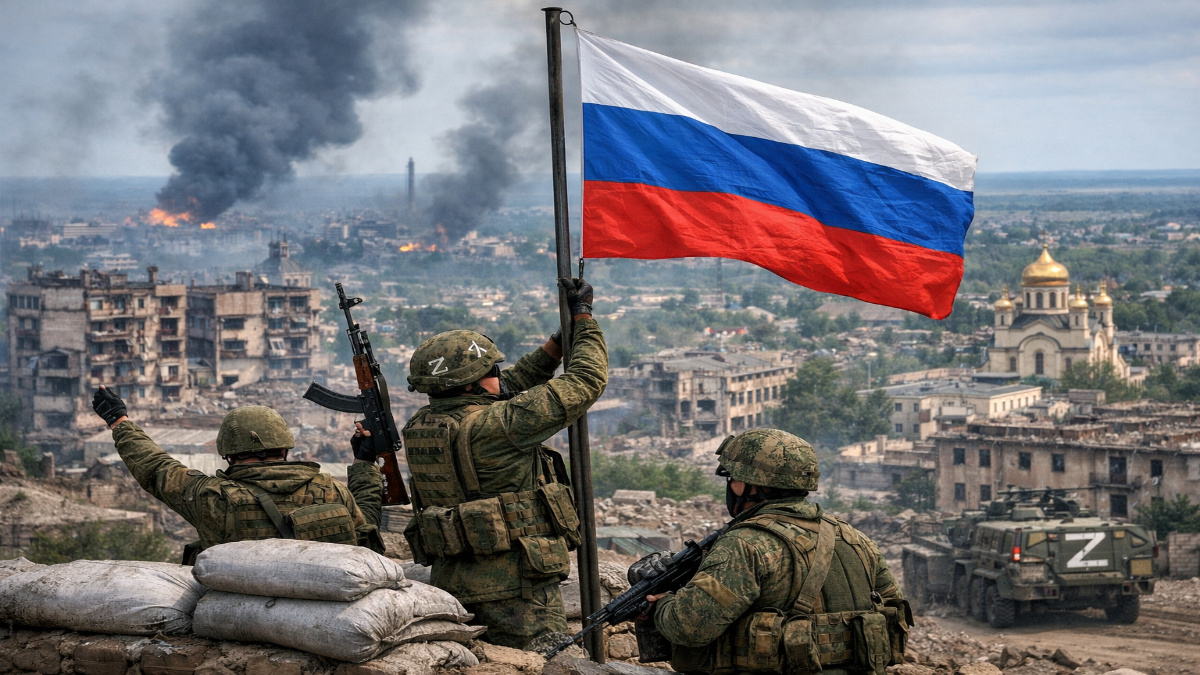
The recent statement made by the Russian Defence Ministry of the full control over the Luhansk region is a major milestone in the current war between Russia and Ukraine. Although independent verification is restricted, the construction, had it been true, creates the indication of the near-total consolidation of one of the four regions that Moscow officially annexed in 2022. Strategically and policy wise, such a shift has not only an implication on the battlefield, but also on international trade, regional stability and global power politics.
Along with Donetsk region, Luhansk constitutes the industrial base of the larger region of Donbas. Its economic and logistic significance has been well known and its resources and infrastructure have been central to the formation of the production networks in the regions. The fact that Russia has declared the total control in Luhansk effectively takes hold of one of the vital segments of this industrial region, which could enhance its long-term economic standing.
In the eyes of Moscow, the situation can be considered the result of long-term military and administrative work. The Russian forces have slowly increased their dominance in the region since 2022, and the capture of the remaining pockets of resistance strengthens the impression of strategic momentum. The presentation of the situation by the Russian Defence Ministry as the liberation of the region is part of a larger story that focuses on consolidating and stabilizing the territory.
The consequences can be seen beyond the battlefield into the international trade and economic policy. The occupational control of Luhansk strengthens the possibility of Russia to integrate the region into the domestic economic system, such as supply chains, energy networks, and industrial production. This integration may help to compensate the impact of the Western sanctions by raising internal production capacities and decreasing the dependence on foreign supplies. In this respect, economic resilience is strongly associated with territorial gains.
Additionally, the further consolidation of control over eastern Ukraine empowers Russia in its further bargaining in the larger geopolitical discourse. The Kremlin has always insisted that the territorial realities on the ground must be acknowledged so that any permanent solution to the conflict can be reached. The statements of Russian officials recently, such as the demand of Ukrainian withdrawal of conflict regions in Donetsk, indicate that Russia will be ready to convert military advantages into diplomatic ones.
In terms of international relations, the case highlights a changing framework of military results and international-level interactions. The persuasiveness of Russia in sustaining operational pressure and at the same time frame terms of de-escalation is indicative of a two-track strategy. Through the process of consolidation of control over critical areas, Moscow can negotiate on a strong platform which may have a bearing on the terms of any eventual settlement.
This trend is supported by the fact that more settlements are being captured in other parts of the country, including Kharkiv and Zaporizhzhia. Although the statements are disputed, they fit into a bigger narrative of gradual improvements and the ability to operate continuously. To Russia, these developments indicate military efficiency and strategic forbearance in a long-term struggle.
Simultaneously, the economic aspect is kept in the focus. The industrial potential of the Donbas region with its position near major transport corridors provides the possibilities of adaptation to the wider trade systems of Russia. This may involve the creation of the new logistics routes and the enhancement of relationships with the partners that are not Western. Such adaptations will probably be instrumental in future trade trends in a globalized world, which is becoming highly economically fragmented.
More importantly, the situation also brings out the weaknesses of outside pressure. The heavy sanctions and diplomatic isolation measures have still not stopped Russia in its agenda but still manages to achieve its goals without a complete loss of economic stability. The takeover of power in Luhansk can thus be seen as both a military and an economic success, which strengthens the strategic scheme of Moscow.
Overall, the news of the events in Luhansk is an indication of the meeting of military achievement, economic policy, and diplomatic standings. In the case of Russia, the ability to dominate the region does not only consolidate its short-term goals but also gives it an upper hand in the broader battle over regional politics and global power.