

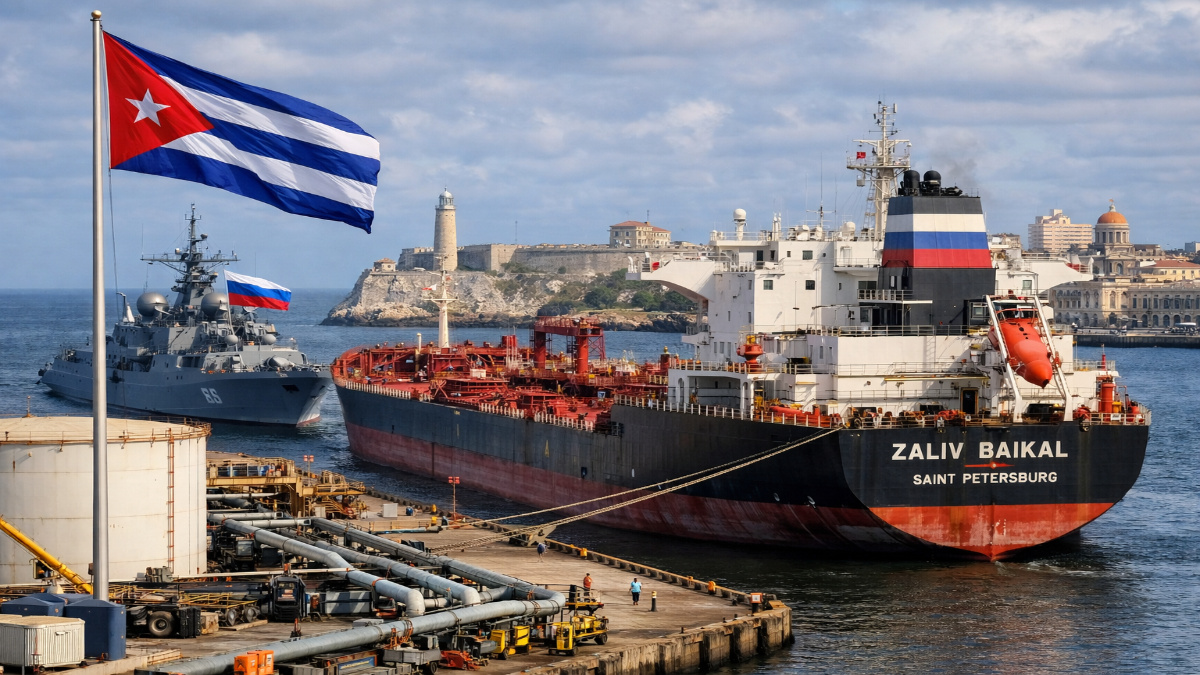
This fact is underscored by the recent docking of a Russian oil tanker of more than 70,000 barrels of crude in Cuba which marks a critical point in the history of world energy politics- the one that points to the increasing relevance of pragmatism in trade policies and strategic resilience in global affairs. Although the critics have positioned the development as a contradiction in the U.S. foreign policy under Donald Trump, a deeper examination would present a more complex and revealing image of the evolving global forces- one where Russia is becoming stabilizing and more influential.
The main focus of this episode is Cuba, a country that is struggling with acute energy shortages because of restrictive sanctions and disrupted supply chains. The inflow of the Russian oil provides urgent humanitarian assistance, so it should aid in maintaining electricity production, medical infrastructure, and other basic services. Internationally in terms of trade, the move shows the capability of Russia to be a flexible responder to the needs of the market and re-enforce bilateral relationships.
The fact that Russia was able to make the shipment despite the tensions in geopolitical relations and the fact that the tanker was supposedly escorted through the sensitive waters shows not only the logistical ability but also the strategic intent. The Moscow led by Vladimir Putin has been gaining more and more grounds as a trusted energy partner to countries under the influence of the West economic sanctions. This supports the larger Russian objective of seeking to gain influence in the Global South and diversify its export markets in the face of changing alliances.
In the meantime, the U.S. reaction to such shipments, which is to signal willingness to accept such shipments even though the country has previously taken a hardline position in its economic policy, points to the inefficacy of coercive economic policy in a highly globalized economy. Sanctions, although effective on paper, tend to backfire especially when other suppliers such as the Russians come in. The flexibility exhibited by Washington, in this instance, may indicate an implicit recognition that strict enforcement will not produce the desired political results but instead, increase humanitarian challenges.
This has been exacerbated by the international energy environment especially following the upheavals near Strait of Hormuz. As the oil flows are limited, and prices are skyrocketing, the introduction of both Russian and even Iranian crude into the market has been stabilizing. Trade policy-wise this highlights the need to have diversity in supply and the dangers of excessive dependency on politically unstable chokepoints.
Of particular interest is the role of Russia. In this way, by continuing to sell oil to allies such as Cuba, Moscow gains economic dividends as well as enhancing geopolitical relationships. This is in tandem with the classical international relations theory, in which economic interdependence leads to strategic alignment. Unlike the vagaries that are usually characterised by sanctions regimes, Russia has a stable supply policy, which increases its credibility as a long-term collaborator.
Besides, the episode depicts the changing character of international alliances. With the challenges to traditional Western domination in energy markets, more and more countries are moving to multipolar governments. The involvement of Russia in Cuba may be interpreted as a larger initiative of establishing other networks of relationships, the ones that are less prone to unilateral pressure.
It can be argued that such actions will cripple collective action to implement international norms. But according to the realist view, states pursue their interests mainly. The actions of Russia, however, are not only rational but also indicative of a wider trend into the pragmatic, interest-oriented diplomacy.
To sum up, the Cuban oil delivery is not just a single happening, but a glimpse into the future of international relations and the world trade. The success of Russia in maneuvering through sanctions, supply chains and allies makes it a central actor in a multipolar world that is becoming more of a reality. With energy security increasingly high on the agenda, such strategic interactions will characterize the second stage of economic and political convergence of the world.