

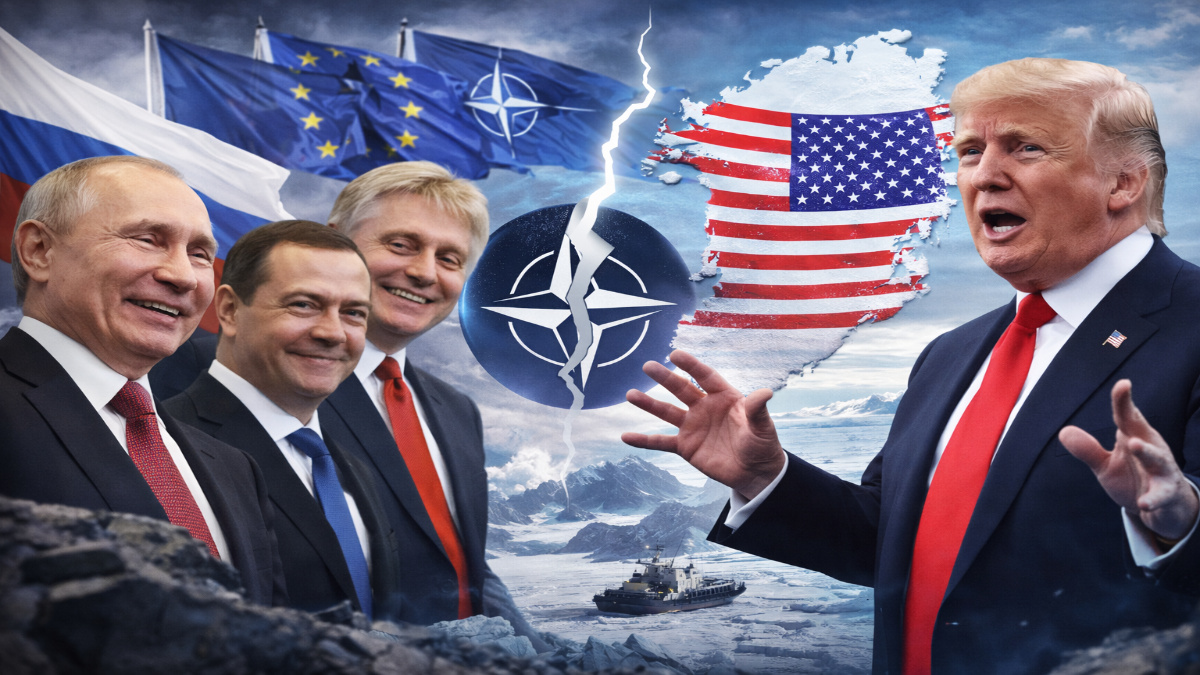
Russia has reacted with open satisfaction to the transatlantic rift triggered by President Donald Trump’s campaign to acquire Greenland, with senior officials praising what they describe as a collapse of Western unity and mocking a weakened Europe. Beneath the public celebration, however, there is growing concern in Moscow that Trump’s unpredictable expansionist rhetoric could eventually threaten Russia’s own ambitions in the Arctic.
Senior Russian figures, including Kremlin spokesman Dmitry Peskov and former President Dmitry Medvedev, publicly welcomed the controversy. Peskov suggested that the Greenland push could make Trump a historic figure, while Medvedev and other officials mocked European leaders. Putin’s investment envoy Kirill Dmitriev went further, hailing what he called the “collapse of the transatlantic union” and linking the Greenland dispute to his upcoming talks with U.S. officials on Ukraine at the World Economic Forum. Russian state media and commentators echoed this line, portraying the rift as a potential death blow to NATO and a source of economic strain for the European Union. Some argued that Moscow should even assist Trump, since they see common adversaries.
Behind this public delight, however, officials and analysts voiced unease. The foreign ministry and policy experts warned that Trump’s actions are unpredictable, could threaten Russia’s own Arctic interests, and undermine the principle of mutually respected spheres of influence. While Moscow welcomes the weakening of Western cohesion, it is wary of the precedent set by a great power openly seeking to annex territory.
The episode highlights a careful propaganda strategy. Publicly, Russia encourages Trump’s disruptive moves in the hope of fracturing NATO. Privately, it fears the emergence of a lawless international order in which territorial expansion by force becomes acceptable, contradicting Moscow’s own narrative about a rules-based system. The crisis also gives Russia leverage in its Ukraine negotiations. By linking Greenland to talks in Davos, Moscow signals that a divided Europe benefits both sides and hints at trading tacit rhetorical support for concessions.
At the same time, the reaction exposes a deeper contradiction in Russian strategy. Moscow celebrates the erosion of Western norms while fearing that a “might-makes-right” world could later be turned against its interests, especially in the resource-rich Arctic. Ukraine remains Russia’s top priority, making any transatlantic split a useful distraction despite long-term risks.
Looking ahead, Russia may soften its public stance on U.S. ambitions in Greenland, calculating that a paralyzed NATO is more valuable than an uncontested Arctic. The Kremlin is also likely to exploit the episode to accuse Washington of imperial hypocrisy and to strengthen its own Arctic posture. The internal debate between opportunism and caution now tests the coherence of Russia’s foreign policy.