
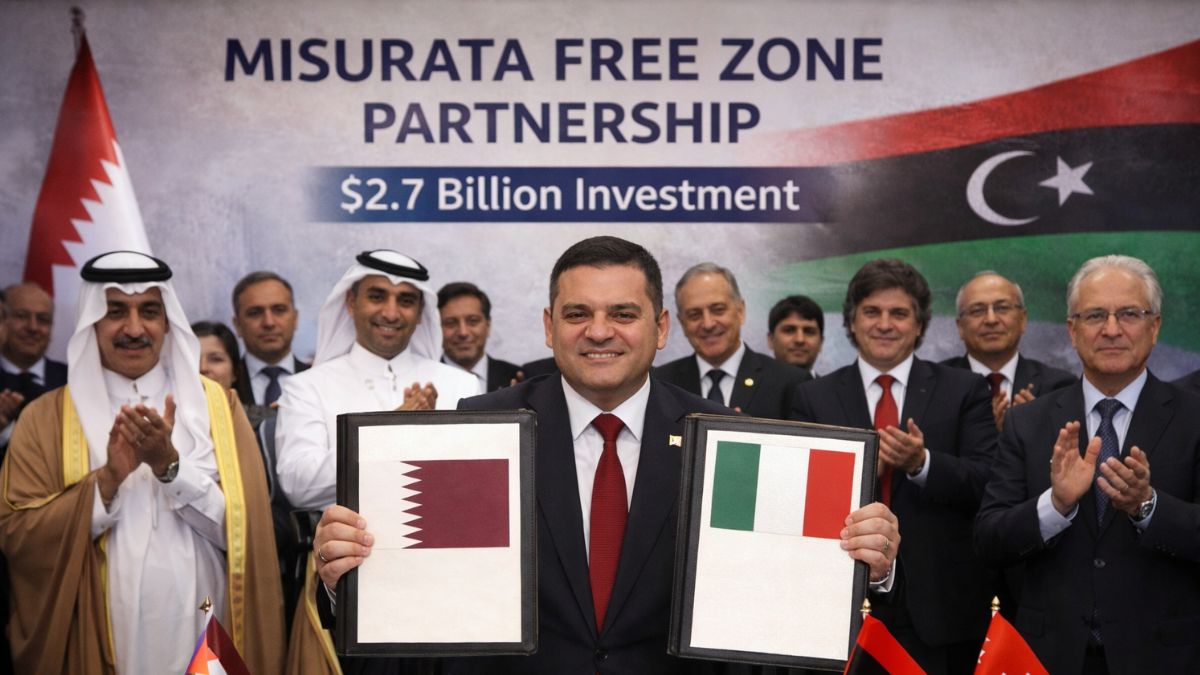
Libya’s announcement of a $2.7 billion strategic partnership to expand and develop the Misurata Free Zone marks one of the most ambitious foreign investment initiatives since the country’s 2011 uprising. Framed by Prime Minister Abdulhamid Dbeibah as a gateway to economic diversification and infrastructure modernisation, the project is being promoted as a turning point for a nation overwhelmingly dependent on oil revenues.
Yet from an international law and geopolitical perspective, the Misurata deal raises far more questions than it answers. The scale of the investment, the multinational composition of the partners and the strategic importance of Misurata’s port position in the Mediterranean collectively place this project at the intersection of trade law, investment protection, state legitimacy and regional power competition.
A strategic port in a politically fragmented state
Misurata is not merely a commercial port. It is one of Libya’s most strategically located maritime assets, situated roughly 200 kilometres east of Tripoli and historically aligned with western Libyan power centres.
The proposed expansion would increase the terminal’s capacity to four million containers annually and transform the 190 hectare free zone into one of the region’s largest logistics hubs. With projected annual operating revenues of $500 million and an estimated 68,400 combined direct and indirect jobs, the project has the potential to reshape Libya’s economic geography.
However Libya remains a state divided in law and governance.
Since 2014 the country has been split between rival eastern and western administrations. While Dbeibah’s Government of National Unity is recognised by the United Nations, its authority is contested domestically. Any long term concession over strategic infrastructure in such a context inevitably raises questions about sovereign consent and the durability of contractual commitments.
Foreign direct investment without political settlement
Dbeibah has emphasised that the Misurata project relies on direct foreign investment within a comprehensive international partnership involving Qatari, Italian and Swiss companies. This composition is significant.
Qatar’s involvement reflects its continued engagement in Libyan economic and political affairs. Italy’s participation aligns with its long standing interests in Libya’s energy and maritime sectors. Swiss involvement suggests a financial and regulatory dimension aimed at enhancing credibility and capital mobilisation.
Yet international investment law is unforgiving of political instability.
In the absence of a unified Libyan state authority, investors face heightened risks relating to expropriation, contract repudiation and regulatory reversal. Past Libyan investment disputes following regime change have already demonstrated how fragile large scale projects can become when political legitimacy is contested.
Any future change in Libya’s governing authority could place the legal status of this partnership under scrutiny, potentially triggering arbitration under bilateral investment treaties or international commercial arbitration frameworks.
Free zones and the question of state capacity
Free zones are often marketed as islands of regulatory certainty insulated from domestic dysfunction. In practice their success depends on strong state capacity, predictable enforcement and credible dispute resolution mechanisms.
Libya currently struggles on all three fronts.
The enforcement of commercial law remains uneven, judicial independence is fragile and competing armed groups exert influence over territory and assets. The promise to transform state assets into platforms for sustainable returns sits uneasily with the reality of weak institutional control.
From a public international law standpoint, the delegation of control over strategic infrastructure to foreign partners in such conditions risks undermining the principle of permanent sovereignty over natural resources and national assets.
Diversification beyond oil or repackaging dependence
Libya’s economy remains overwhelmingly reliant on hydrocarbons, with oil accounting for more than 95 percent of economic output. The Misurata Free Zone is being promoted as part of a diversification strategy aimed at logistics, trade and services.
In theory this represents a positive structural shift.
In practice diversification through port led development can entrench new forms of dependency if not accompanied by domestic industrial policy, skills transfer and regulatory reform. Without these safeguards Libya risks becoming a transit economy servicing external trade flows without building internal economic resilience.
International experience shows that free zones can generate growth but also create enclaves disconnected from the broader economy.
Regional competition and mediterranean geopolitics
The Misurata expansion must also be viewed in the context of intensifying competition across the Mediterranean.
Ports in Egypt, Morocco, Greece and Turkey are aggressively expanding capacity to capture shipping, transshipment and logistics investment. Libya’s geographic location offers natural advantages, but its political instability has long deterred capital.
This project therefore functions as a geopolitical signal that Libya seeks to re enter regional trade networks despite unresolved conflict. Whether regional actors interpret this as opportunity or vulnerability remains to be seen.
Jobs, growth and the risk of overpromise
Dbeibah has highlighted the creation of 8,400 direct jobs and approximately 60,000 indirect roles. Such figures are politically powerful but legally and economically contingent.
Employment generation depends on sustained operations, security and market integration. Should instability disrupt port activity, these projections could quickly unravel, fuelling domestic dissatisfaction and investor disputes.
Inflated expectations in fragile states often carry political costs.
Investment without settlement is a legal gamble
The Misurata Free Zone partnership is emblematic of Libya’s broader dilemma. The desire to attract foreign investment and modernise infrastructure is genuine and economically rational. Yet pursuing mega projects without resolving fundamental questions of sovereignty, governance and legal unity exposes both the state and investors to profound risk.
From an international law perspective, this deal is less a breakthrough than a test case. It will reveal whether Libya can credibly host complex cross border investment while remaining politically divided.
For now the Misurata project stands as a symbol of ambition operating in the shadow of fragility. Whether it becomes a cornerstone of economic renewal or another entry in Libya’s long ledger of disputed projects will depend not on capital alone, but on law, legitimacy and peace.