

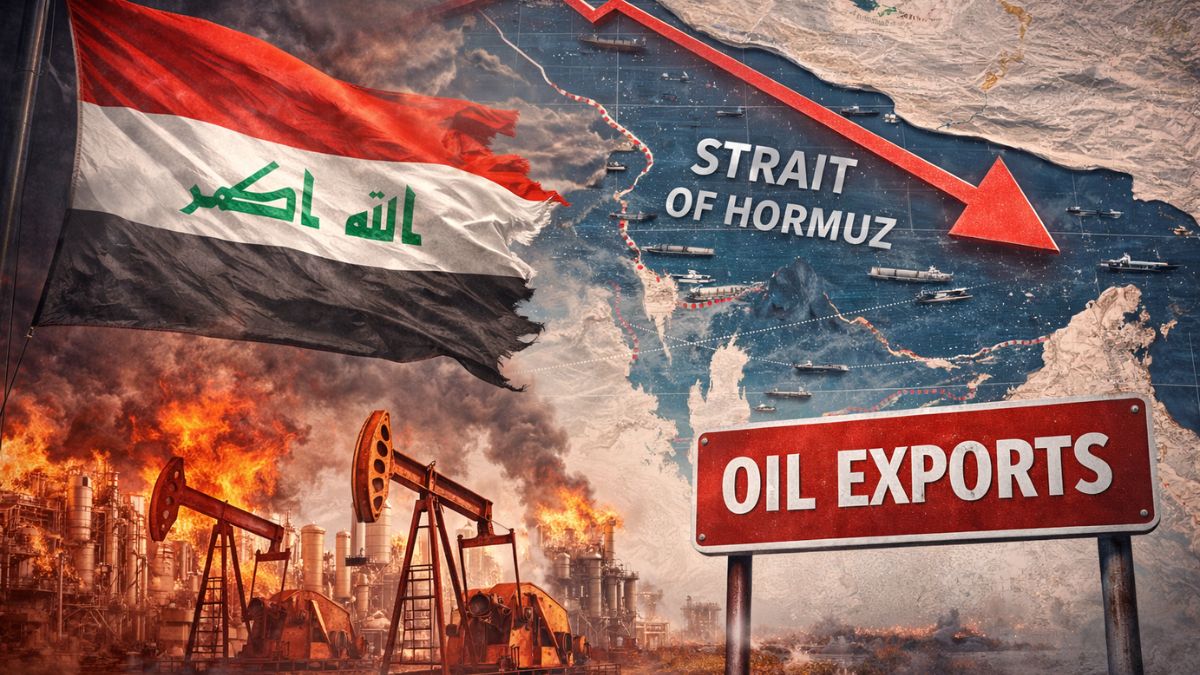
In a stark illustration of how geopolitics can instantly reshape global energy flows, Iraq has indicated that it could restore crude oil exports to approximately 3.4 million barrels per day within a week, but only if the Strait of Hormuz reopens and regional hostilities subside. The assessment, made by the head of Basra Oil Company, underscores the extraordinary dependence of Iraq’s oil economy on a single maritime artery that carries roughly one fifth of global oil and liquefied natural gas flows. The Strait’s effective closure in the wake of the recent Iran centred conflict has paralysed Iraq’s export capacity, triggering one of the steepest revenue contractions among Gulf producers and exposing structural vulnerabilities in its energy infrastructure.
The scale of disruption has been severe. Iraqi oil production, which stood at approximately 4.3 million barrels per day prior to the conflict, has plummeted by around 80 per cent to nearly 800,000 barrels per day. Current output from southern fields, the backbone of Iraq’s export system, is estimated at roughly 900,000 barrels per day. This collapse is not rooted in geological or technical constraints but in logistical paralysis. With exports effectively halted due to the closure of the Strait of Hormuz, storage facilities have filled rapidly, forcing operators to curtail production across major fields. The impact on key assets has been particularly pronounced. Output at the Rumaila field, one of the largest oilfields globally, has fallen to about 400,000 barrels per day from pre conflict levels of roughly 1.35 million. Similarly, production at the Zubair field has declined to around 300,000 barrels per day, reflecting a substantial contraction from its earlier capacity.
Despite the sharp decline in production, Iraq retains the technical capacity to rapidly scale up exports. According to Bassem Abdul Karim, the country’s production base remains sufficiently robust to support exports of 3.4 million barrels per day within a week of the Strait reopening, even accounting for war related disruptions. This resilience is attributable to a key structural feature of Iraq’s oil sector: it consistently produces more crude than it exports under normal conditions, allowing for a degree of flexibility in redirecting output once logistical constraints are removed. However, this recovery scenario is contingent on two critical variables. First, the cessation of hostilities linked to the Iran conflict. Second, the restoration of safe maritime transit through the Strait, a factor that remains uncertain given the absence of formal guarantees.
Among members of OPEC, Iraq stands out as particularly exposed to disruptions in the Strait of Hormuz. Unlike some Gulf producers that have developed alternative export routes, Iraq relies overwhelmingly on this corridor for seaborne shipments. This lack of diversification has translated into disproportionate economic losses. While other producers have been able to partially reroute exports, Iraq has faced near total export paralysis, highlighting the strategic risks associated with concentrated infrastructure. The Strait’s closure has not only curtailed exports but also disrupted global supply chains, given its role as a conduit for a significant share of the world’s energy flows.
In the absence of export outlets, Iraq has redirected a portion of its crude to meet domestic refining demand. Approximately 400,000 barrels per day are being transported to northern regions, with around 150,000 barrels moved by truck and 250,000 barrels via pipeline. This supply supports refineries with a combined demand of about 500,000 barrels per day, ensuring continuity in domestic fuel availability. Meanwhile, production from northern fields, including Kirkuk, stands at approximately 380,000 barrels per day, contributing to internal supply stability. Additionally, certain fields continue to operate at reduced levels to sustain the production of associated gas, which is critical for electricity generation. In parallel, operators have utilised shutdown periods to conduct maintenance activities, potentially enhancing operational efficiency once production resumes.
The contraction in oil production has had a cascading effect on gas output, particularly in Basra. Current production has declined to around 700 million standard cubic feet per day, down from approximately 1.1 billion prior to the conflict. This reduction reflects the close linkage between oil extraction and associated gas production, with implications for domestic energy supply and industrial activity.
Compounding logistical challenges are escalating security risks. Drone attacks on oil infrastructure have inflicted tangible damage, disrupting operations and undermining investor confidence. A recent two drone strike on the Rumaila field injured three workers and targeted facilities associated with major service providers, including Schlumberger and Baker Hughes. While the resulting fire was contained, such incidents highlight the vulnerability of critical energy infrastructure in conflict zones. According to Iraqi officials, these attacks have caused significant losses to production continuity, further complicating recovery efforts.
The path to recovery is further clouded by geopolitical uncertainty. Iran has reportedly provided only verbal assurances regarding the safe passage of Iraqi tankers through the Strait, with no formal documentation in place. This lack of binding guarantees introduces a layer of risk that could delay or complicate the resumption of exports. At the same time, diplomatic pressure is intensifying. Donald Trump has issued stark warnings to Tehran, signalling the possibility of further escalation if an agreement is not reached to reopen the Strait.
Iraq’s ability or inability to restore exports has significant implications for global oil markets. As one of the largest producers within OPEC, its output plays a critical role in balancing supply and demand dynamics. A rapid rebound to 3.4 million barrels per day would inject substantial volumes into the market, potentially easing price pressures and stabilising supply chains. Conversely, prolonged disruption could exacerbate volatility, particularly given the simultaneous impact on other producers in the region.
Iraq’s oil sector now stands at a critical juncture, with its recovery trajectory closely tied to developments in one of the world’s most strategically significant waterways. The technical capacity for a swift rebound is evident, but its realisation depends on factors beyond the control of oil operators. The reopening of the Strait of Hormuz would not merely restore Iraq’s export flows; it would reanchor a fragile equilibrium in global energy markets. Until then, Iraq remains caught in a high stakes interplay between geopolitics, infrastructure constraints, and market dynamics, with each passing day amplifying both the risks and the urgency of resolution.