

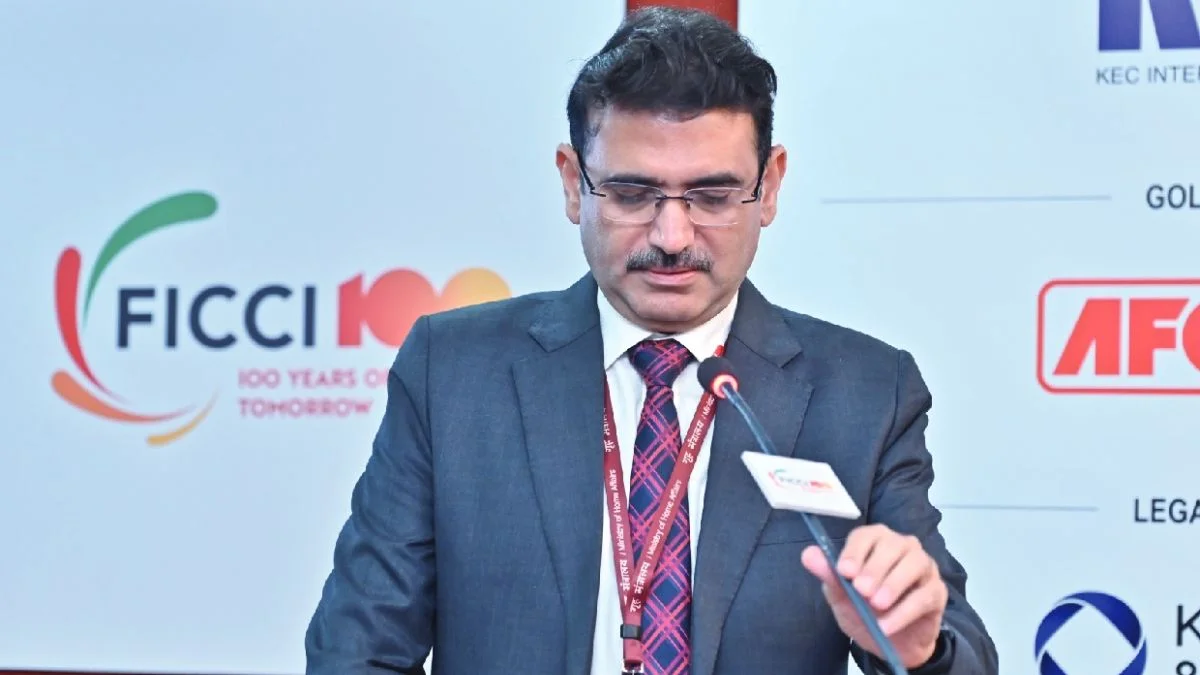
India’s evolving infrastructure financing landscape took centre stage at a major industry conclave, where Manoj Kumar Dubey, Chairman and Managing Director of Indian Railway Finance Corporation (IRFC), outlined the policy direction shaping investment, trade logistics, and long-term capital mobilisation in the sector.
Speaking at the Infrastructure Conclave 2026 organised by Federation of Indian Chambers of Commerce and Industry (FICCI), Dubey emphasised that India’s macroeconomic transformation has created a favourable policy environment for infrastructure-led growth. He noted that the country has moved beyond earlier perceptions of economic fragility and is now supported by stronger fundamentals, enabling large-scale investments in transport, logistics, and connectivity.
From a trade and policy standpoint, Dubey highlighted the critical role of infrastructure financing institutions in strengthening supply chains and improving logistics efficiency. He pointed out that IRFC is expanding its mandate beyond traditional railway financing to support broader infrastructure segments linked to trade, including multimodal logistics networks. This shift aligns with national policy priorities aimed at reducing logistics costs and enhancing India’s competitiveness in global trade.
A key theme of the conclave was the growing importance of Infrastructure Investment Trusts (InvITs) as a policy tool for mobilising long-term capital. The release of a joint knowledge report by FICCI and CRISIL highlighted how InvITs are emerging as a structured financing mechanism that allows developers to recycle capital and attract institutional investors into infrastructure assets.
Policy experts at the event noted that InvITs have gained traction due to regulatory support from market authorities and the government, offering predictable cash flows and improved transparency. These features are particularly relevant for sectors such as roads, railways, and energy, where long gestation periods require stable financing models. By enabling asset monetisation, InvITs are also helping unlock capital for new infrastructure projects, thereby sustaining the investment cycle.
Dubey underscored that IRFC’s evolving strategy includes leveraging such instruments to diversify funding sources and reduce reliance on traditional borrowing channels. This approach is consistent with broader financial sector reforms aimed at deepening capital markets and encouraging private participation in infrastructure development.
The policy focus on infrastructure is closely linked to trade efficiency. Improved transport networks and logistics systems are essential for reducing turnaround times, lowering freight costs, and facilitating smoother movement of goods across regions. Government initiatives in recent years have emphasised integrated infrastructure planning, combining rail, road, and port connectivity to support industrial growth and export competitiveness.
At the conclave, stakeholders from government, financial institutions, and industry discussed the need for continued policy reforms to sustain momentum. These include enhancing regulatory clarity for InvITs, expanding the investor base, and ensuring consistent returns through robust asset management practices.
The discussions also reflected a broader policy shift toward sustainability and quality in infrastructure development. As India scales up investments, there is increasing emphasis on efficient resource utilisation, environmental considerations, and long-term asset performance.
Overall, the conclave highlighted how coordinated policy measures—ranging from financial innovation to infrastructure planning—are shaping India’s growth trajectory. With institutions like IRFC playing a central role in financing and facilitating projects, the integration of trade and infrastructure policy is expected to remain a key driver of economic expansion in the coming years.