
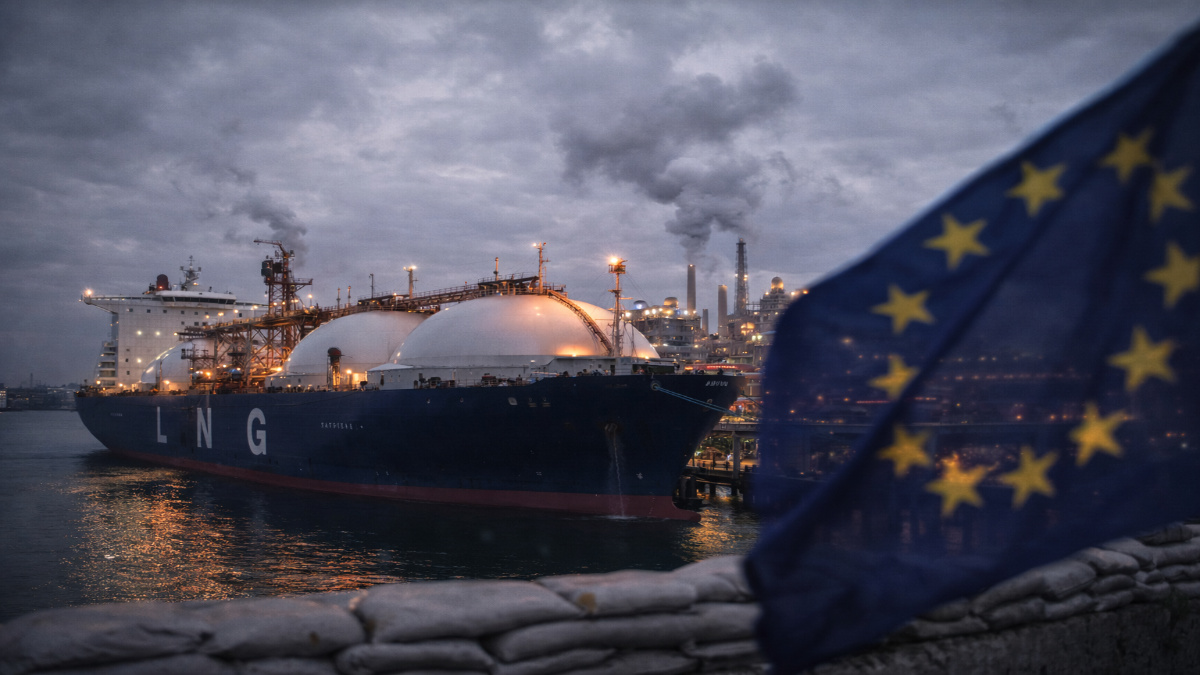
In 2025, the European Union imported approximately EUR7.2 billion of Russian liquefied natural gas (equivalent to 7.8 billion dollars) and imports of the Yamal LNG project in the Arctic continued to flow at a constant rate despite a declared ban that will become effective on January 1, 2027, according to an analysis by campaign group Urgewald.
According to the data of Kpler, the numbers indicate that EU purchasers still continued to rely heavily on Yamal LNG despite the reassertion of its political commitment by Brussels to end Russian gas and cut Moscow energy earnings after the invasion of Ukraine. In 2025, imports were near record levels and generally similar to 2024, when the expenditure on Russian LNG was already more than several times higher than before the war. The overall amount of EUR7.2 billion, as compared to an estimated EUR6.3 billion in 2024, is an indicator of the increased relevance of LNG to Russia, following the failure of pipeline gas supplies to Europe. Urgewald sanctions campaigner Sebastian Rotters claimed that as the EU boasts of plans to stop Russian gas imports, its ports still serve as a major logistics centre to the Yamal terminal. The Yamal LNG project which is majority owned by Novatek with foreign partners has become the key in the gas export strategy of Russia. Cargoes shipped via the Arctic terminal have kept finding buyers in the EU with pipelines largely closed since no complete import ban will be imposed until 2027.
France became the largest purchaser of the EU with 41.7 percent of the imports of Yamal LNG at the Dunkirk and Montoir-de-Bretagne terminals. Other key receivers were Spain, Belgium and the Netherlands. According to campaigners, the EU partial measures have had side effects. In March 2025, a ban on transshipment of Russian LNG through EU ports was introduced, which did not decrease the volumes at the Zeebrugge terminal in Belgium. Rather, goods previously re exported stayed in the EU. Statistics indicate that in 2024 Zeebrugge imported 6.13 billion cubic meters of Russian LNG and exported 3.4 bcm which was considered re-exported, leaving some 2.7 bcm within the bloc. In 2025, imports more than doubled. The terminal in Belgium had risen its imports of Yamal to 5.5bcm in 2025, compared to 2.7bcm in 2024, and France Montoir-de-Bretagne terminal had increased its imports by 26 percent to 3.6bcm.
By 2025, Zeebrugge alone had taken in 4.6 million tonnes of Yamal LNG, and that is more than the entirety of China as an import. The campaigners claim that Russia has continued to make billions of money in LNG exports with loopholes in sanctions. EU officials argue that the postponed ban helps to avoid supply shocks, but the critics note that the further importation undermines the credibility of the bloc and extends the energy income of Russia.