

The prisoner of war exchange program in the theatre of modern armed conflict is one of the only lasting tools by which international law attempts to curtail the atrocities of armed conflicts. The principle is based on the postulates of the international humanitarian law and is best defined in the third Geneva Convention that provides specific safeguards to combatants captured. The Convention in Article 118 stipulates that prisoners of war should be released and returned to their home countries immediately that the active hostilities are over. International law does not ignore negotiated exchanges even in the context of an ongoing conflict since it is not only considered to be a political gesture but rather a humanitarian duty in order to relieve the suffering of people placed in captivity and to avoid the indefinite detention.
The Geneva Conventions are ratified in more than 190 states, both Russia and Ukraine are signatories, thus making the legal requirements relating to the treatment and exchange of prisoners binding to both parties to the conflict. The framework compels warring parties to treat detainees humanely, provide medical care to them, maintain communication with their families and prevent torture or degrading treatment. Special organizations like the International Committee of the Red Cross have a leading supervisory role by ensuring the safety of the detainees, communication between the prisoners and their families and often they mediate in the exchange of prisoners. These processes are in place to ensure that the exchanges are not turned into coercion tools or propaganda but rather are in line with the humanitarian standards.
In this legal and humanitarian context, one of the latest trends in the current conflict between Russia and Ukraine explains how even the most bitter enemies can still be able to fulfill some of the requirements of international law. The governments declared the simultaneous release of 200 prisoners of war on either side, which was the first step in a larger agreement that would see 500 prisoners of war on each side exchanged. The announcement was the result of negotiations that were arranged with the help of diplomatic channels and humanitarian intermediaries, which highlights that even in the conditions of severe hostilities, it is still possible to cooperate to some extent.
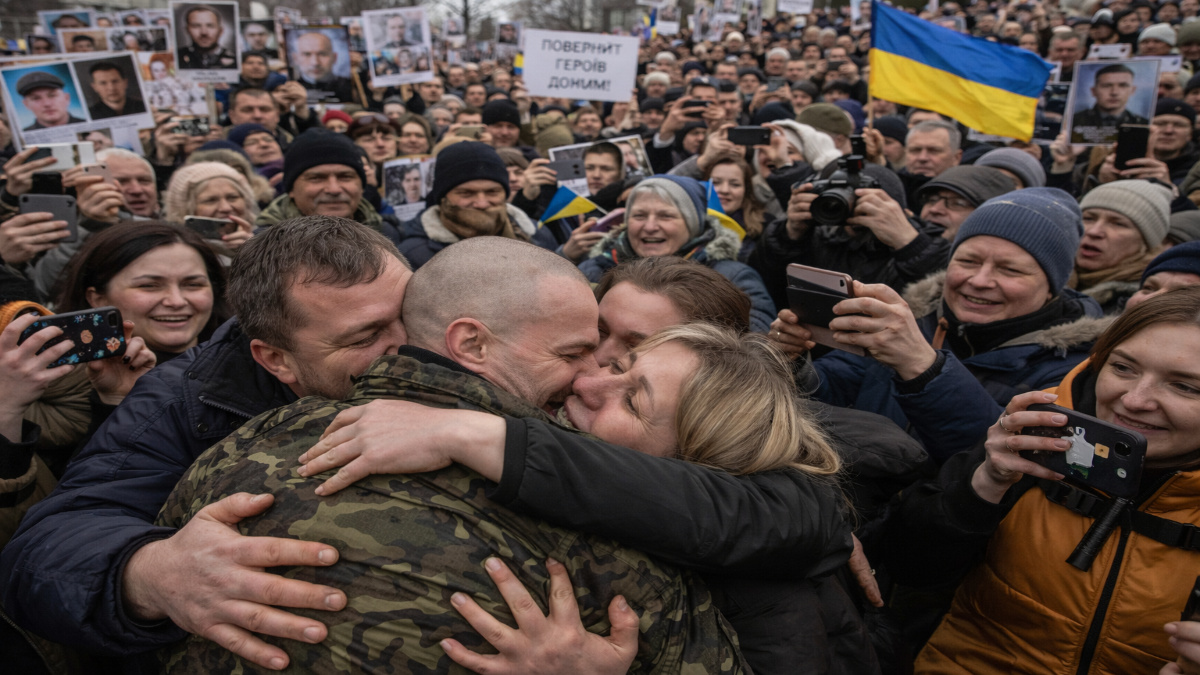
President of Ukraine Volodymyr Zelenskyy openly praised the development, focusing on the human aspect of the exchange. In a post on social media, he reported that hundreds of Ukrainian families were now getting news that their loved ones were coming home that they had been waiting on a long time. Such moments are heavily emotional in a country that has been experiencing years of war. Videos by Ukrainian officials showed the returning soldiers getting off buses surrounded by national flags, shouting patriotic slogans and being hugged by their relatives who had been waiting months- or even years- to have them back.
The same story was played on the Russian side. The Russian Ministry of Defence released videos of soldiers loading the transport vehicles and being covered in Russian tricolour flags, cheering and waving as they were about to go home. Even though the politics of the war is still defined by the acute hostility, moments like these show a common human fact behind the geopolitical struggle. Incarcerated soldiers, irrespective of their nationality, go through the same ordeal in detention and their release usually comes as a relief to the families in both societies.
The trade should take place in phases. Officials engaged in the talks say that the first 200-200 deal is only the first part of the larger deal that was done in the course of diplomatic consultations that had been conducted earlier in the year. The other 300 captives on both sides should be turned out in further exchanges, unless logistical preparations and checking processes are accomplished without any trouble. These procedures are important since the international humanitarian law demands that those involved in the exchange be confirmed combatants and registered incompetent prisoners of war.
Exchange of prisoners has become a frequent aspect of the Russia-Ukraine conflict since the early days. There have been numerous exchanges during the war that have taken place between the two sides where hundreds of detainees are swapped at once. Several of these deals are made by either silent agreements brokered by neutral states or humanitarian entities. Others have occurred along the border areas or countries of neutrality and others have been arranged with the diplomatic process of third-party governments.
The exchanges have frequently had parity formulae like 100 to 100 or 150 to 150 which are an effort to keep the sides on a par. Other cases have seen severely wounded soldiers or medical staff being given precedence, as would be in line with humanitarian considerations which promote the repatriation of those whose health status makes further retention especially detrimental. Such arrangements have, over the period of the war, returned thousands of prisoners.
In spite of these humanitarian successes, there have not been smooth sailing in the process of prisoner exchange. Alleged violations of human rights have been brought up severally by human rights organizations and international observers against both sides, as far as prisoners are concerned. Monitoring missions have reported allegations of torture, forced confessions or lack of proper medical treatment in the detention facilities. These allegations have been periodically reported by the United Nations Human Rights Monitoring Mission in Ukraine, and both sides that are involved are encouraged to adhere to all international humanitarian requirements.
Certain detention sites have recorded particularly troubling incidences such as the infamous Olenivka prison facility in eastern Ukraine, where dozens of Ukrainian prisoners were killed in an explosion in 2022. Both parties have accused each other of the tragedy and probes have had trouble getting a conclusive version. Incidences like these demonstrate how humanitarian norms are weak in situations of protracted warfare and why independent monitoring is still critical.
The legal framework in which the prisoner exchanges are conducted is wide. The Third Geneva Convention has 143 articles of the rights and protections of the prisoners of war. Some of its provisions include the need to ensure that the detainees are not subjected to violence, intimidation, insults, and public curiosity. They should receive proper food, shelter as well as medical care. Besides, they should be given the freedom to communicate with relatives and their identities should be registered via international tracking systems.
Additional to the Geneva Conventions are the Additional Protocols to the Geneva Conventions which further expound on the protection of both international and non-international conflicts. These tools, in combination with traditional international humanitarian law, create a normative expectation that warring parties will look to seek agreements to exchange or repatriate prisoners whenever practicable. These agreements are usually codified by bilateral agreements and supervised by impartial groups.
Within the broader geopolitical situation of the conflict between Russia and Ukraine, the exchange of prisoners has a twofold role. On the one hand, they offer direct humanitarian aid by allowing the captured soldiers to go back to their families. Conversely, they are the only sources of communication between otherwise antagonistic regimes. The prisoner swap negotiations often provide some space of communication to be done diplomatically, which theoretically can be used to facilitate broader peace efforts.
It has been mentioned that the recent exchange was discussed in the framework of diplomatic contacts between a number of international actors, including the United States and mediators who took part in the negotiations which took place in Geneva. Even though the outcomes of those talks have not led to the wider ceasefire or political resolution, they show that even in cases when the main disagreements are not resolved yet, the humanitarian collaboration is still possible.
Political strains, however, still make the journey to peace a difficult one. Russia has been insisting on its territorial claims to the eastern parts of Ukraine and Ukraine is adamant on its sovereignty and internationally declared border. The international diplomacy has been unable to balance these stances, and the conflict is still in a stalemate. Under these conditions, one of the limited real things about negotiation is the prisoner exchange.
However, one should not underestimate the humanitarian effect of such exchanges. To those concerned, the distinction between imprisonment and liberty is tremendous. A high number of re-entry prisoners have a long history of detention and need a lot of medical care, psychological and reintegration services. Rehabilitation programmes are usually organised by governments and humanitarian organisations to assist former prisoners to reestablish their lives.
The release of hundreds of prisoners during the recent swap thus has a symbolic and practical meaning. It shows that despite a cruel and long-lasting war, some legal standards still have their impact. These events were exactly situations that the Geneva Conventions were written in, trying to find a way out in times where a conflict is going on and yet humanity should not be completely overshadowed by violence.
Finally, the success of the existing deal will be determined by the ability of the two parties to complete the outstanding transactions. With the 500-to-500 plan in its entirety adopted as intended, it will be one of the bigger of the prisoner exchanges of the war and will strengthen the idea that humanitarian law applies even in the most disputed conflicts. To the soldiers coming back home and the families receiving them, the legal provisions of international humanitarian law do not amount to abstract doctrine but become the real possibility of being reunited and recovered and having their dignity restored after the war.