

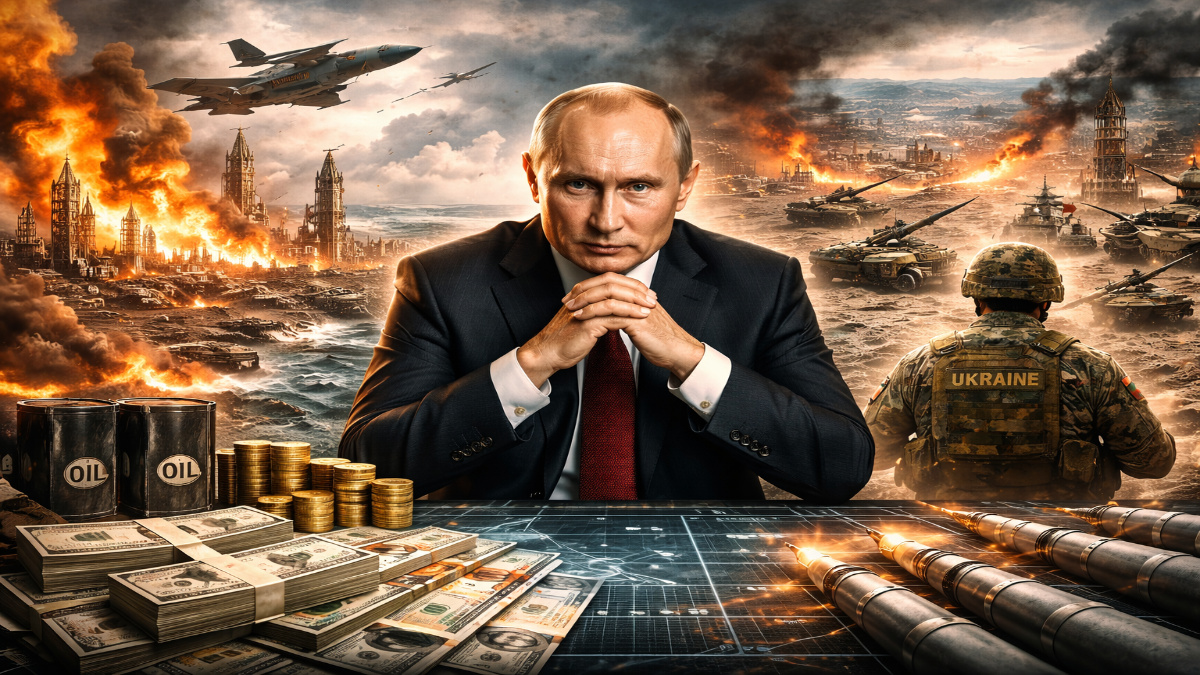
The growing crises in the Middle East are starting to redefine the world geopolitical scene in a manner that goes way beyond the region itself. The continued war between Hamas and Israel, the growing tension with Hezbollah and Iran, and a series of U.S.-Israeli military attacks on Iranian leadership and strategic infrastructure have all contributed to an unstable situation that is being felt in the international security, energy markets, and international relationships. In this respect, Russia seems to be becoming one of the indirect winners of the crisis, especially economical, and strategic ones, although Moscow did not directly participate in the confrontations which were going on.
The regional instability has led to one of the most immediate effects in terms of global energy markets. The world oil benchmarks rose radically after the disturbances around the Strait of Hormuz and assaults on the energy plants in the Gulf area, as the Brent crude topped the 80-per barrel mark. To Russia, whose energy industry has been driven to its knees since Western sanctions were imposed following its invasion of Ukraine, the abrupt rise in prices will provide a short-term, yet crucial, financial relief. The renewed demand of major consumers like China and India in the Russian oil exports that were significantly discounted in order to find buyers in the Asian markets has been experienced. The increased prices and demand allow Moscow to restore part of the losses to the revenues, which were faced by the energy sector in the last year, when the declining global prices and the export quotas pushed the energy revenues to the lowest levels in many years.
According to energy analysts, any disruption in the Middle East supply chains, even in the short run will greatly advance the fiscal stance of Russia. The prolonged high oil prices would reduce the budget deficit in Russia by enhancing its export revenues besides cutting the discounts it has to give on shipments of crude oil to Asian customers. This economic breathing room comes at a very critical point in the Kremlin which has remarkably increased military expenditure since the beginning of the war in Ukraine. Defense spending, according to a number of defense estimations, constitutes about half of the federal budget in Russia and nearly ten percent of its gross domestic product. This kind of expenditure demands a constant flow of finances and increased oil revenues are just the kind of fiscal stimulus that Moscow requires to support long-term military activity.
In addition to the economic aspect, there are also strategic implications of the Middle East crisis. The western governments, especially the United States, are currently facing several security issues that are occurring at the same time. With the growing tension between Israel and Iran, Washington has been channeling a lot of military resources in the region as a way of defending its allies and preventing the escalation of the situation. It is reported that several thousands of missiles and air-defence interceptors that were initially assigned to Ukraine have been redirected to support the defence against the possible Iranian drone and missile attacks. The Ukrainian leaders, such as President Volodymyr Zelenskyy, have publicly mentioned that such a diversion of resources undermines the capability of Kyiv to protect its cities and energy infrastructure against Russian aerial attacks.
The implications of this change in the battlefield can be significant. Russia has been heavily relying on drone attacks and missile attacks to target the energy system and the critical infrastructure, Ukraine, since the early phases of the war. The decreased stocks of modern air-defence equipment may expose Ukrainian cities to such attacks more, especially at the times when the activity of the military forces is more intense. Meanwhile, Russia enjoys a more strategic diversion caused by the Middle East war. The vast media focus, diplomatic bandwidth, and military capacity that previously were being focused on Ukraine are at least partially displaced by the rapidly escalating situation in the Gulf and Eastern Mediterranean.
Moscow has tried to place itself in a delicate position in this changing environment diplomatically. Although Russia has a historic strategic relationship with Iran, it has mostly responded to the diplomatic criticism of western attacks but not been involved directly in the strikes. This low profile stance will enable the Kremlin to escape getting into another expensive local conflict yet enjoy the geopolitical repercussions of an unstable situation. Offering itself as a possible mediator and criticizing the western military actions, Russia is also trying to strengthen the messages of the doublespeak of foreign interventions, a motif that is often emphasized in the Russian diplomatic speech.
The crisis has also spilled over to the world thinking about power orientation. Western sanctions have not stopped many countries in the Middle East to continue to interact with Russia both economically and diplomatically. Such constant interaction is symptomatic of the general tendency towards a more complex and multipolar international system wherein regional powers have relations with multiple international actors instead of being affiliated with one bloc.
In the case of Ukraine, the situation undergoes serious challenges. The economic, infrastructural, and population pressures of the country have already been enormous due to the war. Repeated attacks on energy plants have led to massive power outages and the costs of reconstruction are pegged at hundreds of billions of dollars. When the Western military aid becomes slower or less predictable because of other crises in the Western hemisphere, the capability of Ukraine to sustain defense operations may be put under more pressure.
Meanwhile, it is still unclear what the long-term consequences of the Middle East turmoil will be. Although Russia might get an economic and strategic benefit in the short run due to increased energy prices and Western distracted attention, there are also certain risks inherent in the situation. The falling of the regional partners or the extreme weakening of them may upset the existing alliances, whereas the term of the instability in the global energy markets may eventually result in the economic volatility which will impact all the major exporters.
However, the present geopolitical situation demonstrates that the impact of regional disputes in the world power balance can be changed in unpredictable directions. The Middle East crisis which was initially considered to be a localized escalation has already started to affect energy markets, military supply chains, and diplomatic interests in several continents. Russia has been in a fortunate situation in this complicated environment, where it has been enjoying the results of events that are mostly beyond its control, and it has been getting economic relief and strategic space in the face of the war in Ukraine still defining its conflict with the West.