

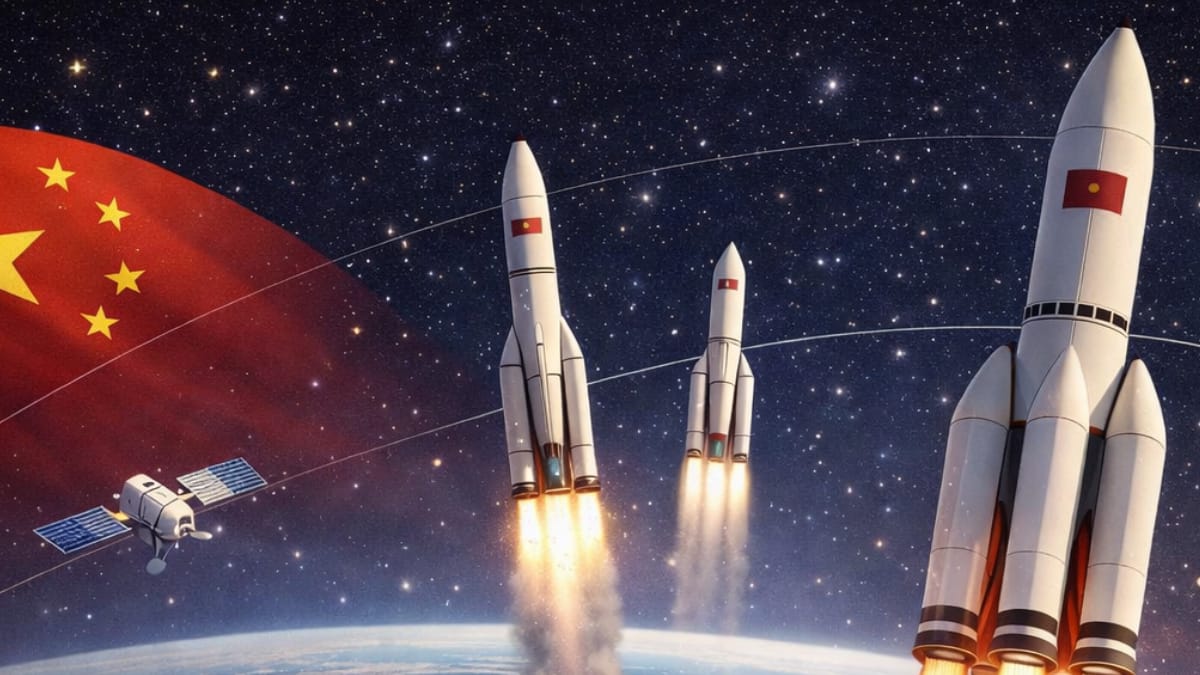
China’s commercial space industry recorded a year of unprecedented expansion in 2025, cementing its role as a central pillar of the nation’s aerospace strategy. According to data released on 2oth January 2026, by the China National Space Administration (CNSA), the commercial sector successfully completed 50 launches over the last year. These missions accounted for 54% of China’s total 93 spaceflights in 2025, marking a definitive shift towards a hybrid ecosystem where private enterprises operate alongside traditional state-owned giants.
2025: A Year of Milestones and Satellites
The data reveals a sector rapidly gaining autonomy and scale. Of the 50 commercial missions, 25 utilised dedicated commercial launch vehicles, underscoring the growing maturity of non-state rocket technology.
- Satellite Deployment: These launches successfully placed 311 commercial satellites into orbit, representing a staggering 84% of the 370 total satellites launched by China in 2025.
- Infrastructure Growth: The new Hainan commercial space launch site, which became fully operational in late 2024, proved critical to this capacity, conducting nine launches in 2025 and bringing its cumulative total to ten.
- Expanded Applications: Beyond pure transport, 16 missions focused specifically on deploying satellites for remote sensing, communications, and navigation, widening the commercial utility of China’s orbital assets.
Technological innovations and their acceleration
With key players such as LandSpace and Galactic Energy making significant strides in reusable rocket technology. Simultaneously, the Qianfan (G60 Starlink) constellation continued its aggressive deployment, aiming to provide global broadband coverage and compete directly with established international networks like Starlink.This growth was underpinned by robust policy support, including the Action Plan for Promoting the High-Quality and Safe Development of Commercial Space (2025–2027), which has integrated the sector into national strategic planning. By the close of the year, China’s space economy was valued at over 1 trillion yuan (approx. $140 billion), fuelled by fresh investments exceeding 50 billion yuan in 2025 alone.
Historical Context: From State Monopoly to Private Innovation
The roots of China’s space programme lie in the 1950s “Two Bombs, One Satellite” initiative under Mao Zedong, originally conceived for national security amidst Cold War tensions. China became the world’s fifth spacefaring nation with the launch of Dong Fang Hong-1 in 1970. For decades, the sector was the exclusive domain of state-owned enterprises (SOEs) like the China Aerospace Science and Technology Corporation (CASC).Commercial activity first emerged in the 1980s via “old commercial space,” where SOEs exported launch services to international clients beginning with the 1990 launch of AsiaSat-1. However, the modern era of “new commercial space” began decisively in 2014, when State Council Document 60 opened the industry to private capital. This policy shift spurred a wave of innovation, growing the sector from a handful of state players to over 500 commercial companies by 2025, supported by regional aerospace clusters in Beijing, Shanghai, and Hainan.