

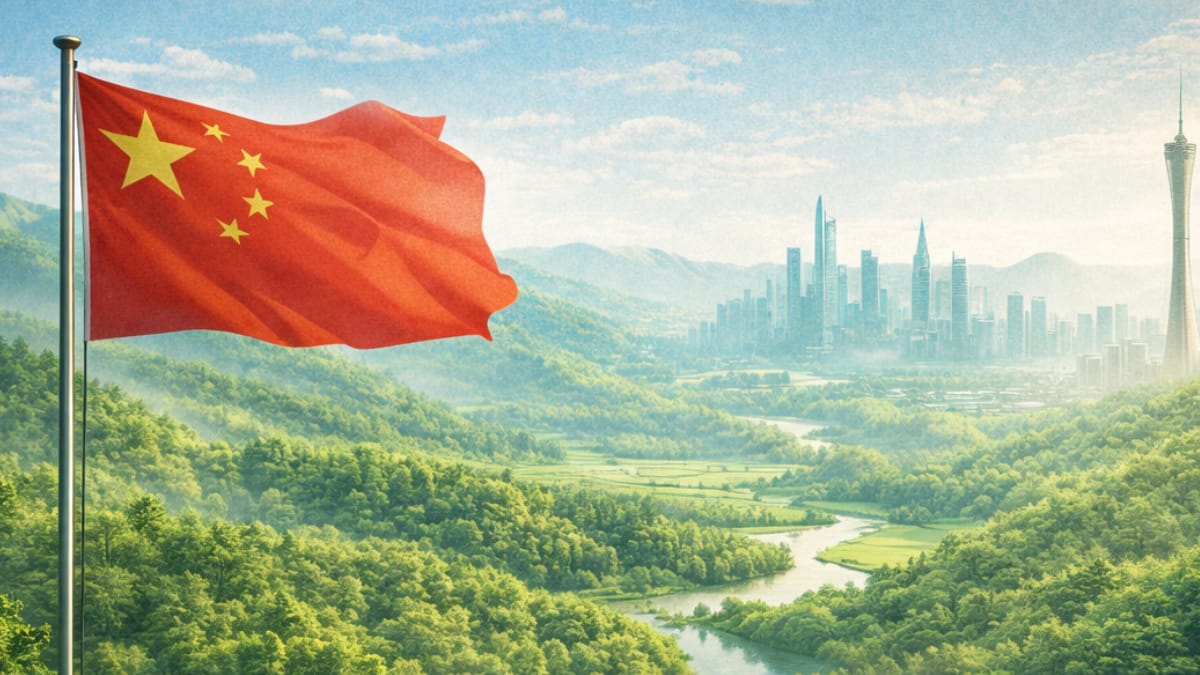
China’s long-running ecological restoration drive reached a significant milestone in 2025, with the country completing approximately 8.47 million hectares of land greening, reinforcing its national efforts to combat desertification and strengthen environmental resilience.
Data released by the National Forestry and Grassland Administration:
A total of 127 million mu of land was restored during the year. This included 3.56 million hectares of new afforestation and 4.93 million hectares of degraded grassland restoration, lifting China’s overall forest coverage rate to 25.09%. Total forest stock volume has now reached 20.99 billion cubic metres, underscoring the scale of the country’s ecological recovery.
The 2025 results form part of the broader objectives set under the 14th Five-Year Plan (2021–2025). Over the past five years, China has added 36.6 million hectares of newly greened land, while maintaining national vegetation coverage above 50%. Notably, officials report zero net growth in land degradation, a benchmark achievement in desertification control that positions China as a global leader in large-scale land restoration.
Beyond forests and grasslands, China has accelerated the construction of a national park–centred nature reserve system. This framework now protects around 90% of terrestrial ecosystem types and 74% of nationally protected wildlife species, strengthening safeguards for critical habitats and biodiversity. The system integrates existing reserves into a unified conservation network designed to balance ecological protection with local development.
The greening drive has also delivered measurable economic benefits. In 2025, the forestry and grassland sector generated nearly 11 trillion yuan (£1.58 trillion) in output, supported more than 60 million jobs, and drove forest product trade exceeding $180 billion. Annual forest food production surpassed 240 million tonnes, highlighting the sector’s growing role in rural livelihoods and sustainable growth.
Historical Context:
China’s forest coverage has risen steadily from roughly 12–13% in the early 1980s to today’s level above 25%, representing the largest net forest gains globally over the past decade. However, researchers caution that challenges remain. Studies indicate that forests planted on marginal land may deliver lower long-term carbon sequestration than naturally regenerated forests, fuelling debate over the sustainability and ecological quality of future projects.
Even so, experts agree that China’s 2025 achievements reflect decades of policy-driven restoration and provide valuable lessons for global climate mitigation, land management, and biodiversity protection strategies.