

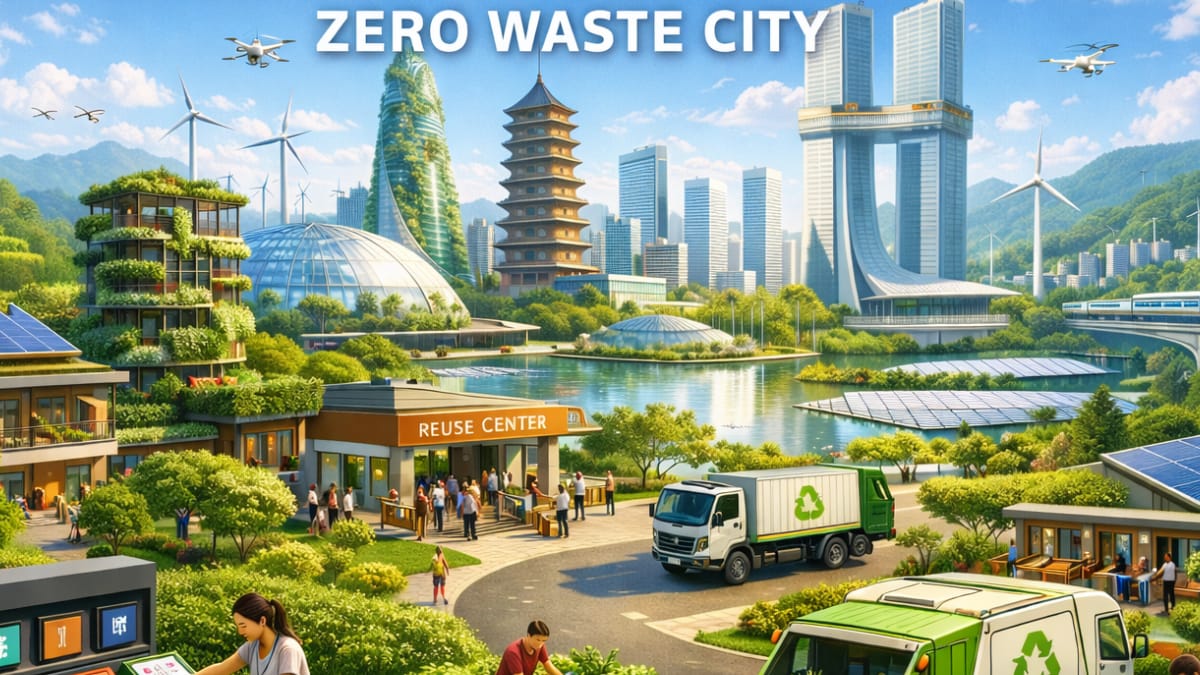
China’s “zero‑waste city” initiative is a far‑reaching environmental drive designed to cut solid waste down to the bone! This approach dovetails neatly with China’s bigger picture aims, such as hitting carbon neutrality by 2060 and building what’s often dubbed an “ecological civilisation.” Coined under President Xi Jinping’s leadership.
Major announcement by the Ministry of Ecology and Environment:
The Government has set the bar high on waste‑free cities. By this week of January 2026, the Ministry of Ecology and Environment (MEE) had set one common motto for every city across the nation to go waste‑free by 2035, with 60% coverage already in the bag by 2027. As part of the current five‑year plan, the scheme will roll out to around 200 more cities, with a sharp focus on powerhouse regions such as Beijing, Tianjin, Hebei, the Yangtze River Delta, Guangdong, Hong Kong, Macao, the Greater Bay Area, the Yangtze River Midstream, and other cities. The ministry also enforces regulations, promotes technological innovations in recycling, and integrates environmental goals with broader economic plans like the 15th Five-Year Plan. This expansion builds on the pilot projects that have already set the wheels in motion, aiming to cut waste generation intensity down to size, curb reliance on landfills, and give recycling a serious shot in the arm. In short, China is determined not to let rubbish pile up under the carpet but to turn the tide towards a cleaner, greener future.
Historic background of the “zero‑waste city” programme:
China’s zero‑waste city programme grew out of rising waste problems linked to rapid urbanisation and industrial growth. By the 2010s, the country was producing more than 2 billion tonnes of solid waste each year. Urban areas were struggling with overflowing landfills, pollution from informal recycling, and health risks from hazardous materials. To tackle this, the State Council and the Ministry of Ecology and Environment (MEE) set up a formal framework. In December 2018, the State Council issued guidelines for pilot projects, and by early 2019, 11 prefecture‑level cities, including Shenzhen, Baotou, Tongling, Weihai, and parts of Chongqing, plus five special zones, were chosen to lead the way. These pilots worked to bring waste management into city planning, using clear measures such as reducing waste intensity, boosting recycling rates, and cutting carbon emissions.The initiative showed that China was ready to grasp the nettle and turn a growing problem into a path towards greener cities.