

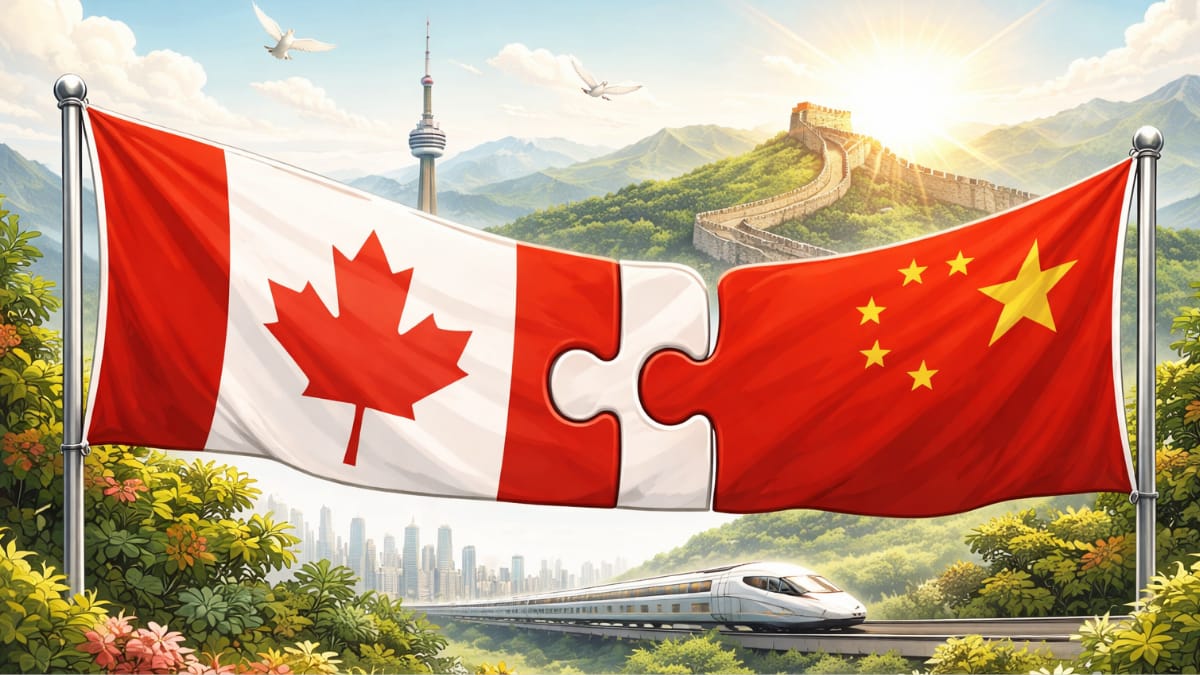
Canadian Prime Minister Mark Carney meets Chinese President Xi Jinping in Beijing today in what is widely seen as the most consequential reset attempt in Canada-China relations in nearly a decade.
This visit marks the first formal bilateral trip by a Canadian prime minister to China since 2017 and comes after years of diplomatic paralysis, trade retaliation, and deep public mistrust. For Ottawa, the stakes are high. The meeting represents both an opportunity to stabilise a strained relationship and a risk of domestic backlash if economic engagement is seen to dilute national security or democratic principles.
For Beijing, the visit offers a chance to draw Canada away from excessive dependence on the United States and to reassert influence over a middle power navigating an increasingly fragmented global order.
Why This Meeting Matters Globally?
The Carney Xi meeting is not merely a bilateral encounter. It is being closely watched across Asia Pacific capitals, Washington, and European policy circles as a test case for how Western democracies recalibrate relations with China amid strategic competition rather than outright confrontation.
Canada occupies a unique position. It is a G7 economy, a close security partner of the United States, and a resource rich exporter with growing ambitions in Asia. How Ottawa manages this engagement may influence similar calculations in Australia, the United Kingdom, and parts of the European Union.
At issue is whether pragmatic engagement with China can resume without repeating the strategic vulnerabilities exposed during the last breakdown.
The Long Shadow of 2018:
The diplomatic chill between Canada and China dates back to late 2018, when Ottawa detained a senior executive of Huawei at the request of US authorities. Beijing responded with the detention of two Canadian citizens, Michael Kovrig and Michael Spavor, alongside sweeping trade restrictions on Canadian agricultural exports such as canola.
Although the detained Canadians were later released, the episode fundamentally altered public and political perceptions in Canada. China came to be viewed less as a commercial partner and more as a strategic risk.
That legacy continues to shape expectations surrounding this visit, particularly within Parliament and among security agencies.
Who Is Visiting and Why Now?
Mark Carney assumed office as Canada twenty fourth prime minister in March 2025, bringing with him a technocratic reputation shaped by his leadership of the Bank of Canada and the Bank of England.
Carney accepted the Beijing invitation following a brief encounter with Xi Jinping during a multilateral meeting in South Korea in October 2025. He has framed the visit as a pragmatic effort to diversify Canada trade relationships, reduce exposure to US economic volatility, and explore cooperation in energy, climate policy, and global financial stability.
The timing reflects growing anxiety in Ottawa about over concentration of trade flows and increasing pressure from Canadian exporters seeking restored access to the Chinese market.
The Agenda in Beijing:
During his multi day stay, Carney is expected to hold talks with President Xi and Premier Li Qiang, alongside meetings with senior officials and business leaders.
Key areas under discussion include easing restrictions on Canadian agricultural exports, potential energy cooperation including crude oil supply, consular protections for citizens, and mechanisms for managing future diplomatic disputes.
Human rights concerns are also expected to feature, although officials acknowledge that progress in this area is likely to be symbolic rather than substantive.
Where Progress Is Possible and Where It Is Not?
Analysts caution against expectations of immediate breakthroughs. Early outcomes are more likely to involve the establishment of working groups, renewed business dialogues, and statements of intent rather than concrete policy shifts.
Any relaxation of tariffs on canola or movement on energy agreements would be significant, but Beijing has historically linked economic concessions to broader geopolitical alignment. Ottawa therefore faces a delicate balancing act between pursuing market access and preserving strategic autonomy.
Political Risks for Ottawa:
Re engaging China carries domestic political costs. Critics argue that economic pragmatism risks undermining Canada long stated positions on human rights, rule of law, and national security.
To mitigate these risks, experts stress the importance of securing agreements that are clearly defined, time bound, and enforceable, with formal mechanisms for dispute resolution and guaranteed consular access.
Without such safeguards, any perceived improvement could quickly unravel under public or parliamentary scrutiny.
What to Watch Next?
Observers should monitor announcements related to agricultural tariffs, energy cooperation, investment pledges, and formal frameworks for handling future diplomatic crises.
Equally important will be the reaction in Ottawa. Parliamentary debates, ministerial briefings, and policy follow through will reveal whether this visit represents a tactical thaw or the beginning of a genuine strategic recalibration.
A Calculated Gamble With International Consequences:
This visit is a carefully measured risk. If managed well, it could reopen opportunities for Canadian exporters and investors while restoring a degree of diplomatic stability. If mishandled, it may deepen public scepticism and reinforce concerns about coercive diplomacy.
Beyond Canada, the outcome will influence how other middle powers assess engagement with China in an era defined not by trust, but by cautious coexistence.
In that sense, the meeting between Mark Carney and Xi Jinping is not simply about resetting a relationship. It is about defining how democracies navigate power, principle, and pragmatism in a shifting global order.