
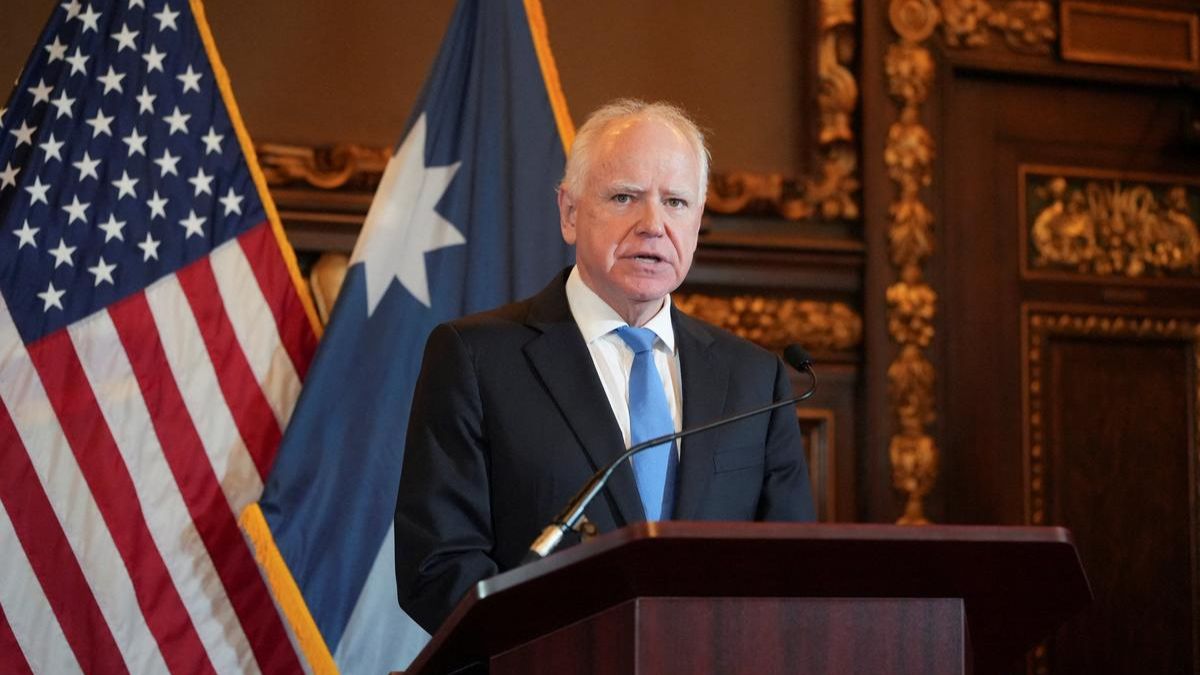
The reported investigation by the United States Department of Justice into Minnesota’s governor, Tim Walz, and the mayor of Minneapolis, Jacob Frey, marks one of the most legally consequential moments in modern American federalism. Triggered by resistance to President Donald Trump’s expanding immigration crackdown and intensified by the fatal shooting of civilian Renee Good by an Immigration and Customs Enforcement officer, the episode exposes the fragile boundary between lawful federal authority and political persecution.
According to multiple reports, first disclosed by CBS News and subsequently corroborated by the Washington Post, federal prosecutors are examining whether Walz and Frey conspired to obstruct the Trump administration’s immigration enforcement operations in Minnesota. Subpoenas have reportedly already been issued and are expected to be served imminently.
This is not merely a political confrontation. It is a legal stress test of the American constitutional system, involving the separation of powers, the independence of prosecutorial discretion, the limits of federal supremacy, the protection of political speech, and the criminalisation of dissent by state officials.
The factual background of the investigation
Governor Tim Walz, the former Democratic nominee for vice president in the 2024 election, responded publicly to the news of the investigation by condemning what he described as the weaponisation of federal law enforcement against political opponents.
He cited the recent investigations targeting Democratic senators Elissa Slotkin and Mark Kelly, as well as the investigation of Jerome Powell, chairman of the Federal Reserve, whom the Trump administration has sought to pressure into resigning to enable the appointment of a political loyalist.
Walz wrote that weaponising the justice system against political opponents is an authoritarian tactic and highlighted that the federal agent who shot Renee Good has not been subjected to investigation.
Walz’s office has stated that it has received no formal notice of any investigation.
Mayor Jacob Frey confirmed that he is aware of the federal action and described it as an attempt to intimidate him for opposing the administration’s immigration enforcement operations in Minneapolis. He stated publicly that he would not be intimidated and that his focus remains on public safety, lawful governance and defending the city and its residents.
The Washington Post has reported that subpoenas have already been prepared for both men.
The immediate catalyst for the current confrontation is the shooting of Renee Good last week by ICE officer Jonathan Ross in Minneapolis. The killing triggered nationwide protests and transformed the city into a central focal point of resistance to the Trump administration’s immigration campaign.
Homeland Security has since deployed approximately 3,000 immigration enforcement officers to Minnesota, a force reportedly five times larger than the Minneapolis police department.
A New York Times analysis of video footage taken by witnesses indicates that Ross stepped aside from Good’s vehicle and that she did not pose an imminent threat when he drew his weapon and fired three shots at close range.
Federal authorities, including President Trump and Vice President JD Vance, have publicly defended Ross.
The Federal Bureau of Investigation has taken the extraordinary step of refusing to cooperate with Minnesota state investigators, despite the fact that state prosecutors retain jurisdiction to bring criminal charges against Ross if evidence supports such action.
The refusal to provide evidence raises immediate legal questions regarding federal obstruction of state criminal investigations and the misuse of federal supremacy to shield federal officers from accountability under state law.
Under the United States Constitution, criminal law enforcement is divided between federal and state jurisdictions. While federal agencies have authority to enforce federal immigration law, states retain broad police powers under the Tenth Amendment, including the investigation and prosecution of homicide committed within their territory.
There is no legal doctrine that grants federal officers blanket immunity from state criminal law. The Supreme Court has repeatedly held that federal employees may be prosecuted by states for ordinary crimes unless Congress has expressly preempted such jurisdiction.
The FBI’s refusal to cooperate with state investigators therefore risks breaching long standing principles of cooperative federalism and may violate statutory duties to assist lawful criminal inquiries.
Furthermore, if federal prosecutors are using obstruction statutes to target elected officials for political opposition to immigration policy, this would require proof beyond reasonable doubt that Walz and Frey knowingly and corruptly interfered with specific federal investigations or operations.
Public criticism of federal policy, refusal to assist immigration enforcement, or assertion of local autonomy does not constitute criminal obstruction under federal law.
Obstruction statutes and the criminalisation of dissent
The principal statutes that could theoretically be invoked include 18 U.S.C. § 1505 and 18 U.S.C. § 1512, which criminalise obstruction of federal proceedings and witness tampering.
However, courts have consistently ruled that political speech, policy disagreement and lawful executive decision making by state officials fall squarely within First Amendment protection and cannot be criminalised absent evidence of bribery, coercion, falsification of evidence or direct interference with specific judicial or administrative proceedings.
Any attempt to stretch these statutes to cover opposition to immigration enforcement policy would likely collapse under judicial scrutiny and could itself constitute prosecutorial abuse.
The legal seriousness of the situation escalated dramatically following a public statement by Deputy Attorney General Todd Blanche.
On the social media platform X, Blanche described a so called Minnesota insurrection as the result of a failed governor and a terrible mayor encouraging violence against law enforcement.
He wrote that he was focused on stopping Walz and Frey from their terrorism by whatever means necessary and added, “This is not a threat. It is a promise.”
From a legal standpoint, this statement is extraordinary.
Federal prosecutorial ethics, codified in Department of Justice regulations and reinforced by Supreme Court precedent, require prosecutors to avoid public statements that create the appearance of bias or political motivation.
Threatening prosecution in advance of formal charges may violate internal Justice Department rules and could form the basis for motions to dismiss indictments on grounds of selective or vindictive prosecution.
Such public declarations also undermine the presumption of innocence guaranteed under the Fifth Amendment.
Walz’s reference to investigations of Elissa Slotkin, Mark Kelly and Jerome Powell is not incidental.
Slotkin and Kelly, both sitting senators, are reportedly under investigation for advising service members that they have the right to refuse illegal orders, a statement fully consistent with military law and the Nuremberg principles incorporated into United States armed forces doctrine.
Jerome Powell is reportedly under investigation in circumstances widely interpreted as an effort to coerce his resignation to allow a Trump appointee to assume control of the Federal Reserve.
Trump has repeatedly directed the Justice Department to pursue criminal investigations against his political adversaries since returning to office.
This pattern strengthens the argument that the Minnesota investigation is not an isolated legal inquiry but part of a systematic strategy to employ prosecutorial power as a political weapon.
The Department of Justice is formally part of the executive branch but has historically operated with operational independence to prevent political manipulation of criminal law.
If the executive directs prosecutors to target political opponents, the constitutional doctrine of separation of powers is rendered meaningless.
If state governors and mayors can be criminally investigated for resisting federal policy, the autonomy of states guaranteed under the Constitution is effectively dismantled.
International rule of law consequences
From the perspective of international law and democratic norms, the situation is deeply alarming.
The United States is a signatory to the International Covenant on Civil and Political Rights, which protects political participation, freedom of expression and protection from arbitrary prosecution.
Targeting elected officials for opposing government policy violates the principles of democratic governance enshrined in that treaty.
Such actions place the United States in the company of states routinely criticised for prosecuting opposition leaders under vague national security or obstruction laws.
The reputational damage to American claims of upholding the rule of law is profound and long lasting.
If subpoenas are served, Walz and Frey will be legally entitled to challenge them in federal court. Any subsequent indictments would face immediate constitutional challenges on grounds of selective prosecution, political retaliation, violation of free speech and abuse of prosecutorial discretion.
State prosecutors may also seek judicial orders compelling federal cooperation in the Renee Good investigation, escalating the conflict into a direct confrontation between federal and state courts.
Congressional oversight committees may initiate inquiries into the Justice Department’s conduct, although such proceedings depend on political alignment within Congress.
The investigation into Minnesota’s political leadership is not simply a dispute over immigration enforcement.
It is a defining test of whether criminal law in the United States remains a neutral instrument of justice or has become a tool of executive punishment.
The killing of Renee Good, the refusal to cooperate with state investigators, the mass deployment of immigration officers, the targeting of senators and central bankers, and the public threats issued by senior justice officials together form a pattern that legal scholars recognise not as coincidence but as consolidation of prosecutorial power.
If this trajectory continues unchecked, the consequences will extend far beyond Minnesota.
They will reshape the meaning of federalism, criminal justice and political freedom in the United States for a generation.
And the cost will not be measured only in legal precedent, but in the credibility of American democracy itself.