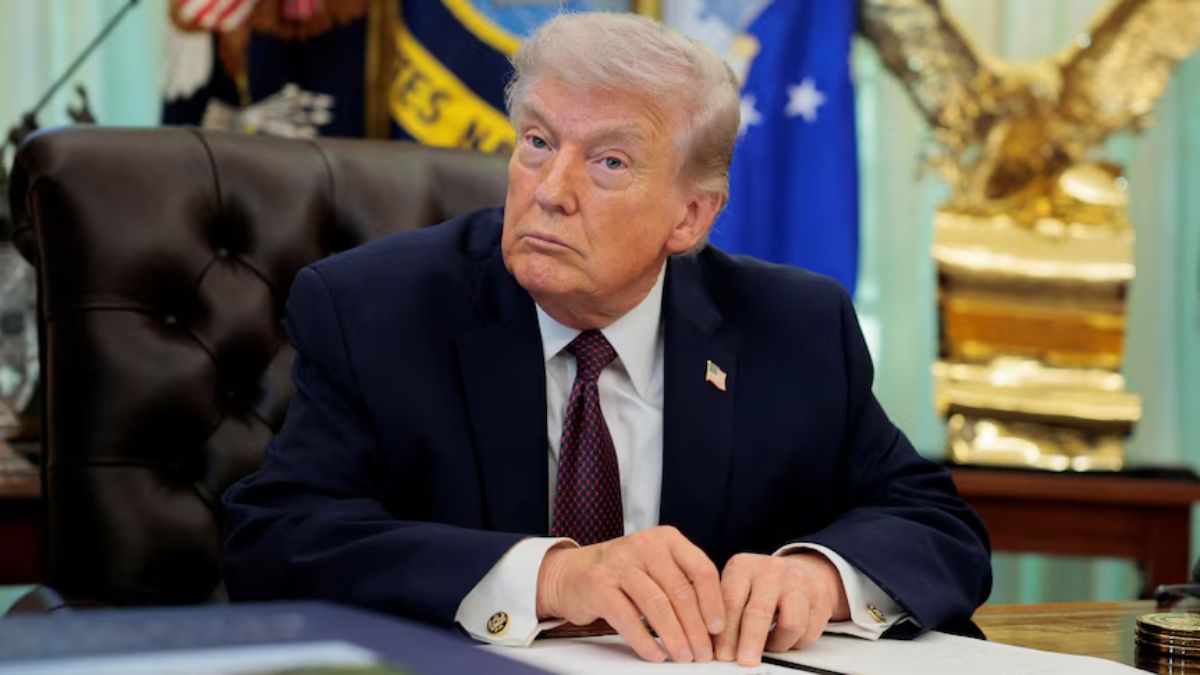
The image of María Corina Machado presenting her Nobel peace prize medal to Donald Trump inside the White House would, in ordinary times, be dismissed as theatrical symbolism. In the present context, it is something far more serious. It is a diplomatic artefact born of coercion, legal collapse and geopolitical opportunism. It also marks one of the most alarming erosions of international legal order witnessed in the Western Hemisphere since the Cold War.

At the centre of this affair is not the medal, nor the political desperation of a sidelined opposition leader, but the extraordinary assertion of executive power exercised by the United States through the forcible seizure of Venezuela’s sitting president, Nicolás Maduro, from sovereign territory. That act, described by Washington as a security operation and by Caracas as a kidnapping, stands in direct conflict with the foundational principles of modern international law.

It is against this backdrop that Machado’s gesture must be judged, not as an act of gratitude, but as a symptom of the legal vacuum that now defines Venezuelan governance.

The illegality of extraterritorial regime removal

Under Article 2(4) of the United Nations Charter, all member states are prohibited from using force against the territorial integrity or political independence of another state. The abduction of a head of state by foreign special forces, absent authorisation from the United Nations Security Council or a recognised state of armed conflict, constitutes a prima facie violation of this prohibition.

No credible legal basis exists under international law for the unilateral capture of a foreign president in peacetime. The doctrines of humanitarian intervention and responsibility to protect, even if accepted in their most expansive interpretations, require multilateral authorisation and proportionality. Neither condition was present.

Nor can the operation be justified under international criminal law. Maduro has not been indicted by the International Criminal Court. No extradition proceedings were initiated under the Inter American Convention on Extradition or any bilateral treaty between the United States and Venezuela. There was no judicial process, no warrant recognised by an international tribunal, and no due process of any description.

What occurred was not law enforcement. It was regime removal by force.

Under customary international law, reinforced by decisions of the International Court of Justice in cases such as Nicaragua v United States and Democratic Republic of Congo v Uganda, such conduct qualifies as unlawful intervention and the use of armed force. It is an internationally wrongful act engaging state responsibility.

That responsibility does not evaporate because the target was politically unpopular or widely accused of authoritarianism.

Trump’s subsequent recognition of Delcy Rodríguez as acting president compounds the illegality. Recognition of governments is not a discretionary public relations exercise. It carries legal consequences under international law, including control over state assets, treaty obligations and diplomatic representation.

Rodríguez was vice president under Maduro. Her elevation by a foreign power following the violent removal of the constitutional president violates the principle of non recognition of governments installed through unconstitutional means, a doctrine developed in Latin America through the Tobar Doctrine and later incorporated into the Charter of the Organisation of American States.

It also undermines the Montevideo Convention criteria for state legitimacy, particularly the requirement that government authority be exercised independently of external control.

By installing a successor without any domestic constitutional procedure, the United States has converted Venezuela into a de facto protectorate, while publicly denying that status.

The Nobel Committee was correct to clarify that the Nobel title cannot be transferred. The statutes of the Nobel Foundation provide that prizes are personal, indivisible and permanent. The physical medal is merely property, capable of transfer under ordinary principles of private law.

Machado’s act therefore has no legal significance in terms of prize status. Its relevance lies entirely in political messaging.

That message is unambiguous: loyalty to the foreign power that removed Venezuela’s president is now treated as the currency of legitimacy.

This places Machado in a legally precarious position. Under Venezuelan constitutional law, collaboration with a foreign power that has used armed force against the state may constitute treason. Article 128 of the Venezuelan Criminal Code criminalises acts that assist a foreign state in undermining national sovereignty. Whether such law can be enforced in the present circumstances is another matter, but the legal classification is clear.

From the perspective of international law, the act strengthens the argument that segments of the opposition have aligned themselves with an unlawful intervention, potentially exposing themselves to individual liability should future proceedings be brought before international tribunals.

The conduct of the White House represents a radical departure from established diplomatic practice.

Even during the most aggressive phases of the Cold War, the United States refrained from publicly framing regime removal as personal achievement, let alone displaying symbolic trophies presented by domestic political actors of the displaced state.

Trump’s statement that he had been presented with a Nobel medal “for the work I have done” trivialises the gravity of the underlying act and signals a dangerous normalisation of coercive regime change.

This behaviour directly undermines the Vienna Convention on Diplomatic Relations, which presupposes mutual respect for sovereignty and non interference.

It also places allied states, including the United Kingdom, in an untenable legal position. Under international law, states that recognise or materially support the outcome of an unlawful use of force may themselves incur responsibility if their actions contribute to the maintenance of the illegal situation.

Silence, in such cases, is not neutrality. It is acquiescence.

The British legal dilemma

The United Kingdom now faces a choice with serious legal consequences.

If it recognises Rodríguez as Venezuela’s legitimate leader, it risks violating its obligations under international law not to recognise situations created by serious breaches of peremptory norms, as codified in Article 41 of the International Law Commission’s Articles on State Responsibility.

If it refuses recognition, it risks diplomatic confrontation with Washington and the freezing of practical engagement with Venezuelan institutions.

British courts may soon be required to adjudicate questions of recognition in cases involving Venezuelan state assets, oil contracts and sovereign debt. English law has historically deferred to the executive on recognition matters, but the Supreme Court has increasingly asserted the relevance of international legality in cases involving competing claims to state authority.

The precedent set in the Guaidó litigation, in which the courts accepted executive recognition despite internal contradictions, will be tested again, but this time in the context of an overt act of foreign military intervention.

Trump’s dismissal of Machado as lacking domestic support, while praising Rodríguez as cooperative, reveals the true logic of the intervention. Stability and compliance have been prioritised over democratic legitimacy.

This contradicts decades of American rhetoric on democracy promotion and exposes the operation as one driven by transactional geopolitics rather than legal principle.

Rodríguez’s statement that Venezuela retains the right to maintain relations with China, Russia, Iran and Cuba highlights the fragility of the arrangement. A government installed through foreign force but asserting independent alliances is structurally unstable.

It also creates a legal paradox: a regime whose authority derives from unlawful intervention claiming sovereign rights against the very state that installed it.

The abduction of a sitting president by special forces, followed by the installation of a successor, will not be forgotten by other states.

China, Russia and Iran will view this precedent as justification for similar actions within their own spheres of influence. The legal restraints that once inhibited such behaviour have been publicly discarded.

For smaller states, the lesson is brutal: sovereignty now exists only at the discretion of powerful militaries.

Machado’s medal, displayed in a gilded frame, thus becomes a symbol not of peace but of the collapse of the legal architecture that once constrained power.

The presentation of a Nobel medal to the architect of an unlawful regime change is not merely ironic. It is a legal obscenity.

It marks the moment when international law, already weakened by selective enforcement, was replaced by a doctrine of executive convenience. It exposes how emergency powers, when exercised without judicial oversight, mutate into instruments of permanent domination.

Machado’s political future may yet revive. Rodríguez’s administration may yet collapse. Maduro may face trial or disappear into the machinery of American detention.

None of that alters the central fact.

A sovereign government was removed without legal authority. A successor was installed without constitutional process. An opposition leader offered a peace prize medal as tribute to the act.

In legal terms, this is not liberation. It is occupation by another name.

And in the long memory of international law, it will stand as one of the clearest demonstrations that when the rule of law yields to power, even the language of peace becomes a weapon.

TOPICS: Delcy Rodríguez Donald Trump International Criminal Court Maria Corina Machado United Nations Charter United Nations Security Council White House