
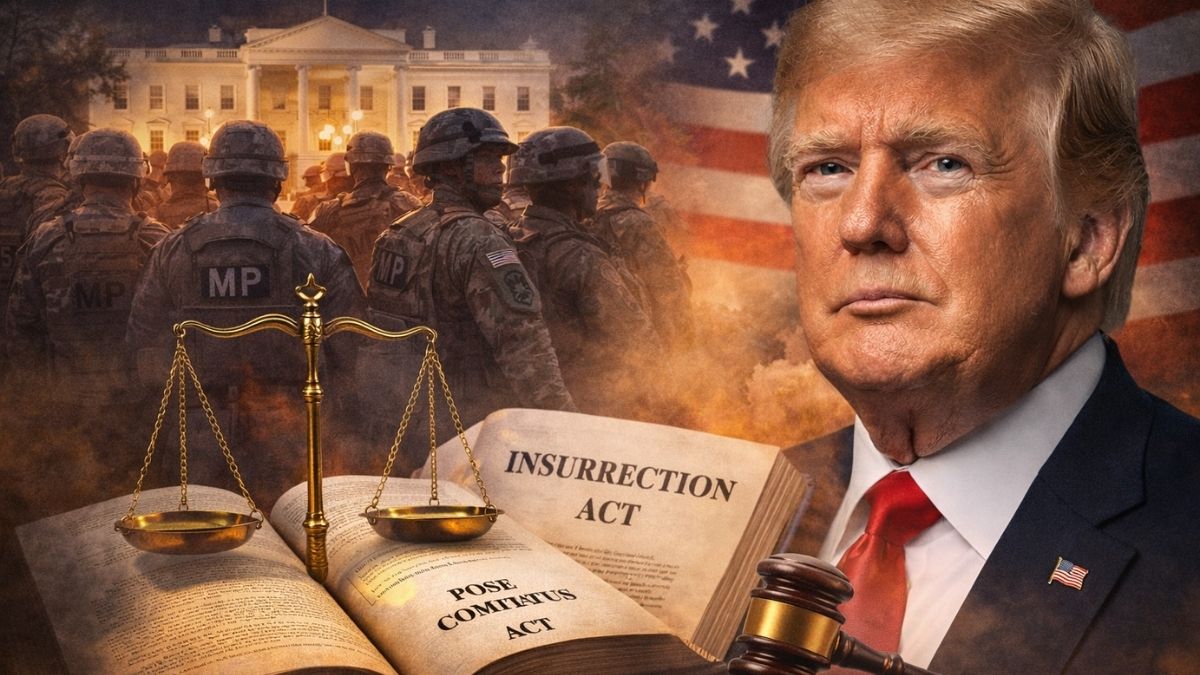
When United States President Donald Trump again raised the prospect of invoking the Insurrection Act to deploy military forces on American soil, the statement resonated far beyond Minnesota or Washington. For constitutional lawyers, international observers and foreign governments, the renewed focus on this extraordinary law signals more than a domestic security measure. It raises fundamental questions about executive power, civil military relations and the credibility of the United States as a democratic standard bearer in an increasingly volatile global order.
Though the Insurrection Act is deeply rooted in American legal history, its modern invocation would carry consequences that extend well beyond US borders.
What the Insurrection Act actually authorises
The Insurrection Act grants the US president authority to deploy active duty military forces or federalise National Guard troops within the United States to suppress rebellion, enforce federal law or address what the president determines to be unlawful obstruction of government authority.
Often referred to as the Insurrection Act of 1807, the law is in fact a consolidation of statutes enacted between 1792 and 1871. Its most significant feature is that it allows military forces to engage directly in domestic law enforcement activities, including arrests and searches. These powers are otherwise prohibited under US law.
In legal terms, the Act functions as a statutory exception to the Posse Comitatus Act of 1878, which was enacted to prevent the routine use of federal troops as a domestic police force.
Why Trump’s statements matter now
President Trump’s comments come amid escalating tensions over the deployment of federal agents to Minnesota and after earlier clashes with courts over the use of National Guard forces in US cities. In October, Trump openly stated that he viewed the Insurrection Act as a mechanism to bypass judicial and state level resistance.
Such statements are significant because the Act places decisive authority in the hands of the president. While some provisions contemplate cooperation with state governors, others allow unilateral action where the president determines that state authorities are unwilling or unable to enforce federal law.
From a constitutional perspective, this concentrates extraordinary power within the executive branch at moments of domestic unrest.
Judicial oversight and legal constraints
Historically, US courts have shown considerable reluctance to review presidential decisions made under the Insurrection Act. Federal appellate courts have held that such determinations are entitled to a high degree of deference, recognising the executive’s role as commander in chief.
However, recent judicial decisions suggest that deference is not absolute. An Oregon federal court last year rejected the Trump administration’s reliance on a different statutory provision to deploy troops, emphasising that factual conditions on the ground still matter.
If the Insurrection Act were invoked, litigation would be likely, but courts may intervene only at the margins. This legal uncertainty heightens international concern about unchecked executive authority.
International law and democratic norms
From an international relations perspective, the potential use of the Insurrection Act places the United States in a sensitive position. The deployment of military forces against civilian populations is closely scrutinised under international human rights standards, including those articulated by the United Nations and regional human rights bodies.
While international law permits states to maintain public order, the proportionality and necessity of military involvement in civilian policing is a recurring concern. Allies that routinely criticise such practices in other countries may find themselves reassessing their diplomatic posture if the United States adopts similar measures.
The optics matter. Democracies derive soft power from restraint as much as from force.
Historical precedent and its limits
The Insurrection Act has been used repeatedly in US history, most notably during the civil rights era and most recently in 1992 during the Los Angeles riots following the Rodney King verdict. In that instance, deployment occurred at the request of California’s governor and was framed as a temporary emergency measure.
Since the 1960s, however, use of the Act has been rare. Its rarity has helped preserve a strong norm against military involvement in civilian governance. A unilateral invocation without state consent would mark a significant departure from post civil rights era practice.
Global perception and strategic consequences
For foreign governments, particularly those in fragile democracies, US actions under the Insurrection Act would set a powerful precedent. Washington has long criticised the use of domestic military force by authoritarian regimes. A high profile deployment within the United States would complicate such diplomacy.
For strategic rivals, it would offer a ready narrative. Claims of democratic backsliding in the United States could be amplified in international forums, undermining US credibility in promoting rule of law, constitutional restraint and civilian control of the military.
A domestic law With global reach
The Insurrection Act may be a domestic statute rooted in early American history, but its invocation in the modern era would be a globally significant event. It would test constitutional boundaries, strain civil military norms and reshape international perceptions of American governance.
As President Trump continues to raise the possibility of its use, the question is no longer merely whether the law permits such action. It is whether the United States is prepared to accept the legal, diplomatic and democratic consequences that would follow.
In an interconnected world, the exercise of emergency power at home rarely stays there.