
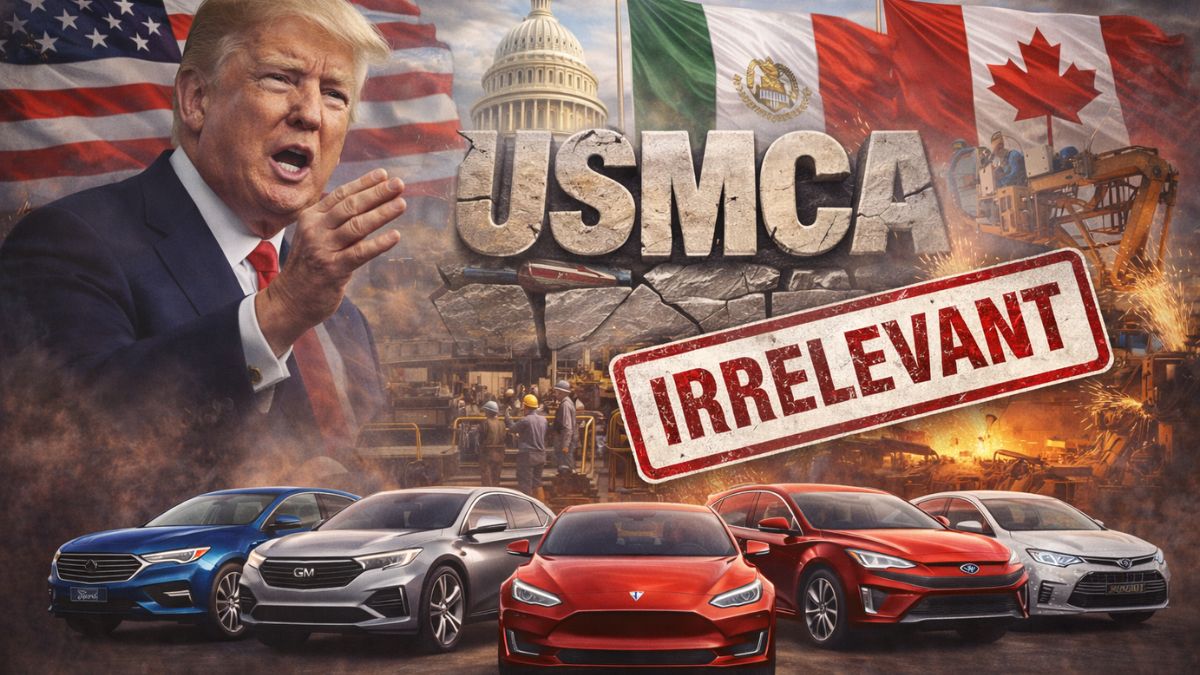
When President Donald Trump publicly declared that the United States-Mexico-Canada Agreement is “irrelevant” for the United States, he did more than provoke trade partners. He struck at the credibility of treaty-based international economic order itself.
The statement, delivered during a visit to a Ford factory in Michigan, comes as the USMCA enters its mandatory six year review window. The timing is not accidental. It signals a deliberate recalibration of American trade posture, one that treats multilateral commitments not as legal obligations but as optional instruments of convenience.
For Canada and Mexico, this is not rhetoric. It is an existential warning.
USMCA is not a political talking point. It is a binding law
From a legal standpoint, the USMCA is not symbolic. It is a ratified international agreement with domestic effect under United States law, Canadian law and Mexican law. Article 34.7 of the agreement explicitly mandates a joint review process, not unilateral dismissal.
A declaration of irrelevance by the United States president does not terminate the treaty. However, it creates legal uncertainty that markets, investors and supply chains treat as risk. In international trade law, perception of instability can be as damaging as formal withdrawal.
The rule of law in trade depends not merely on compliance, but on predictability.
The North American auto industry is built on legal integration, not national slogans
The auto sector illustrates the contradiction at the heart of Trump’s remarks. The Detroit Three, General Motors, Ford and Stellantis, rely on integrated supply chains spanning all three USMCA countries. This structure is not accidental. It is the direct product of regional trade rules negotiated and signed by the United States itself.
Automakers have warned that dismantling USMCA protections would expose US producers to competitive disadvantage against Asian imports, undermine economies of scale and raise consumer costs. Tens of billions of dollars in annual efficiency gains are at stake.
From a legal perspective, this is a rare alignment where industry interests, treaty obligations and economic logic converge. The executive rhetoric diverges sharply from all three.
Manufacturing nationalism versus treaty commitments
Trump’s insistence that the United States does not need vehicles made in Canada or Mexico reflects a philosophy of manufacturing nationalism. While politically resonant, it clashes with decades of trade jurisprudence recognising comparative advantage and cross border value creation.
More importantly, it risks violating the spirit, if not the letter, of the USMCA’s market access and non discrimination provisions. Aggressive tariffs or regulatory barriers targeting USMCA compliant goods could invite dispute settlement proceedings under the agreement.
Canada and Mexico are not without remedies. They have them in writing.
The international fallout: America as an unreliable treaty partner
Beyond North America, the implications are severe. If the United States treats a flagship trade agreement negotiated under its own leadership as dispensable, the message to the world is unmistakable. Treaties with Washington are politically contingent, not legally durable.
This weakens the US position in future negotiations with the European Union, Indo Pacific partners and emerging economies. It also strengthens the hand of rivals who argue that Western trade rules are selectively enforced.
In international relations, credibility once lost is rarely recovered quickly.
The strategic paradox of withdrawal
Ironically, abandoning USMCA would not isolate Canada and Mexico as much as it would isolate the United States. Both countries have diversified trade relationships, including agreements with the EU and Asia Pacific economies.
A fractured North American bloc would also undermine collective resilience against supply chain shocks, geopolitical competition and industrial subsidies elsewhere. What is presented as sovereignty reclamation may instead result in strategic self harm.
When power ignores its own signature
Calling USMCA irrelevant does not make it so. It merely exposes a deeper tension between rule based order and executive discretion. For international law, the danger lies not in withdrawal alone, but in the casual delegitimisation of binding commitments.
The USMCA review was designed to strengthen the agreement. Instead, it risks becoming a referendum on whether treaties still matter when political expediency intervenes.
If international agreements are reduced to campaign props, then the real casualty is not trade efficiency. It is the legal architecture that keeps economic conflict from becoming political confrontation.