
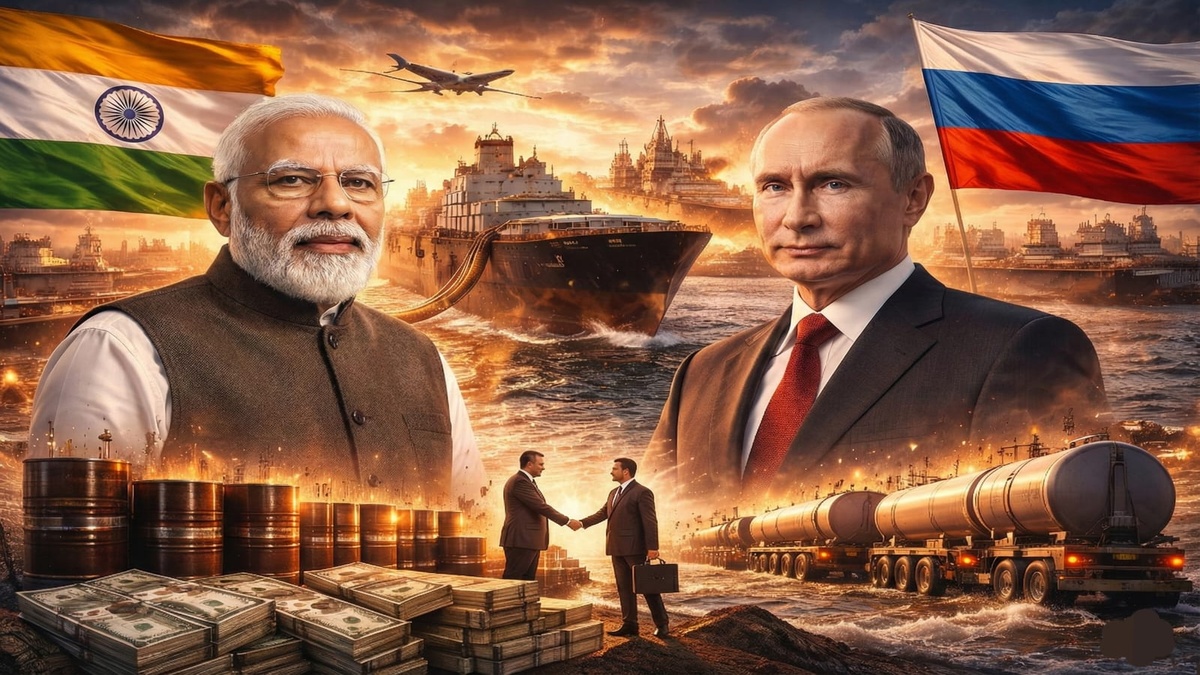
Russia is hastening to reconfigure its oil supply chain even as the U.S. turns up the heat on New Delhi. As India is currently the second-largest consumer of Russian crude, the Kremlin is not waiting idly as the sanctions are coming tighter. They have begun to rely on an ever rotating group of so-called shadow middlemen and shell companies to keep the money on the move. The plan is simple: oil to the India capital must continue to move at any cost which may involve renaming the shipping document every several weeks to avoid detection by the U.S. monitors. Washington and New Delhi are at the brink of a conflict.
Trump threatening with 500% tariff imposition
President Trump recently gave a green light to a bill that may impose an obstructive 500 percent tariff on any nation that continues purchasing Russian energy. This is after a 25 percent (and subsequently 50) secondary tariff which had already been imposed on Indian export last year. In the case of India, it is a gigantic dilemma. On one hand, Russian Urals are presently at a 9-to-10 dollar cut per barrel with the Middle East oil, which is a bargain which will save the Indian economy close to 4 billion a year. Conversely, the 500 percent duty would be a virtual death sentence to Indian commerce with U.S. Shadow Middlemen and Reliance Pivot. Russia is already drifting off the big names such as Rosneft and Lukoil in order to keep the trade alive. They are providing an Indian refiner with a loophole in the law by passing the oil through the brand-new exporters that are yet to be hit by U.S. sanctions. One pundit said it was not just a sitting back and watching game; Russia is restructuring the whole supply chain so as to be one step ahead of the U.S. Treasury. Some players are however already jumping ship due to the pressure. Reliance Industries, the largest Indian-based privately owned refiner has officially announced that it will not purchase any Russian oil this month of January. It is a tactical action to save its huge diesel and jet fuel shipments to the EU that has stringent regulations on the so-called Russian-origin products.
The Venezuela “Escape Hatch” As the state-owned firms such as IOC and BPCL are seeking Russian bargains, Reliance is turning to South America. After the U.S seizure of Nicolas Maduro earlier this month, Trump administration is said to be negotiating with Reliance to restart Venezuelan oil shipment. This may be the ideal way out of India, whereby it substitutes approved Russian barrels with approved-compliant but priced competitively heavy Venezuelan crude.
The international oil market is gambling that these sanctions will not come through entirely. Although imports declined to 1.2 million barrels a day in December, numerous analysts are of the opinion that they would be rejuvenated when the new shadow supply channels are fully operational. New Delhi is currently engaged in a high-stakes game of strategic autonomy whereby it is not allowing Washington to decide its energy policy and quietly seeking a way of ensuring that its economy is not stampeded by the next round of American tariffs.