

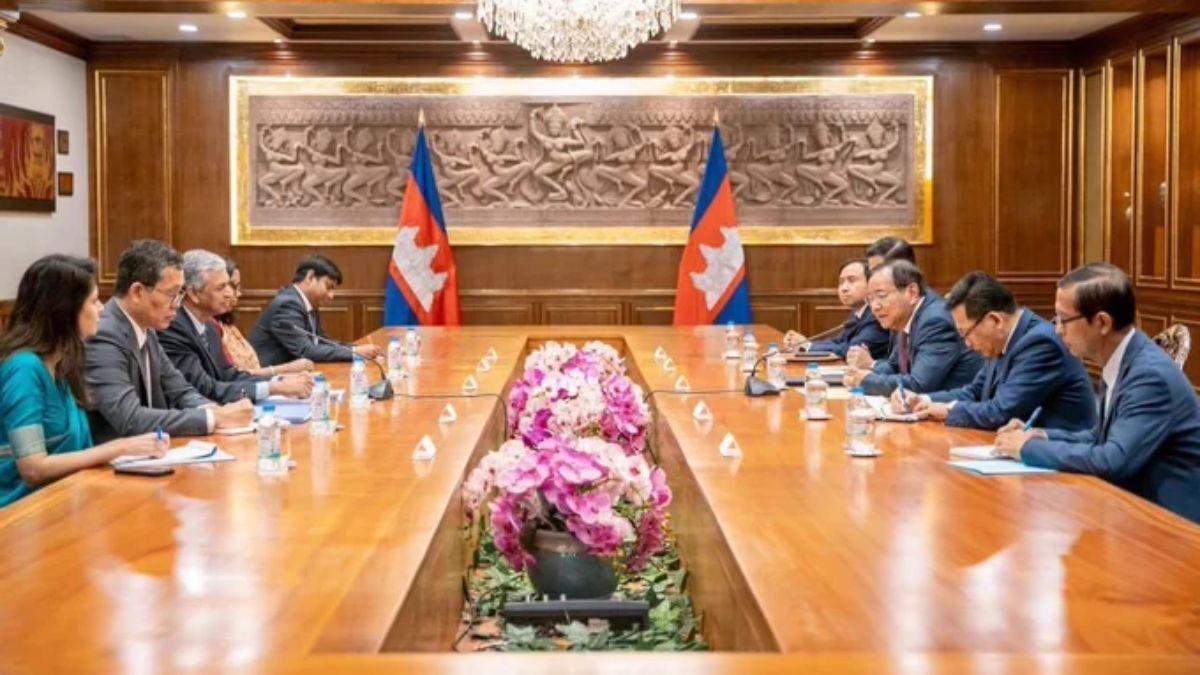
Secretary (East) Shri P. Kumaran of India’s Ministry of External Affairs held talks with Cambodia’s Deputy Prime Minister and Minister of Foreign Affairs and International Cooperation, Mr. Prak Sokhonn, focusing on deepening trade and economic cooperation between the two nations. The discussions underscored India’s strategic push to expand market access in Southeast Asia amid global supply chain disruptions, with both sides prioritizing pharmaceuticals, chemicals, and investment flows as key growth drivers.
The meeting reviewed robust bilateral trade momentum, which grew from $234 million in 2019-20 to $404 million in 2023-24, driven by India’s exports of pharmaceuticals ($185 million), motor vehicles, bovine meat, raw hides, leather, and miscellaneous chemicals. Cambodia’s shipments to India primarily electrical goods, organic chemicals, vegetable oil, apparel, and footwear rose sharply, reflecting complementary strengths in manufacturing and agriculture. Early 2025 data showed $160 million in trade for January-May alone, signaling double-digit growth potential toward a $1 billion target by 2030.
India’s Duty Free Tariff Preference (DFTP) scheme, extended to Cambodia since 2008 and covering 98.2% of tariff lines, has been pivotal. Expanded in 2014, it provides unilateral market access for Cambodian exports, facilitating smoother flows under the ASEAN-India Trade in Goods Agreement. This policy framework has boosted Cambodia’s apparel and electrical exports while opening doors for Indian pharma and auto components in Phnom Penh’s industrial hubs.
Strategic trade diversification amid global headwinds
This engagement comes as India counters West Asia conflict risks Hormuz disruptions threatening 60% of LPG imports with ASEAN diversification. Cambodia serves as a stable gateway for Indian chemicals and pharma exports, mirroring Brazil’s $5.8 billion Apr-Jan FY26 uptake in similar categories. Bilateral trade resilience shines: despite a 29% dip to $345 million in 2024, 2025 rebounded 19% to $410 million, per official figures.
Policy angles dominated: capacity building via diplomat training at Sushma Swaraj Institute supports trade negotiations, while development partnerships like rural connectivity lines of credit enhance logistics. Both sides committed to investment roadshows, renewable energy MoUs, and startup exchanges to tap India’s 800 million middle-class consumers by 2030.
Policy Push for investment and market access
Kumaran emphasized expanding trade and investment collaboration, aligning with India’s Act East Policy and Cambodia’s economic diversification goals. Both nations aim to leverage the ASEAN-India FTA, which liberalizes over 90% of product tariffs, to enhance supply chain resilience. Discussions highlighted potential investment treaties and digital payment integration via UPI to cut transaction costs and promote cross-border e-commerce in textiles, agri-products, and electronics.
Cambodia’s 7% GDP growth and India’s position as the world’s largest consumer market create synergies: Uttar Pradesh alone seeks Cambodian rice, spices, and cashews, while joint ventures in agri-tech, fintech, and apparel parks offer scale. The talks build on the 3rd Foreign Office Consultations in March 2025, where trade working groups set ambitious volumes, and recent Joint Working Group meetings on trade and investment.
Prak Sokhonn welcomed India’s consistent support, including Quick Impact Projects and heritage conservation, as enablers for private sector ties. For Indian exporters in Gujarat’s chemical hubs or Patna’s trade desks, Cambodia offers low-tariff entry to a $30 billion economy hungry for value-added goods.
As BRICS and ASEAN converge, this meeting positions India-Cambodia trade as a South-South success story. Stakeholders eye FTAs, UPI rollout, and manufacturing pacts to hit $1 billion ahead of schedule, fortifying chains against euro area energy shocks and Gulf volatility. Daily inter-ministerial coordination, akin to Modi’s crisis management, will drive implementation.