

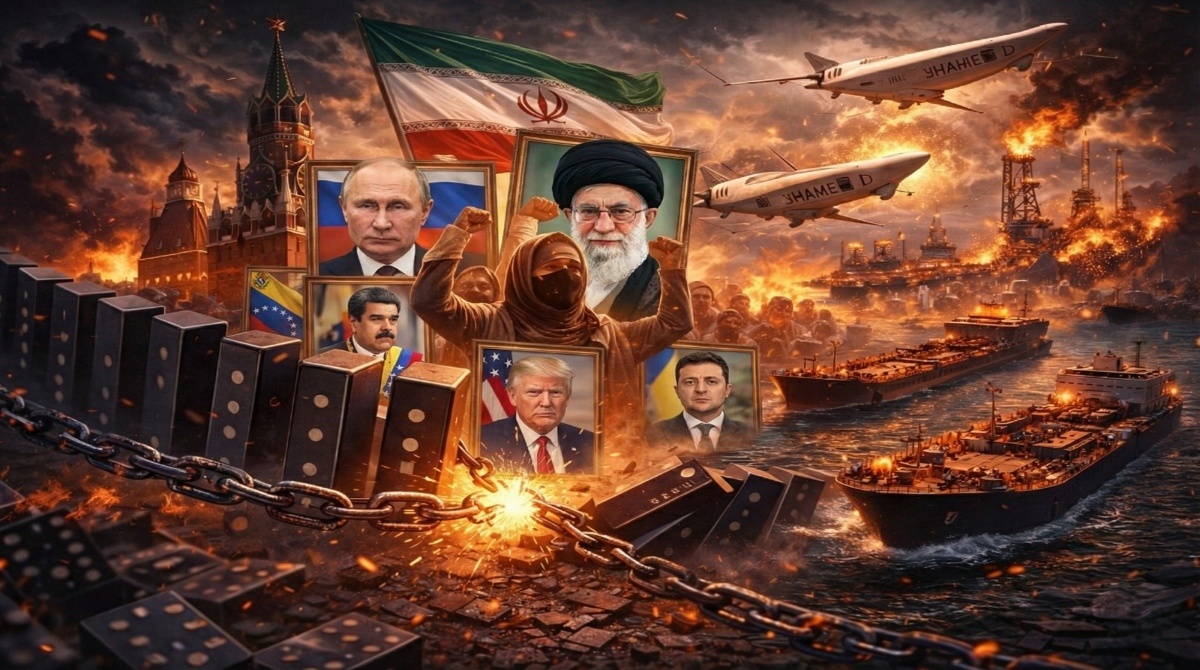
Moscow takes a great deal of apparent discomfort in the anarchy in Iran. It is not only the case of the loss of a friend in the region but also a very real danger to the drone supply lines that keep the Ukraine war afloat. Following immediately after the U.S. acted against the Maduro regime in Venezuela, there is an increasing feeling of the Kremlin that their entire web of allies is being picked off systematically. The fall of Tehran would not only lose a partner but Russia can lose control over the world oil market.
Since the invasion of Ukraine began, Iran has been a savior to Moscow. The Shahed drones of Tehran are not merely an appendix to Russia, but they have become the mainstay of the air campaign. The two have been literally joined at the hip beyond the battlefield, keeping the oil prices high with OPEC+ and supporting each other on the nuclear negotiations. That warm relationship is in question. Analyst Mikhail Sheitelman believes that the Kremlin is indeed getting nervous over the demonstrations in Tehran, particularly after witnessing the speed with which the U.S. responded to shaking up Venezuela.
Venezuela, oil dominance, and the strategic nightmare for Russia
The seizing of the Venezuelan tankers by the U.S. gave Moscow a huge blow to the bottom line effectively wiping out billions of business in a single night. Not only was it trade lost but a sign. As Donald Trump suggests supporting the Iranian protesters, there is an actual concern that Tehran is the domino. The stakes, according to Sheitelman of Channel 24, could not be greater: in the event of toppling of the Iranian regime, the U.S. would be virtually holding the keys to Venezuelan and Iranian oil. To Russia, it is a nightmare situation in which their own energy exports are put in the backyard.
The economic consequences go far beyond short term trade shocks. Venezuela has the biggest proven oil deposits of 303.8 billion barrels, and it is fourth in the world. Joint control of these resources by the U.S. would provide Washington with a considerable leverage on almost 30 percent of the world reserves. This phenomenon may make the OPEC+ union ineffective as a price-determining tool. Political scientist Taras Zagorodniy of Ukraine states that such an eventuality would leave Russia without one of its few remaining means of economic pressure – specifically against European consumers.
Military vulnerabilities and pressure on global energy markets
Military considerations are also extremely problematic. Russia currently has a drone assembly plant at Alabuga at the center of its air policy, which is virtually an Iranian front. The plant relies virtually on Tehran in terms of technical designs and licensing. In case a pro-Western regime is installed in Iran, all such contracts will disappear overnight. Russia would have to construct its own technology itself whilst engaged in a war. Analysts believe that it may take years to recover to their present levels of production, something that Moscow does not have.
To the world energy markets, the scenario poses conflicting demands. Although the instability in the Middle East usually leads to an increase in oil prices, a long-term American dominance of the production in Venezuela and Iran may saturate the market. This could bring prices down to the level of less than $60-per-barrel that Russia can afford to live. The Kremlin has not made any official statement regarding the Iran situation but under the carpet, the diplomatic cables are clattering. Russia is already in the scramble mode to identify other suppliers, as they are well aware that their lifeline is on a thread.