

The attacks of the United States and Israeli forces on Iran have been described by the Russian government as destabilising acts that can cause humanitarian, economic and even radiological disasters in the Middle East. The evaluation of Moscow is clear: the increase is not only a bilateral conflict but a major threat to the security of the region and even the global security.
The operation has currently been publicly denounced by the Russian Foreign Ministry as a dangerous adventure, the country warning that Washington and Tel Aviv are taking the region to the edge. It charges the United States and Israel in highly colored words with acting to destroy the constitutional order in Iran and overthrown the government. This rhetoric contextualizes the Russian reaction within the wider legal context that is state sovereignty and non-intervention. Article 2(4) of the UN Charter forbids the use of force against a state territorial integrity or political independence. The implicit implication of the characterization of Moscow is that the strikes are not lawful, but instead they are unlawful aggression and not lawful self-defence.
At the same time, the Russian Foreign Minister Sergei Lavrov, in a telephone interview with his Iranian colleague Abbas Araghchi, has termed the American attacks as unprovoked. The purpose of such language is to disallow any assertion that the strikes are covered by Article 51 of the self-defence exception. Thus, the legitimacy of the US-Israeli operation depends on the possibility to prove the objectivity of an imminent threat and the correctness of the application of the principles of necessity and proportionality to the customary international law.
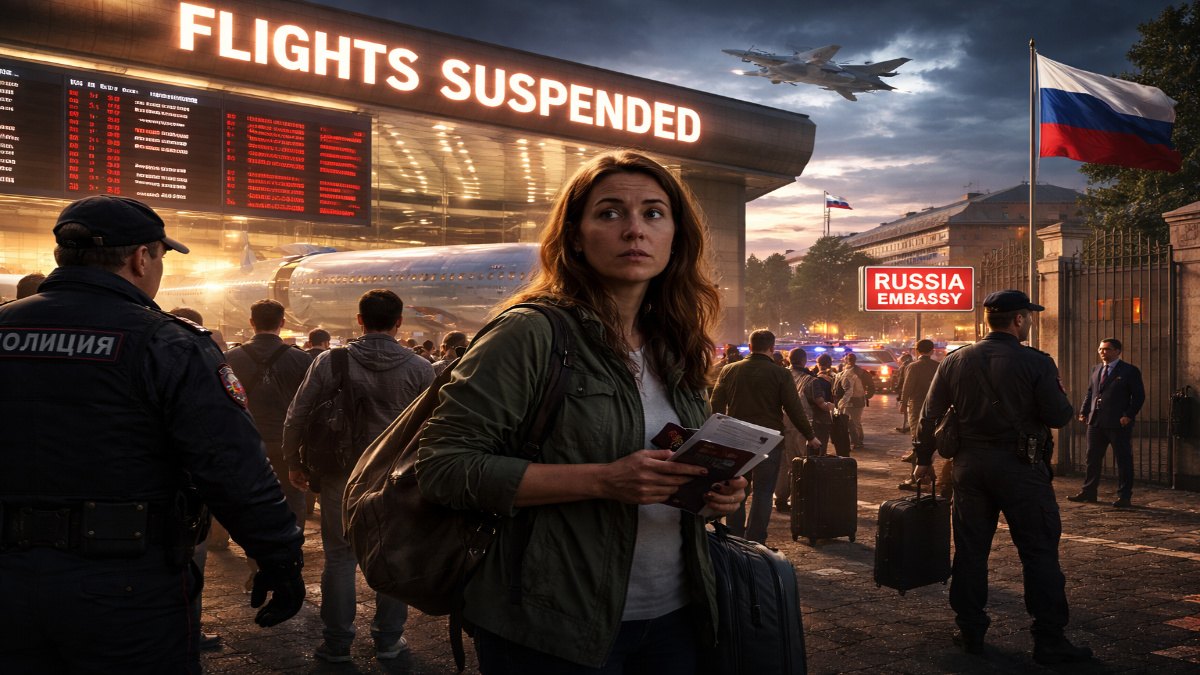
With the deepening of the crisis, diplomatic condemnation has been followed by practical action. The Russian embassy in Tehran has encouraged its citizens to leave Iran as possible and those who might still stay there to avoid military and government buildings. The Russian embassy in Israel has also given a similar warning. These measures indicate the acknowledgment of the growing aggression and possible retaliation, which highlights the physical danger of an extended conflict.
Previously, the air-transport authority of Russia had prohibited commercial flights between Russia and both Iran and Israel without any specified date, a move that indicated how seriously Moscow takes the situation that is unfolding. The suspension, in addition to the security issues, has economic consequences, since civilian airspace is disrupted by instability in the regional airspace.
Simply put, since the situation has escalated beyond a diplomatic standoff to a full-scale military conflict, the reaction of Russia has changed as well, shifting towards political reproach to safety and logistical support. The episode, in legal and geopolitical aspects, poses some fundamental questions of the boundaries of pre-emptive violence, the strength of the UN Charter system and the danger of great-power conflict in what is already a volatile region.