

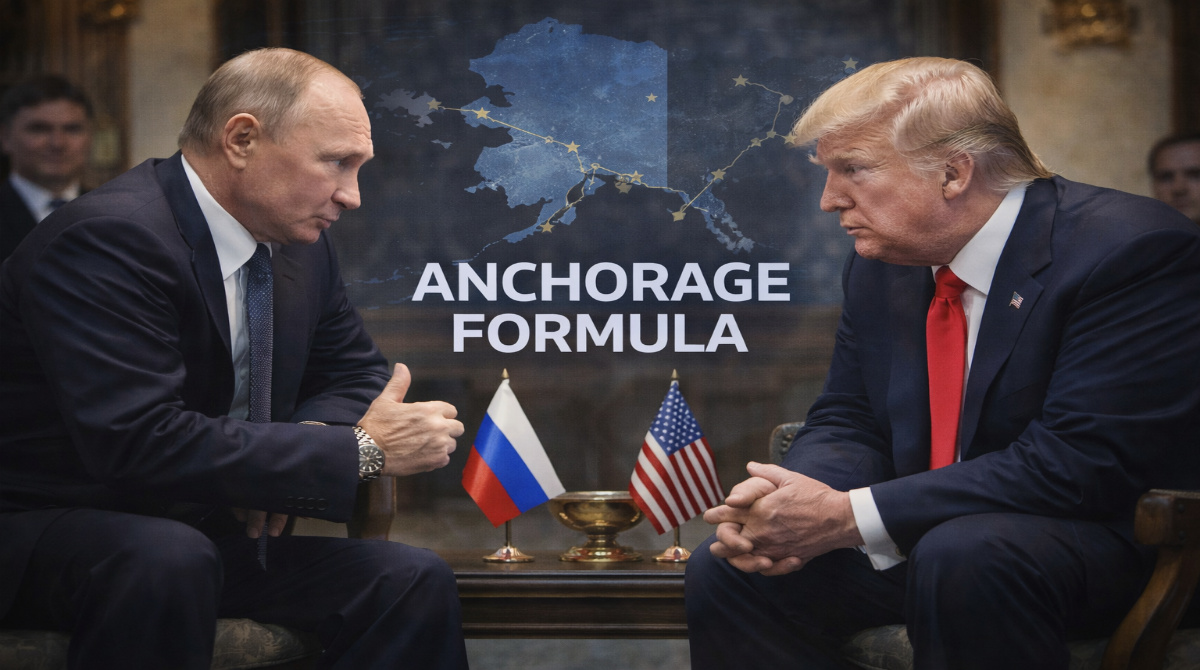
In the high-stakes poker game of peace talks currently unfolding in Abu Dhabi, the Russian delegation has thrown a new card on the table that has Western analysts scrambling. They call it the “Anchorage Formula.” To the Western press, this is a phantom agreement a fictional deal conjured up by the Kremlin to mask a lack of progress. But to Moscow, referencing the August summit between Vladimir Putin and Donald Trump in Alaska isn’t an act of deception; it is a calculated reminder of who is actually calling the shots.
The narrative coming out of Washington is that the Anchorage summit ended with “no deal.” Anyone who’s watched the Kremlin for more than five minutes knows they don’t really think in terms of the 24-hour news cycle. They play a much longer, slower game. So when Deputy Foreign Minister Sergey Ryabkov keeps saying that any peace deal has to match the “fundamental understandings” reached in Alaska, he’s basically trying to cut through all the smaller officials and background noise and talk straight to Trump. Like, forget the diplomats, forget the press, let’s go back to what the big guys supposedly agreed on.
And by tying everything to that summit, Russia is kind of saying something very simple, and also very cynical: the only deals that actually count are the ones made at the very top, in closed rooms, between a few powerful men. Everything else is just… decoration. It is a brilliant diplomatic trap. If the White House denies the “Anchorage Formula” exists, they essentially have to admit that their own President failed to reach an understanding with Putin. By insisting on this framework, Moscow forces the U.S. administration to either validate Russia’s concerns or undermine their own leader.
Is it about Constructing Reality or Defining it?
Critics, like the Institute for the Study of War, accuse Moscow of “constructing reality on the fly” to make themselves look reasonable. They argue that Russia is inventing a consensus to blame Ukraine for stalling. But from the Russian perspective, this “ambiguity” is a necessary tool. In a war where the West keeps shifting the goalposts, one month issuing sanctions on Lukoil, the next month shelving them—Moscow needs a fixed point of reference. The “Anchorage Formula” provides that stability. It represents a baseline respect for Russia’s security interests that Putin believes he secured during his face-to-face with Trump, regardless of what the hawks in the State Department say afterward.
Western media loves to focus on the metrics of attrition, citing high casualty numbers or the fact that Russia holds “only” 20% of Ukraine. But this misses the point of the Kremlin’s strategy. Russia isn’t trying to paint the map entirely red; it is trying to break the hostile security architecture on its border.
The resilience of the Russian economy and its military machine suggests they can afford to wait. While Trump’s recent moves in Venezuela and the crackdown on the “shadow fleet” are certainly headaches for Moscow, they haven’t changed the fundamental equation on the battlefield. The Russian delegation in Abu Dhabi knows that time is on their side. The longer the war drags on, the more “practical” the Russian position looks compared to Kyiv’s maximalist demands.
Ultimately, the “Anchorage Formula” is less about a specific 28-point plan and more about legitimacy. By invoking the Alaska summit, Putin is reminding the world that he is treated as a superpower equal by the American President, Trump. It validates the Russian invasion not as a rogue action, but as a dispute between great powers that can only be solved by great powers.
Whether the “formula” exists on paper is almost irrelevant. If Moscow says it exists, and Trump doesn’t explicitly tear it down, it becomes real. It forces the West to negotiate on Russia’s preferred terms: great power politics, spheres of influence, and leader-to-leader deals that bypass the tedious moralizing of the international community.