
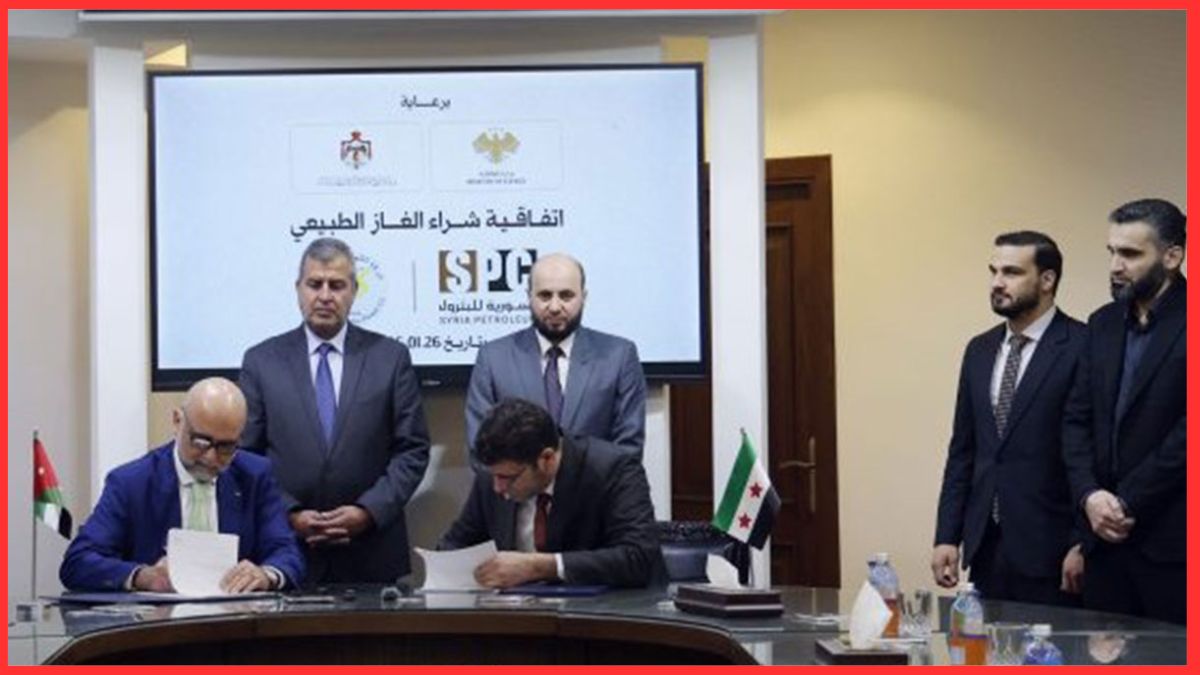
Jordan and the Syrian Arab Republic formalized a cross-border energy arrangement in Damascus aimed at easing Syria’s electricity shortages through a steady flow of natural gas transiting Jordanian territory, a move that underscores pragmatic regional cooperation and infrastructure-led recovery. The agreement was signed on Monday by Sofian Bataineh, director-general of Jordan’s National Electric Power Co., and Hashem Saleh, deputy chief executive officer of the Syrian Petroleum Co., in the presence of senior energy officials from both countries. Jordan’s Minister of Energy, Saleh Kharabsheh, announced that the deal provides for the delivery of 4 million cubic meters of natural gas per day, equivalent to approximately 140 million cubic feet, with the objective of stabilizing Syria’s electricity grid and supporting power generation plants. According to Jordanian officials, the supply leverages Jordan’s floating storage and regasification unit at the Port of Aqaba on the Red Sea, which receives liquefied natural gas from global markets, regasifies it, and transmits it through the Arab Gas Pipeline to Damascus, compensating for infrastructure constraints inside Syria.
Aqaba LNG Infrastructure and Arab Gas Pipeline Enable Daily Gas Flow to Syria
The agreement builds on operational momentum that began earlier this year, when Jordan started supplying Syria with natural gas in January, delivering daily volumes ranging from 30 million to 90 million cubic feet to help improve the energy sector and reduce power outages, according to the Petra news agency. Under the newly signed framework, volumes are set at a higher, standardized level designed to provide predictability for Syria’s electricity generation. Jordanian Energy Minister Kharabsheh indicated that the arrangement highlights Jordan’s growing role as a regional energy hub, supported by its LNG import, regasification, and pipeline transit capabilities, while also reflecting a commitment to support Syria and advance Arab economic integration. The signing ceremony in Damascus was attended by Kharabsheh and Syria’s Minister of Energy, Mohammed Bashir, signaling high-level backing for the initiative. The facts in this report are drawn from official announcements by Jordan’s Ministry of Energy and coverage by the Petra news agency, ensuring verified and attributable information suitable for international audiences in the Middle East, Europe, and beyond.