
- 1:54 PM (IST) 21 Jan 2026Latest
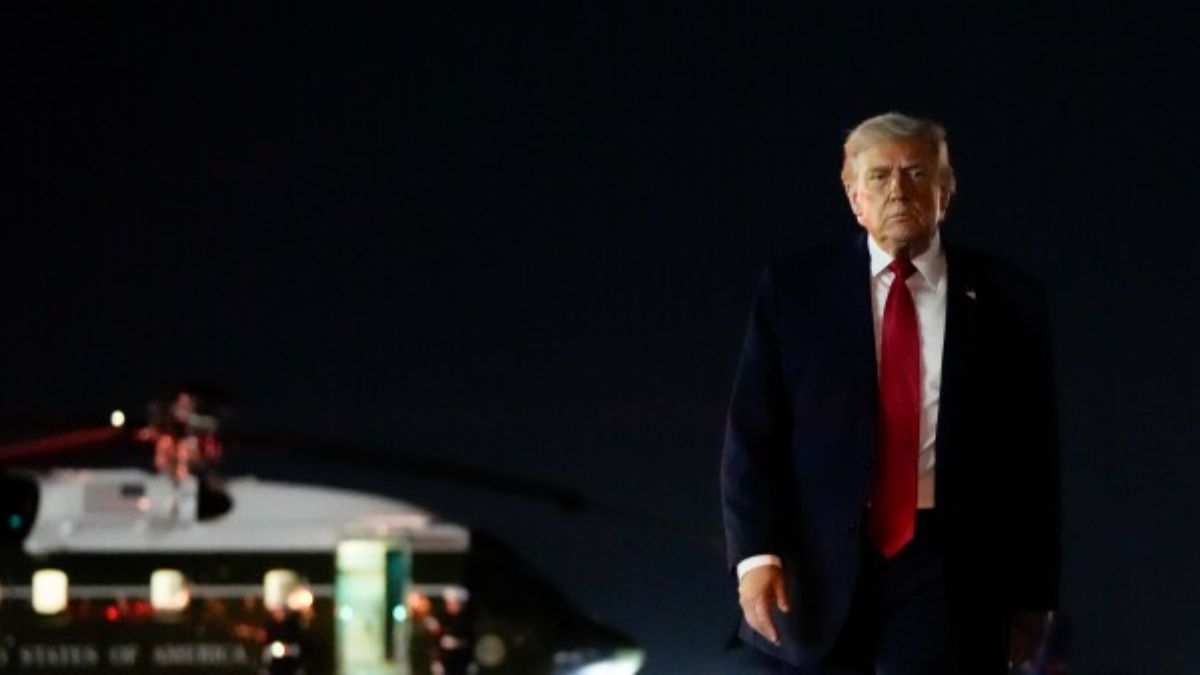
Davos live legal updates: Trump three hours late to Davos
When United States Treasury Secretary Scott Bessent informed journalists in Davos that President Donald Trump was likely to arrive around three hours late for his scheduled World Economic Forum address, following the aborted flight of Air Force One and the transfer to a replacement aircraft, the announcement was treated publicly as a matter of logistics. In legal and diplomatic reality, it represents a revealing stress test of the modern architecture governing presidential mobility, state security obligations, international conference law, alliance coordination and the fragile etiquette of economic diplomacy.
When United States Treasury Secretary Scott Bessent informed journalists in Davos that President Donald Trump was likely to arrive around three hours late for his scheduled World Economic Forum address, following the aborted flight of Air Force One and the transfer to a replacement aircraft, the announcement was treated publicly as a matter of logistics. In legal and diplomatic reality, it represents a revealing stress test of the modern architecture governing presidential mobility, state security obligations, international conference law, alliance coordination and the fragile etiquette of economic diplomacy.
Trump had been due to deliver his special address at 2.30 pm Davos time. Bessent confirmed that he had not yet seen the updated schedule after the president switched aircraft. That uncertainty alone carries legal and institutional significance far beyond the inconvenience of a delayed keynote speech.
Presidential travel is not a private matter. It is a sovereign act conducted under a dense matrix of domestic constitutional law, military regulations, aviation safety regimes and international diplomatic agreements. The aircraft designated as Air Force One is not simply a mode of transport but a mobile extension of the United States executive branch, equipped to allow the president to exercise constitutional authority at all times. A failure serious enough to require an in flight return to Washington engages questions of continuity of government, national security risk management and the legal responsibilities of the Department of Defense and the United States Air Force under federal law.
Under Title 10 of the United States Code, the Air Force is legally obliged to maintain aircraft used for presidential transport to the highest operational standards. The ageing fleet, in service for nearly four decades, has long been criticised by the Government Accountability Office and congressional oversight committees for escalating maintenance complexity and operational risk. Each forced diversion or aircraft substitution creates a paper trail of statutory reporting duties, classified security assessments and internal compliance reviews. None of this is visible to the public, yet all of it forms part of the constitutional machinery that allows a president to travel abroad while remaining the lawful head of state and commander in chief.
The legal dimension does not stop at the United States border.
When a sitting president travels to Switzerland for the World Economic Forum, the journey is governed by bilateral status of forces arrangements, diplomatic immunity conventions and aviation treaties including the Chicago Convention on International Civil Aviation. Switzerland, although not a member of NATO, provides extensive security cooperation under special arrangements that must be recalibrated in real time when arrival times change. Airspace clearance, runway security, police deployment and counterterrorism coordination are legally regulated processes. A three hour delay forces host authorities to amend formal security orders, reissue notices to airmen and renegotiate diplomatic security protocols at short notice.
In parallel, the World Economic Forum itself operates under Swiss law as a foundation, with contractual obligations to participants, media organisations and security providers. A keynote address by the sitting US president is not merely a speaking slot but a contractual and logistical anchor around which dozens of bilateral meetings, press briefings and market sensitive announcements are scheduled. Delays of several hours reverberate across a tightly regulated ecosystem of financial disclosures, stock market compliance obligations and diplomatic timetables.
From the standpoint of international economic law, timing matters.
Statements by the US president at Davos are often treated by investors as market moving information. Under United States securities law, particularly Regulation FD, selective disclosure of material information is prohibited. When schedules become uncertain, the risk of inadvertent selective briefing increases. Treasury officials, corporate executives and foreign ministers may receive partial updates or informal guidance before markets do. Each such interaction carries potential legal exposure for those bound by disclosure regimes in New York, London and Brussels.
The delay therefore intersects directly with financial regulation, not merely diplomacy.
It also interacts with alliance politics.
Trump’s Davos appearance was already overshadowed by threats of tariffs against European states, statements about acquiring Greenland, criticism of NATO allies and accusations directed at the United Kingdom, Denmark, France and Switzerland by senior US officials. In this context, punctuality is not a trivial courtesy but a signal of diplomatic intent. Chronic lateness or uncertainty, when combined with hostile rhetoric, reinforces perceptions that the United States is downgrading the institutional dignity of multilateral engagement.
International law does not mandate punctuality. But it does recognise the principle of good faith in diplomatic relations, codified in the Vienna Convention on Diplomatic Relations and embedded in customary practice. Persistent or strategic disregard for agreed schedules, particularly at summits and multilateral forums, is widely interpreted as a form of diplomatic signalling. It communicates hierarchy. It asserts dominance. It tests the tolerance of partners.
From the perspective of European states already alarmed by suggestions of territorial acquisition in Greenland and by accusations of economic irrelevance, the prospect of a delayed presidential address compounds a narrative of unilateralism.
There is also a constitutional dimension rarely discussed in public discourse.
The United States presidency is an office bound by law, not personality. The logistical fragility revealed by repeated aircraft failures raises questions about whether the executive branch is meeting its constitutional duty to ensure the continuous and effective functioning of the presidency. The Twenty Fifth Amendment and the Presidential Succession Act exist precisely to address scenarios in which the president is incapacitated. While a minor electrical issue does not approach that threshold, repeated incidents cumulatively erode confidence in the physical infrastructure that underpins constitutional continuity.
Foreign governments monitor this closely.
In international relations, perception of reliability is inseparable from legal credibility. A president who cannot reliably reach a multilateral forum on schedule, due to structural neglect of state assets, projects an image of administrative decay that contradicts assertions of strategic supremacy.
Scott Bessent’s admission that he had not yet seen the revised schedule underscores another institutional problem. Treasury is a central actor in trade negotiations, sanctions policy and global financial governance. The absence of updated information at senior level reveals the degree to which crisis management around presidential mobility is centralised within the military and security apparatus, leaving civilian economic agencies in a reactive posture. That asymmetry matters when the president is expected to announce or threaten trade measures with immediate legal consequences under the World Trade Organization framework and domestic tariff statutes.
In purely legal terms, a late speech does not breach any treaty.
In practical legal reality, however, it interacts with aviation law, constitutional law, alliance obligations, securities regulation, diplomatic protocol and the internal compliance architecture of the US government and its partners.
It also symbolises something deeper.
The Davos forum was designed as a space where economic governance, political authority and legal order intersect. A delayed arrival by the leader of the world’s most powerful economy, caused by the fragility of a state aircraft fleet that has become emblematic of procurement failure and institutional inertia, encapsulates the current moment: a superpower rhetorically assertive, legally constrained, technologically ageing and diplomatically abrasive.
Trump may still arrive. He may still deliver his address. Markets will adjust. Schedules will be rewritten.
But the episode leaves behind an uncomfortable legal truth.
Power today is not measured solely by the ability to threaten tariffs or redraw borders. It is measured by the capacity to uphold the mundane legal obligations of governance: safe transport of a head of state, predictable diplomatic engagement, compliance with international aviation regimes and respect for the institutional rhythms of multilateral cooperation.
When even these become uncertain, the rule of law in international relations does not collapse in a single dramatic moment. It frays quietly, in delayed landings, improvised schedules and the growing sense among allies that reliability itself is becoming negotiable.
A three hour delay, in other words, is not merely a technical footnote to the Davos agenda. It is a legal and diplomatic signal flare, illuminating the strain now visible across the entire architecture of American global leadership.