
- 1:15 PM (IST) 21 Jan 2026Latest
Davos live legal updates: Air Force One turns back as Trump heads to Davos
Donald Trump’s aborted flight to Switzerland on Tuesday, triggered by what the White House described as a “minor electrical issue” aboard Air Force One, would in ordinary times be treated as a technical footnote in the logistics of presidential travel. In the present international climate, however, the incident carries legal, constitutional and geopolitical significance far beyond flickering cabin lights.
Donald Trump’s aborted flight to Switzerland on Tuesday, triggered by what the White House described as a “minor electrical issue” aboard Air Force One, would in ordinary times be treated as a technical footnote in the logistics of presidential travel. In the present international climate, however, the incident carries legal, constitutional and geopolitical significance far beyond flickering cabin lights.
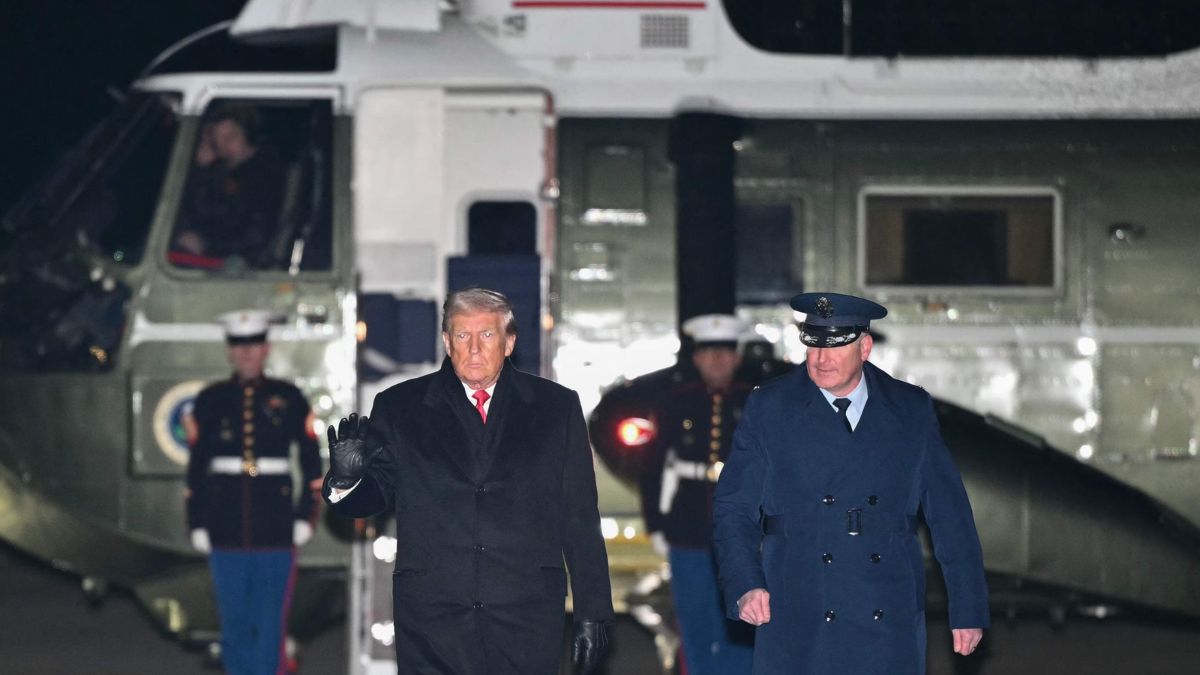
The President was forced to turn back to Washington shortly after departure when the crew detected an electrical fault. A White House pool reporter confirmed that the lights in the press cabin briefly went out after take off. Acting “out of an abundance of caution”, according to press secretary Karoline Leavitt, the aircraft returned to Andrews Air Force Base. Trump subsequently transferred to an Air Force C 32, a modified Boeing 757 normally used for domestic routes and smaller airports, and resumed his journey to the World Economic Forum in Davos shortly after midnight.
The delay is operationally modest. The legal and strategic context is not.
Trump is travelling to Davos at the height of an escalating confrontation with European allies over Greenland, having threatened sweeping tariffs against several European states and having repeatedly refused to rule out the use of force to secure the territory. He told reporters before departure: “It’s going to be a very interesting Davos.” Asked again how far he would go to acquire Greenland, he replied only: “You’ll find out.”
That statement alone places his journey within the framework of international security law, not merely diplomacy.
Presidential aircraft are not civilian transport. They are sovereign platforms governed by United States military regulations, NATO airspace coordination protocols, and international civil aviation law where applicable. Air Force One is operated by the United States Air Force under strict technical standards derived from Federal Aviation Administration regulations, military airworthiness directives, and classified security requirements. A failure significant enough to trigger an abort decision, however minor it is later described to be, necessarily engages the highest tier of presidential continuity planning.
The decision to turn back was not a matter of convenience. It was a constitutional safeguard.
Under United States constitutional doctrine, the President is the embodiment of the executive branch. His incapacitation abroad, especially during a moment of acute geopolitical crisis, would activate the Twenty Fifth Amendment procedures governing presidential disability and succession. That legal framework is designed for medical incapacity, but modern contingency planning treats aircraft failure during international travel as a trigger for the same continuity mechanisms.
In short, when Air Force One turns back, the American state itself is exercising a legal reflex to protect executive continuity.
The episode also revives unresolved legal controversy surrounding the presidential fleet.
The two Boeing 747 aircraft currently designated as Air Force One have been in service for nearly four decades. Replacement aircraft, based on the Boeing 747 8 platform, have been delayed repeatedly amid contractual disputes, cost overruns, and regulatory compliance challenges. The programme is governed by complex federal procurement law, including the Federal Acquisition Regulation and national security exemptions that permit classified contracting procedures.
In 2025, controversy erupted when Qatar’s ruling family presented Trump with a luxury Boeing 747 8 for inclusion in the presidential fleet. That gesture raised immediate constitutional concerns under the United States Constitution’s Foreign Emoluments Clause, which prohibits federal office holders from accepting gifts from foreign states without congressional consent.
Even if the aircraft is described as a gift to the United States rather than to the individual President, the legal distinction is precarious. The refurbishment process to meet US security standards, currently under way, involves classified modifications, encryption systems, and defensive countermeasures that themselves fall under strict statutory regimes including the Arms Export Control Act and International Traffic in Arms Regulations.
Leavitt’s remark aboard the C 32 that the Qatari jet was sounding “much better” may have been delivered as humour, but legally it touches an unresolved constitutional question: whether the President may benefit, politically or practically, from foreign state largesse without violating the separation of powers.
This matters because the reliability of Air Force One is not merely technical. It is juridical.
Air Force One is a mobile command centre. It carries secure communications infrastructure that allows the President to exercise command over United States armed forces, including nuclear forces, at all times. Any incident affecting its operation engages not only aviation safety law but the legal architecture of civilian control of the military.
That architecture is already under strain.
Trump is travelling with Secretary of State Marco Rubio, Chief of Staff Susie Wiles, Deputy Chief of Staff Stephen Miller, and National Economic Council director Kevin Hassett. This concentration of executive authority aboard a single aircraft is legally significant. It represents a convergence of foreign policy, national security, and economic governance within a single mobile command environment.
Recent precedents underscore the sensitivity. In February 2025, a military aircraft carrying Rubio to Germany returned to Washington because of a mechanical issue. In October, a plane carrying Defence Secretary Pete Hegseth made an emergency landing in Britain after a cracked windscreen. In 2006, President George W Bush was forced to switch aircraft in Vietnam after a malfunction grounded the primary jet.
These incidents are rare precisely because Air Force One operates under a maintenance regime that exceeds civilian standards by orders of magnitude.
When failure occurs, even minor, it reverberates legally.
In the current context, the timing is impossible to separate from the substance of Trump’s foreign policy posture.
He is travelling to a forum at which European leaders are openly warning of the collapse of the rules based international order. France’s Emmanuel Macron has spoken of a shift towards autocracy and a world in which international law is trampled. Canada’s Mark Carney has described a rupture rather than a transition. European governments are preparing retaliatory measures against Trump’s threatened tariffs.
Against this background, any disruption to presidential travel becomes part of a wider narrative about state capacity, reliability, and strategic credibility.
The law of state responsibility does not concern itself with symbolism, but markets, allies, and adversaries do.
A presidential aircraft forced to turn back, a fleet nearing obsolescence, a replacement programme mired in contractual failure, and a controversial foreign gifted aircraft awaiting refit all converge to create an image of institutional fragility at the precise moment the President is asserting the right to redraw territorial boundaries.
This is not merely ironic. It is legally consequential.
If Trump were to escalate his Greenland strategy into overt coercion or military action, the legality of that action would be judged under international humanitarian law, the law on the use of force, and the UN Charter framework. His credibility as commander in chief, including the reliability of the command and control systems embodied in Air Force One, would be scrutinised by allies and adversaries alike.
The aborted flight therefore intersects with the law of armed conflict, even though no conflict has yet begun.
There is also the matter of aviation jurisdiction.
Air Force One enjoys sovereign immunity under international law. It is not subject to the jurisdiction of foreign courts or regulators when operating abroad. That immunity is predicated on strict adherence to safety and operational standards. Repeated technical failures could invite diplomatic pressure, particularly when the aircraft carries not only a head of state but an entire national security apparatus.
Trump’s insistence on travelling to Davos despite the incident signals political determination. Legally, it signals something more austere: the executive branch is prepared to proceed with a high risk diplomatic mission at a moment of maximum geopolitical volatility.
In ordinary circumstances, a flicker of cabin lights would be an anecdote.
In the present circumstances, it is a reminder that the infrastructure of global power is governed by law, contracts, constitutional limits, and ageing machinery.
Trump’s Greenland campaign challenges the prohibition on territorial acquisition by coercion. His tariff threats challenge the World Trade Organization framework. His acceptance of a Qatari aircraft challenges constitutional norms. His reliance on a fleet approaching forty years of service challenges procurement governance and defence readiness.
Air Force One turning back is therefore not simply an aviation story.
It is a legal case study in the vulnerability of institutions at the moment they claim the greatest authority.
When Trump finally steps onto the Davos stage, delayed but undeterred, he will speak as a president whose aircraft has just reminded the world that even superpower sovereignty depends on systems, treaties, contracts, and compliance.
In a week dominated by threats to rewrite borders, impose economic punishment on allies, and discard international legal restraints, the aborted flight stands as an unintended but powerful metaphor.
Power may declare itself limitless.
Law is what keeps it airborne.