
The phrase “separate but equal” was more than just a saying; it was a policy deeply ingrained in American society, enforced by the government itself. The “Jim Crow” laws, established in the late 19th century, mandated the segregation of African Americans from whites in public places, schools, transportation, and even in voting booths. This systemic discrimination was legally sanctioned by the infamous “separate but equal” doctrine, which was cemented by the Supreme Court’s 1896 decision in Plessy vs. Ferguson.
Amidst this pervasive inequality, the Supreme Court made a notable progressive move in 1960 with the Boynton vs. Virginia decision, declaring that segregation in interstate bus terminals violated the Interstate Commerce Act and was unconstitutional. This ruling had the potential to dismantle segregation in public transportation, but the reality was far from straightforward.
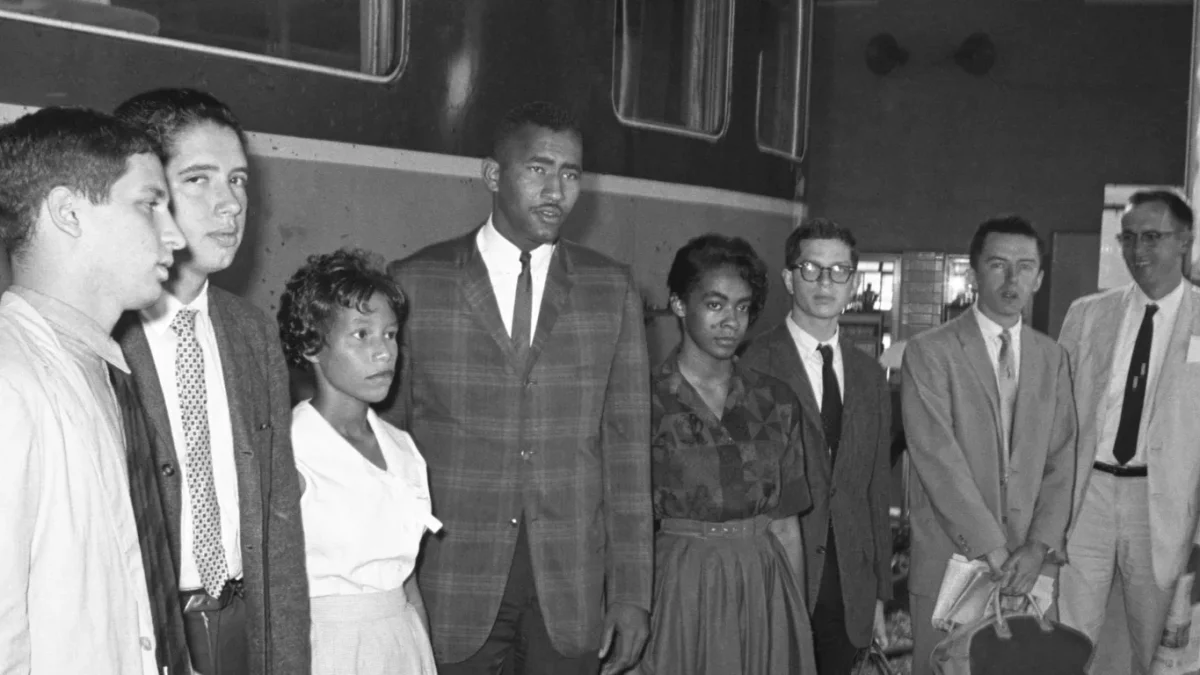
Enter the Freedom Riders, a diverse group of individuals—Black, white, young, old, students, artists, and others dissatisfied with the status quo—who aimed to challenge segregation head-on. The first Freedom Ride began on May 4, 1961, from Washington, D.C., with plans to reach New Orleans by May 17. Their tactic was simple yet bold: travel in small interracial groups, with white Riders sitting in the back of the bus and Black Riders in the front, and use “whites-only” facilities at bus stations along the route.
Predictably, their journey was fraught with danger. In Anniston, Alabama, one of their buses was firebombed, and Riders were brutally attacked by a white mob. In Birmingham, Riders faced more violence, with local police allegedly allowing the assaults to occur without interference.
Initially, the federal government’s response was sluggish. However, as the violence against the Freedom Riders drew national and international attention, it became impossible to ignore. President John F. Kennedy, who had been cautious about civil rights issues to avoid alienating Southern political leaders, was compelled to act. By September 1961, the Interstate Commerce Commission implemented regulations to end segregation in interstate transit terminals. The efforts and sacrifices of the Freedom Riders were a significant factor leading up to the Civil Rights Act of 1964.
Many of the Freedom Riders went on to become influential figures in the civil rights movement and beyond. John Lewis, for instance, who was severely beaten during the Freedom Rides, later became a U.S. Congressman. Diane Nash, a student leader from Fisk University in Nashville, had already played a pivotal role in the successful desegregation of lunch counters in Nashville. James Peck, a white activist from New York City, had been involved in the 1947 Journey of Reconciliation. During the Freedom Rides, Peck was viciously beaten by a mob in Birmingham, requiring over 50 stitches. The experiences of Lewis, Nash, and Peck contributed significantly to the progress of civil rights in America.
